

Bitcoin fell roughly 6% on Tuesday, dipping to an intraday low of $65,710, and the headlines did what they always do at moments like this: they led with the liquidations. More than $1.23 billion in crypto liquidations were wiped out in a single session, and the market moved on to debate whether the $60,000 to $62,500 support zone holds.
That's not wrong. It's just the wrong level of the story.
The liquidations are plumbing. They're the consequence of being leveraged on the wrong side of something larger. What actually moved markets this week wasn't leverage density - though leverage amplified the fall - but a quiet, persistent rotation of institutional capital out of crypto and into the AI infrastructure buildout. The evidence isn't in the liquidation dashboards. It's in the ETF flow data, the futures market structure, and the IPO calendar.
The real outflow isn't on-chain. It's in the ETF wrapper.
Here's the number that tells you what's happening: US spot Bitcoin ETFs have seen $4.2 billion in outflows over the first three weeks of June. That's not a bad week or a flash panic. That's sustained selling through the institutional front door, the very channel that was supposed to make crypto "mature" and stickier. When the money that entered via the regulated wrapper is also the money that leaves, you're not looking at a liquidity problem. You're looking at an allocation problem.
And the allocation is going somewhere specific.
BlackRock's latest research notes that planned AI capital expenditure is now approaching $1 trillion per year by 2028. That's not a buzzword - that's a plumbing fact about where institutional balance sheets are being deployed. When something that large, that tangible, and that politically legible enters the room, attention and capital tend to follow. K33 Research flagged it bluntly last week: Bitcoin faces "choppy summer months" as investors favor AI-related stocks and upcoming tech IPOs over crypto.
Leverage is the amplifier, not the driver.
This is where the $1.2 billion figure fits in. When prices fall - for whatever reason - leveraged long positions get liquidated automatically by exchanges. The exchange sells the position to cover the loss, which pushes the price down further, which triggers more liquidations. It's a cascade, not a cause.
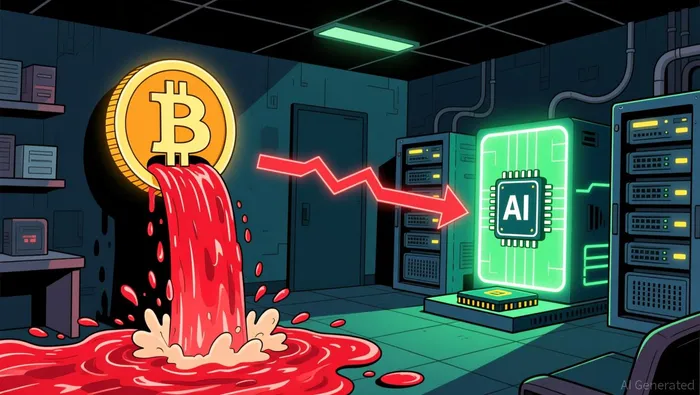
The cascade was worse this time because the derivatives market had been running hot. Bitcoin futures open interest had climbed to $42 billion in early May. That means $42 billion of directional bets were sitting in the system, many of them leveraged, waiting for a move. Over the past few weeks, open interest has collapsed to roughly $25 billion - a six-month low. Funding rates (the periodic payments traders make to hold leveraged positions) have flipped from positive to neutral or negative.
Translation: a lot of long bets were unwound, whether voluntarily or by forced liquidation. The market is deleveraging.
But here's the part the liquidation headlines skip: the open interest didn't just fall because prices dropped. It fell because the underlying reason to hold leveraged long exposure weakened. When the broader narrative shifts and capital rotates elsewhere, leverage gets crowded out first. The leveraged trader is always the most sensitive participant in the room.
The IPO pause tells you where conviction went.
There's a quieter signal worth noticing. Multiple crypto companies that had IPO plans for 2026 have paused or shelved them. The reason cited in coverage: investor money rotated into AI infrastructure plays and trillion-dollar tech listings. This isn't about crypto being uninvestable. It's about opportunity cost. When the alternative is a sector with trillion-dollar valuations, real capex, and a politically sanctioned buildout, crypto has to fight harder for the same pool of institutional dollars.
That fight is losing ground right now.
So what happens at $62,500?
Technical analysts have flagged the $60,000 to $62,500 range as the next support zone. Some of this is chart geometry - previous consolidation levels, psychological round numbers, areas where spot buyers have historically stepped in. If Bitcoin holds that zone and ETF outflows slow, a technical bounce toward $70,000 is plausible.
But the more important question isn't whether $62,500 holds. It's what conditions would need to change for the rotation to reverse.
The AI buildout isn't going anywhere. The capex commitments are contracted, not aspirational. The political tailwinds are real. So crypto doesn't need to "beat" AI for attention - it just needs to offer something the AI trade doesn't. That might be yield, in the stablecoin or tokenized funds space. It might be regulatory clarity that actually sticks. It might be a macro shock that makes Bitcoin's asymmetric risk profile compelling again.
None of those conditions are present today. The Fed held rates steady, the labor market is soft but not broken, and the AI narrative still has runway.
The structural takeaway
What this selloff reveals - if you look past the liquidation theater - is how integrated crypto has become with the broader capital-allocation cycle. Bitcoin used to move on its own rhythm, insulated from what Wall Street found interesting on any given Tuesday. Today, $4 billion in ETF outflows and a $17 billion collapse in futures open interest show that crypto's institutional participants are making the same sector-rotation calls as everyone else.
That's not a bug. It's what happens when the asset class grows up. The question is whether this rotation is a seasonal feature - summer being historically thin for crypto flows - or the leading edge of something more structural.
I think the answer is somewhere in between. The AI trade is real and it's large, but the last time crypto lost institutional attention this sharply, the rebound was brutal. Liquidity dried up, yes, but when the narrative shifted back, it shifted fast.
The $62,500 level matters because it's where we'll see whether buyers still show up. What matters more is what happens next.