

The headline reads like internet folklore: a man won the lottery 14 times by cracking a hidden code. Stefan Mandel, a Romanian-Australian economist, is supposed to have pulled this off, starting in Romania in the late 1980s and culminating with a $27 million jackpot in Virginia, USA in 1992. The story has the texture of a parable - a regular person outsmarting a rigged system.
But the thing that catches my attention isn't the drama of it. It's the mechanism. Mandel didn't hack a computer or bribe anyone. He did something that should feel familiar to anyone who watches how financial systems actually work: he found a gap between the rules as written and the rules as intended, raised the capital to exploit it at scale, and collected the spread.
That's not luck. That's arbitrage. And the pattern - find a design flaw, exploit it, watch the gatekeepers scramble to close the door - is the operating system of markets, payment rails, and now crypto.
The math was boring. The edge was structural.
Mandel's method, which he called "combinatorial condensation", is harder to explain and easier to execute than people think. The basic idea: in some smaller lotteries, the number of possible combinations is finite. The strategy relied on a simple principle: identify lotteries where the jackpot exceeded the cost of buying every possible number combination. At that point, you don't need luck. You need capital.
He didn't buy every single combination every time - that's mathematically impossible in larger games. His method let him cover enough combinations to guarantee at least the second-prize tier while spending far less than buying them all. Under the system, that meant he could predict five of six winning numbers with certainty. Good enough.
For the 1992 Virginia play, he recruited roughly 4,700 volunteers who fanned out across the state to buy tickets at every available machine, racing against the sales deadline. They won the $27 million jackpot, six second prizes, 132 third prizes, and hundreds of smaller prizes. After costs, Mandel's estimated take was around $3 million.
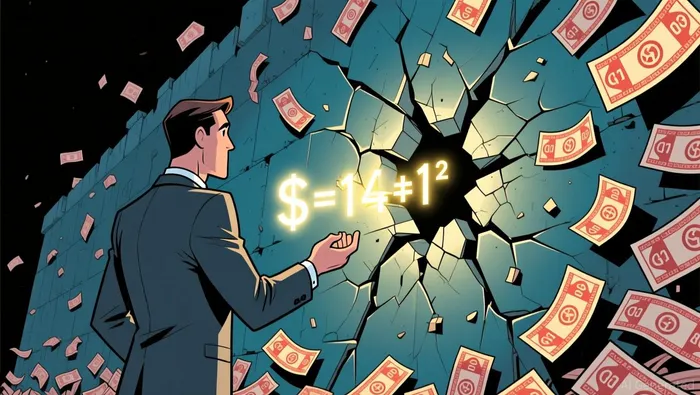
The story always frames this as a mathematician's triumph. I'd frame it differently. Mandel was an operator who recognized that a state-run lottery - designed to run on the assumption that nobody will actually try to buy everything - had a structural gap. The game's own rules, written for mass retail participation, didn't account for coordinated bulk buying. That's a product-design failure that any fintech founder would spot on a Monday morning.
The gatekeepers always close the door.
Here's where the story stops being about Mandel and starts being about every financial system that's ever existed.
After Virginia, lotteries around the world changed their rules. Some added minimum-participation thresholds. Others capped the number of tickets one entity could buy. Many raised the minimum number of winners required before a jackpot would be paid, or introduced rules that made the arbitrage math no longer work. The exploit was closed, the way it always is.
This is the lifecycle of every edge in finance. Someone finds a gap in the system design. They exploit it at scale. The institution whose margins or legitimacy are threatened changes the rules. The edge disappears - until a new one opens somewhere else.
We've watched this play out in crypto, in stablecoins, in DeFi yield farms. The actors change. The rails change. The pattern doesn't.
The repeat offenders.
Mandel wasn't alone. A few years later, two MIT graduates - Mark Abraham and M.O. Scott - exploited a similar gap in Pennsylvania's scratch-off lottery. The game's algorithm had a flaw: the number of $1,000 prizes printed into the roll exceeded the number that should have been distributed, based on the price and prize structure. They wrote a program to identify the winning rolls, bought them systematically, and walked away with about $27 million before the lottery pulled the game.
Then there's Joan Ginther... who won at least four times over roughly a decade, collecting close to $21 million. She didn't buy every ticket - she used publicly available prize distribution data to identify games where the remaining prize pool implied a positive expected value. Again, the system was leaking money to anyone who could read the numbers better than the house assumed its customers could.
What ties these cases together isn't the math. It's the fact that each system was designed for casual retail play and never stress-tested against coordinated, analytical attack. The house assumed its customers were guessing. They weren't.
Why this matters when you're thinking about financial design.
The reason I keep coming back to Mandel isn't because I think you can apply his method to anything. Modern lotteries are patched. You can't buy your way through a Powerball jackpot - the number of combinations is 292 million, and at $2 per ticket, you'd need $584 million just to guarantee a win, and that's before the pari-mutuel prize splitting eats you alive. The arbitrage is dead.
The reason is that every new financial system - crypto exchanges, stablecoin markets, tokenized funds - launches with the same blind spot: it's designed for expected usage, not for adversarial optimization. Rules are written assuming the participants are retail. The moment someone brings capital and a spreadsheet, the design assumptions collapse.
Look at it this way. Mandel's exploit only worked because the Virginia lottery had three features: a jackpot that could outpace the cost of coverage, ticket machines that couldn't distinguish between 4,700 people and 4,700,000, and no legal rule preventing bulk purchasing. Change any one of those, and the arbitrage vanishes.
Every financial product has an equivalent set of assumptions. Deposit insurance assumes you won't all withdraw at once. Stablecoin pegs assume arbitrageurs are available to keep price aligned. DeFi protocols assume liquidity is deep enough to absorb the strategies they incentivize. When the assumptions break, the system breaks - and someone who read the fine print gets paid for finding out first.
The real question isn't whether you can win. It's who designed the game.
I don't write about Mandel to suggest the lottery is a model for how to think about markets. It's a model for how to think about system design. Every time we launch a new way to move money - whether it's a new exchange, a new stablecoin rail, a new tokenized product - we're writing rules that someone will try to break.
The question that should matter to anyone allocating capital isn't "can I find the next Mandel loophole?" It's "which side of this system design am I on?" Are you the participant relying on the house's assumptions, or are you the one who's noticed that the assumptions don't hold under pressure?
Mandel retired to an island. The lotteries learned to patch. And somewhere else, a new system launched with its own quiet gaps, waiting for the next person who would rather do the math than buy the dream.
I think that tension - between systems designed for casual trust and participants who treat every rule as an input to optimize - is the permanent condition of financial innovation. It's not going away. If anything, with programmable money and onchain settlement, the gaps are going to be narrower, faster to close, and harder to exploit. But they'll still be there.
The players who understand that won't be the ones looking for the next big jackpot. They'll be the ones reading the fine print.