

The Eastern Pacific Is Not Your Portfolio's Battleground
The US military has conducted 59 strikes on alleged drug-trafficking vessels in the eastern Pacific Ocean since September 2025. The death toll stands at approximately 194 killed, including 5 missing and presumed dead. The Pentagon watchdog is now evaluating whether these strikes followed an established targeting framework.
None of this matters to your portfolio.
Here's why you're seeing this headline and why it's a distraction from what actually moves semiconductor and AI infrastructure markets.
The real story hides in the targeting systems
Every one of those 59 strikes required precision guidance systems, radar processing, satellite communications, and onboard computing that traces directly back to the semiconductor supply chain. The US defense industrial base runs on chips from Raytheon, Lockheed Martin's embedded systems, and increasingly, commercial-grade processors that happen to overlap with the same foundry capacity constrained by SMIC, TSMC, and Samsung.
But no amount of Pentagon targeting data tells you whether TSMC's CoWoS expansion is on schedule, whether Nvidia's Blackwell utilization is plateauing, or whether Broadcom's custom silicon pipeline for AI accelerators is winning share. Those are the questions that compound. Boat strike death tolls do not.
Scale tells the real story - and it's not what the headlines claim
Let's build the per-unit framework that actually matters:
- 59 strikes over ~8 months = roughly 7.4 strikes per month
- ~194 deaths across 59 vessels = ~3.3 casualties per strike
- Each strike consumes precision munitions valued at $200K–$2M+ per unit depending on weapon system
The cost per interdicted kilogram of narcotics is astronomically higher than any enforcement method that operates within the rule of law. The Pentagon is burning defense-grade hardware to fight a logistics problem that requires customs infrastructure, not airstrikes. Any astute policy analyst would have seen that this campaign confuses theatrical violence with sustainable interdiction.
What the Pentagon watchdog investigation actually signals
The Inspector General evaluation (announced May 2026) is the only data point that deserves attention. If the targeting framework was ad hoc rather than codified, it means the US military has been conducting lethal operations in international waters without a clear legal architecture. That creates policy risk for defense contractors: potential procurement freezes, audit delays, and congressional backlash.
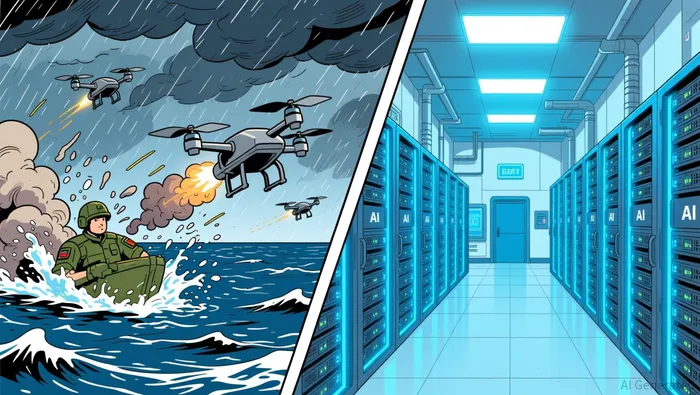
Defense semiconductor suppliers absorb policy risk long before it shows in earnings.
The cross-currents are: (1) continued operations increase munitions and sensor demand through Q2-Q3 2026, (2) an IG finding of procedural violations could trigger spending reviews that delay multi-year programs, and (3) international pushback may force operational scaling back. Directionally, the net effect on defense semiconductors is negligible - the boat strike program is a rounding error against the $80B+ annual US defense budget.
Where your attention should actually go
If you're invested in semiconductors, AI infrastructure, or energy tech, the Eastern Pacific campaign is background noise. The capital allocation decisions happening this quarter at TSMC, Nvidia, AMD, Broadcom, and their foundry customers will shape your returns for the next three years. Precision munitions spending will not.
You decide which was signal and which was noise.