

Chili's just delivered its 20th consecutive quarter of same-store sales growth. The number - 4.0% in Q3 of fiscal 2026 - sounds like momentum you should chase. The competitor narrative is already writing the headline for you: strong momentum, great time to buy.
The question isn't whether Chili's is growing. The question is whether Brinker International's factor stack - valuation, growth, and capital returns - justifies a different posture than the rest of casual dining commands. Because here's the thing: Brinker (ticker: EAT) trades at roughly 13 times trailing earnings. Darden Restaurants, which operates Olive Garden and The Cheesecake Factory, trades at roughly 20 times. Yum Brands, which owns KFC, Taco Bell, and Pizza Hut, trades at roughly 24 times.
Brinker is the cheapest name in the set by a wide margin - roughly 35% cheaper than Darden and nearly half the multiple of Yum - and it is growing its core brand faster than either of them. That is the kind of mismatch a relative-value screener flags every day.
Let's break it down by factor.
Valuation: C+, with a real discount
At roughly 13 times earnings, Brinker sits 13% below its own 10-year median PE of about 14.7. Against peers, the gap widens. You aren't paying a premium for a brand that has grown same-store sales for five straight years and counting. In our book, a valuation this compressed on a growth streak of this length is either a gift or a warning. The distinction comes from the other factors.
Growth: A+, including 20 consecutive quarters of positive same-store sales
Chili's is not flashing a one-quarter blip. The run has extended from 14.1% growth in early quarters down to 4.0% now - the rate is moderating, but the streak is durable. Company-wide comparable sales grew 3.3% in Q3, and revenue hit $1.47 billion with EPS of $2.90, beating the analyst consensus of $2.86. That 20-quarter run is rare in casual dining, an industry where traffic is under macro pressure and consumers are tightening budgets.
This is the factor that should be pulling the multiple higher. It isn't. That's the tension.
Profitability and capital returns: B+, powered by aggressive buybacks
Brinker authorized $415 million in share repurchases for fiscal 2026, targeting a share count reduction to roughly 45 million from higher levels. EPS benefits mechanically from fewer shares - which is fine, as long as the underlying earnings power supports it. Q3 EPS of $2.90 on $1.47 billion in revenue gives you a sense of the cash-generation engine. EBITDA margins have been the focus of management commentary, though exact quarterly margin figures aren't consistently reported.
The counterpoint: Maggiano's, and the consumer question
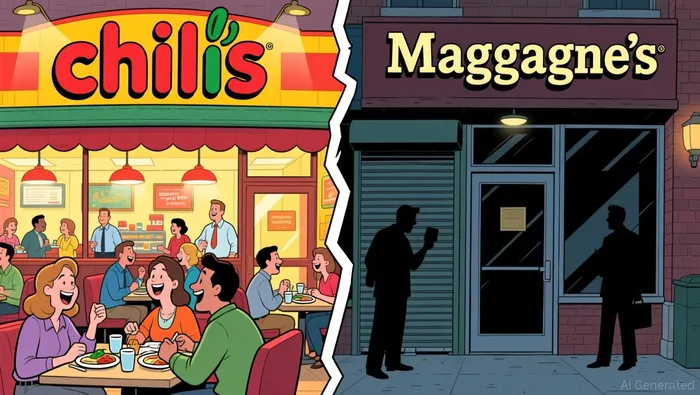
Here's what the momentum narrative underweights. Maggiano's, Brinker's upscale brand, saw sales decline $13.4 million year-over-year, dragged down by negative same-store sales. It is the anchor on the company-wide number. Without Chili's growing by $55.9 million, the full-company result would have been negative.
Wider to the sector, the casual dining consumer is showing cracks. Persistent inflation, tight household budgets, and weak consumer confidence are pushing diners toward value - which helps Chili's relative to its former self, but creates a ceiling on how long the growth streak can hold. The Restaurant Association's 2026 industry report notes cautious optimism, but Morningstar's DBRS outlet flags weak consumer confidence and conservative spending as ongoing headwinds. This is a tailwind with an expiration date.
What the factor stack says to do
The setup is clean: cheapest valuation in the peer set, strongest growth streak, aggressive share count reduction. Against Darden at ~20x and Yum at ~24x, Brinker at ~13x with better same-store growth is a GARP-style asymmetry - you get growth at a value price.
But the stock price has retreated from its $152 post-guidance-raise high to roughly $132. That pullback tells you the market is pricing in two risks: Maggiano's deterioration and the possibility that the consumer tailwind fades. If Chili's growth moderates further or turns negative, the discount has a reason to persist.
For a growth sleeve, Brinker belongs at the lower end - add position on factor strength (the streak, the PE gap) but size for the risk that Maggiano's keeps dragging and the consumer softens. Hold the position as long as the streak holds and the PE discount stays above 20% vs. Darden. Sell the trade if Chili's posts negative same-store sales for two consecutive quarters or if Brinker's PE closes the gap to Darden without a corresponding growth justification. The discount is the edge. When the gap narrows, the edge narrows too.
Volatility here usually means the market can't decide whether Chili's turnaround is durable or just a value-play cycle. The answer lives in the next two quarters' same-store print. Until then, the factor stack says the stock is cheap for reasons that may be temporary - not permanent.