

Valuation gaps stand out while global markets stay strong
Asia still has names trading roughly 15% to 40%+ below estimated fair value, even as world shares hovered near record highs. That contrast is the hook: if the discounts are real, the upside is not just theoretical.
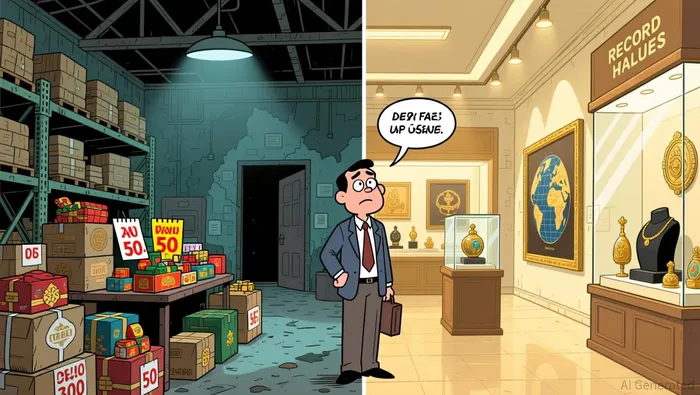
But price alone is not enough. In Asia right now, Japan's stock markets registering gains sit alongside retreats in China. That mix can keep discounts wide for longer, which means the real filter is not just the spreadsheet but also who has skin in the game.
Why trust matters as much as discount
A deep discount only deserves serious attention if there are signs the market may eventually see the business differently. In practice, that means looking for signals such as insider buying, management ownership, or institutional accumulation. Those are not proof of upside, but they do suggest better alignment between owners and outside investors.
That is why the three names below should not be treated as a single bucket. They sit at very different points on the trust curve, even though all three appear discounted on cash-flow estimates.
Cofco Sugar has the deepest discount and the clearest near-term business proof
Cofco Sugar looks like the strongest discount-with-momentum case here. The stock carries a 40.3% estimated discount to fair value, with shares around CN¥10.21 versus CN¥17.11 fair value. More importantly, the business is tangible: it generates revenue from sugar and tomato processing across China and international markets, and earnings are forecast to grow at 36.89% annually, above the Chinese market average of 23.6%, while revenue is expected to expand about 18% per year.
The main weakness is not business complexity but cash-flow quality. The dividend track record is unstable, which matters if you are relying on cash-flow models or long-term income consistency. Still, compared with the other two names in this piece, Cofco offers the deepest discount alongside a business that already has visible operating scale.
ST Engineering looks cleaner, but the rerating case is smaller
ST Engineering is the cleaner operator, but also the easier case for the market to understand. It is only 14.8% below estimated fair value, trading at S$8.97 versus S$10.53. The business is diversified across Commercial Aerospace, Urban Solutions & Satcom, and Defence & Public Security, and it had already secured S$14 billion in contracts by Q3 2025.
That stability comes with a trade-off: less immediate upside. The company still carries a high debt level and an unstable dividend track record, even as it expects 7.8% annual revenue growth and positive net profit for H2 2025 after one-off effects. A reasonable read is that ST Engineering deserves more trust than the other names here, but less excitement. It may be more appealing as a hold for existing owners than as a chase trade.
SK Biopharmaceuticals remains the highest-risk valuation case
SK Biopharmaceuticals is the riskiest of the three on trust alone. The headline gap is still meaningful at a 32.8% estimated discount to fair value, with shares at ₩120,700 versus ₩179,605.48. But the business proof point is thinner: the New Pharmaceutical Business segment generated only about ₩675.41 million in revenue.
Bulls can argue that pipeline and partnerships matter more than today's scale, especially with recent strategic alliances in radiopharmaceuticals. Bears will argue that execution risk is still underpriced: forecast profit growth of 16.2% annually trails the Korean market forecast of 32.9%, and a high level of non-cash earnings makes the valuation case less clean. For now, this looks more like a watchlist name than a chase.
Why Asian valuation gaps can persist
A 15% to 40% gap between price and value can be real, but it can also be the market's way of charging a skepticism premium. In Asia, that premium can persist because capital is choosing sides in a fragmented region: Japan's stock markets registered gains while China's faced retreats, and broader pressure from growth concerns and inflationary challenges makes investors pay up for clarity.
That is why these discounts may stay wide even when the model says otherwise. The bull case improves when behavior starts to confirm the valuation, not just the spreadsheet. If insiders, institutions, or management begin to show more alignment, a discount can close faster than expected. If not, the market may be right to remain skeptical.
What to watch before the discount closes
Watch these signals over the next reporting window:
- Insider buying: repeated purchases by executives and board members matter more than bullish commentary.
- Management alignment: higher insider ownership and longer-term decision-making usually matter more than short-term optics.
- Institutional ownership changes: accumulation in filings can matter more than headline target hikes.
- Guidance updates: firmer forecasts and fewer vague qualifiers suggest management is willing to be held accountable.
- Segment-revenue confirmation: proof that the growth engine behind the valuation case is actually producing sales.
If those signals appear, the gap can narrow quickly. If they do not, the market may simply be pricing in a trust discount rather than a temporary mistake.