

The question isn't whether two congressmen sold Intel stock after a monster rally. The question is whether the factor stack that drove that rally is still intact or whether valuation has caught up and the rest is coasting. When I run the screener, I don't start with the political narrative. I start with where Intel sits relative to the semiconductor sector today on valuation, growth, and profitability-and the answer is a report card that tells a different story than the headlines.
First, the valuation. Intel trades at a PE TTM of -175.45 and a price-to-sales ratio of 10.36. Those aren't just warm numbers-they're extreme multiples for a company that's still losing money. The stock is up 200.3% year-to-date and 423.1% on a rolling annual basis, but that rally has been built on something other than current earnings power. When you compare it to the sector-where the PHLX Semiconductor Index is up about 70% this year-you're looking at a disconnect between price action and fundamental reality. In our book, a D is a passing grade, but only if the growth story is accelerating. Here, the valuation grade would be flashing red.
Second, the government's paper gain. On August 22, 2025, the U.S. government purchased 433.3 million Intel shares at $20.47 each for a total investment of $8.9 billion. That stake is now worth roughly $48 billion at today's $110.80 price-a paper gain of about $39 billion, or 440%. But here's the catch: the government can't sell that position without potentially crashing the very stock price they're trying to support. That creates a perverse incentive where political success is measured by paper gains that can't be realized, while the underlying business still shows negative earnings of -$74.47 on a forward PE basis. The rally is real. The question is whether it's sustainable when the largest shareholder is effectively trapped.
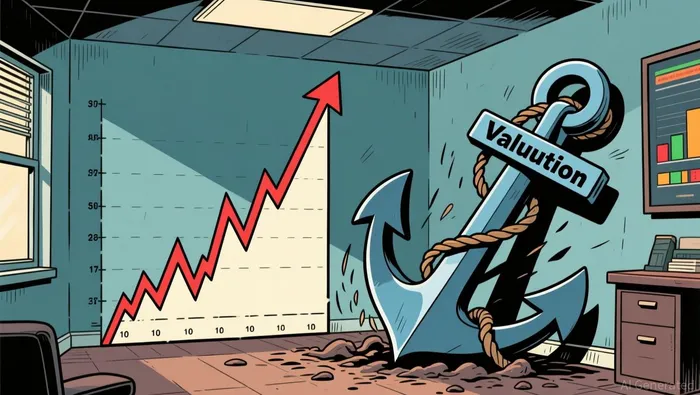
Third, the sector context and timing. While Intel has soared, the rest of the semiconductor space tells a more nuanced story. The PHLX Semiconductor Sector index is up about 70% in 2026, driven by AI demand, but individual names show different factor profiles. NVIDIA is up 18% year-to-date while AMD has gained 114%-both with positive earnings and clearer growth trajectories. Intel's 20-day return of 67.22% looks impressive until you remember it's coming off a base of negative profitability. The two congressional sales that sparked the headlines-Rep. Dwight Evans selling $1,000 to $15,000 on May 7 and Rep. Cliff Bentz selling a similar amount on April 9-are tiny, partial transactions that represent routine portfolio management, not insider pessimism. Evans bought at around $23.90 in April 2025 and could have made a 379% profit; Bentz owned since at least 2022 with the stock around $26.46, for a potential 135% gain. These aren't signals-they're small-scale profit-taking after a big run.
So what does the factor stack say to do? In our framework, a stock with negative earnings trading at extreme sales multiples needs either explosive growth or a durable catalyst to justify the premium. Intel has the latter in government support and domestic manufacturing tailwinds, but the former is still missing from the financials. The portfolio role here isn't as a core growth holding-it's as a policy-driven special situation with asymmetric risk. If the government doubles down or Intel's foundry business accelerates, the multiple could compress through earnings growth rather than price decline. But if the political winds shift or fundamentals don't catch up, that 440% paper gain could become a very real problem.
Watch the factor grades, not the headlines. When valuation warms up this much relative to the sector, the burden of proof shifts to the growth story. Right now, Intel's report card shows strong momentum but weak fundamentals-and in our process, that combination gets a Hold, not a Strong Buy, until the earnings turn positive or the multiple comes back to earth. The congressional sales are noise. The factor stack is the signal.