

As the market remained obsessed with the memory semiconductor frenzy, investors finally began waking up to the impact of rising US Treasury yields.
US stocks plunged last Friday, while index futures continued falling on Monday.
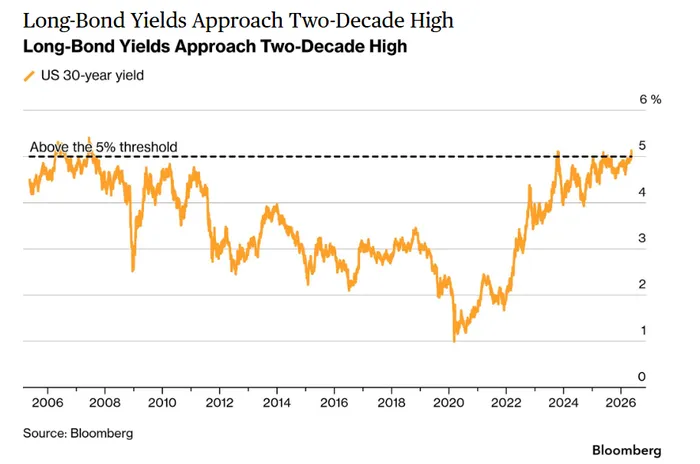
The core reason behind the selloff was the sharp rise in bond yields. Long-term US Treasury yields have now moved above 5%, approaching their highest levels in nearly two decades.
Rapidly rising Treasury yields tend to place enormous pressure on stock valuations because both corporations and consumers face higher borrowing costs. That not only weakens the outlook for economic growth and corporate earnings, but also significantly increases the relative attractiveness of bonds, pulling capital away from equities.
🛢️ Oil Shock and Inflation Fears Are Fueling Yields
The blockade of the Strait of Hormuz remains ongoing, with no clear resolution currently visible. At the same time, global oil inventories are being depleted rapidly.
“Crude oil prices are more likely to move even higher from here,” said Elias Haddad, global market strategist at Brown Brothers Harriman.
According to Haddad, rising oil prices imply higher inflation, which would place additional pressure on both global bond and equity markets.
Scott Ladner, chief investment officer at Horizon Investments, argued that the Iran conflict will eventually end and commodity prices should gradually retreat toward pre-war levels.
However, with the US first-quarter earnings season nearing completion, investors are shifting their attention back toward macroeconomic conditions — and the macro backdrop is increasingly being defined by higher interest rates, which historically remain unfavorable for stocks.
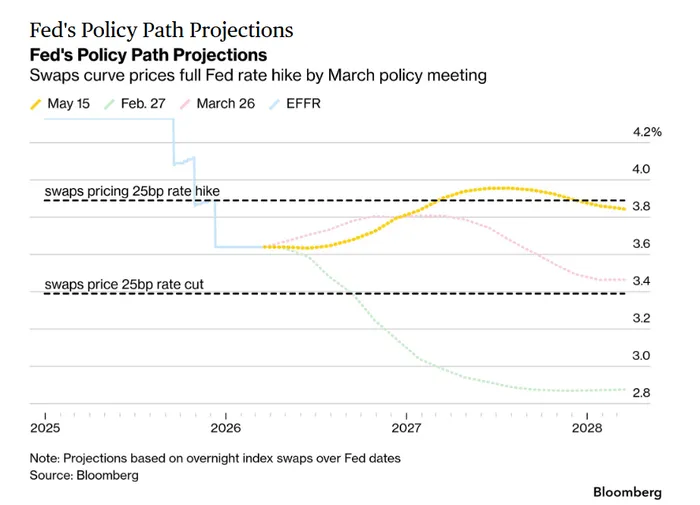
Meanwhile, Jeffrey Gundlach, CEO of DoubleLine Capital, stated clearly that the probability of Federal Reserve rate cuts this year has “essentially disappeared.”
⚠️ Bank of America Strategist Warns of Bubble Risk
Michael Hartnett, chief investment strategist at Bank of America, issued a major warning to investors.
Hartnett argued that asset booms historically tend to end when yields rise rapidly. Combined with crowded positioning in equities and rising inflation risks, he believes early June could become a critical profit-taking window.
In his latest report, Hartnett noted that the 30-year Treasury yield has climbed to 5.11%, decisively breaking above the psychologically critical 5% threshold and approaching a multi-year technical resistance level.
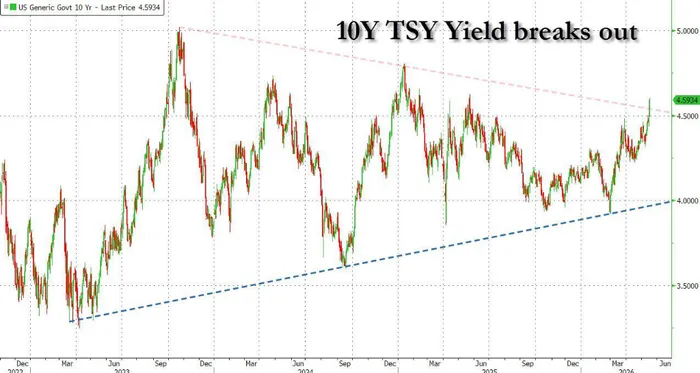
He warned that such a move could trigger a historic “risk valuation shock,” potentially causing yields to spike even more aggressively in the short term.
History repeatedly shows that bubbles often burst alongside sharp increases in yields. Once the 5% threshold is meaningfully breached, Hartnett suggested, “the door to doom opens.”
📈 Inflation Is Accelerating Again
US April PPI rose 6% year-over-year, marking the fastest pace since 2022.
Meanwhile, CPI climbed 3.8% annually, exceeding economists’ expectations.
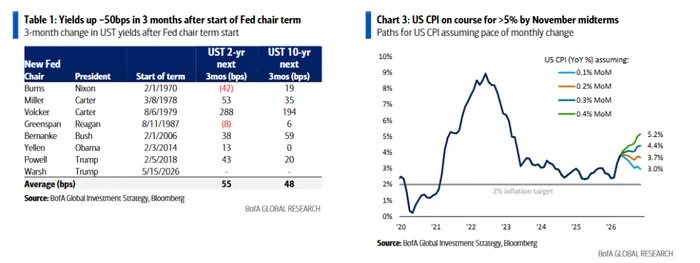
Hartnett’s team estimated that if the recent monthly inflation pace of roughly 0.4% continues without meaningful moderation, US CPI could exceed 5% before the November midterm elections.
Such a scenario would create significant pressure for equities.
💥 Could Rising Yields Burst the Stock Bubble?
History offers repeated examples of bubbles ending alongside rapidly rising yields.
In 1989, Japanese government bond yields surged 230 basis points. The Nikkei index peaked that same year and did not return to new highs for more than two decades.
In 1999, US Treasury yields jumped roughly 260 basis points — and the aftermath became the collapse of the dot-com bubble.
Today, both the NASDAQ Composite and US 10-year Treasury yields are rising sharply at the same time, creating what Hartnett described as a “clear echo” of the 1989 and 1999 turning points.