

Borrowed ETH on Binance matters more than the bearish take
Just earlier this week, whale 0x1be4 borrowed 35,000 ETH from Aave and deposited it to Binance. That matters because borrowed supply has now been pushed into a highly liquid venue. If price starts moving higher, that inventory has to be managed, covered, or defended.
Bears can argue this is only one short in a noisy market. Fair enough. But visible large shorts are not just directional calls. As prior whale shorts show, they can become a magnet for traders who trade around liquidation zones, because the market can also feed on forced covering.
So the real setup is not the bearish bet itself. It is the possibility that a highly visible short changes market dynamics if price starts pushing into pain.
The first short is still exposed
The key update is not that the whale took some profit. It is that the short is still alive.
Balance-sheet capacity turned into a visible bearish position
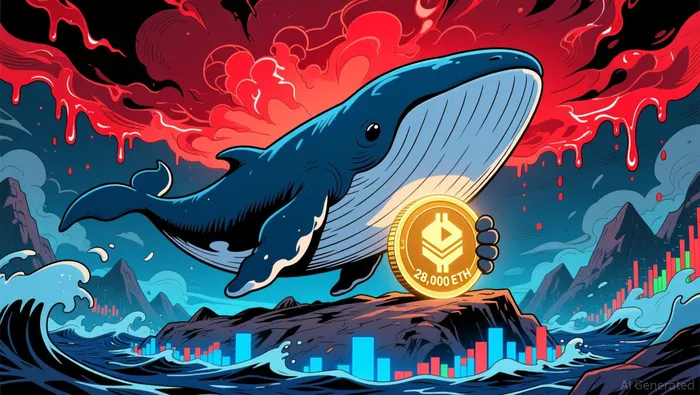
This trader pledged 132 million stablecoins, then sold 35,000 ETH at $1,672. The whale later withdrew 7,000 ETH to repay an Aave loan, booked about $190,000 in profit, and still has 28,000 ETH outstanding. That means the position is smaller than it was, but not gone.
That helps explain why smart money is not unified. The same tape that supports the bear case also shows sophisticated players making opposite bets. One wallet placed an asymmetric bet across ETH and BTC, staking $25.27 million long on Bitcoin while opening a $50.55 million ETH short with 25x leverage. That looks more like a relative-value call than one-way conviction.
A second liquidation zone sits less than 5% above spot
There is also a second trigger closer to spot. That whale's ETH short carries a liquidation price of $2,288, while ETH was near $2,193, leaving less than 5% of room. If price pushes through the low-$2,200s, traders may react to the liquidation band before they react to fresh fundamentals.
A 25x short can still be directionally right and get squeezed if the move comes too fast. When one whale still has 28,000 ETH outstanding and another liquidation zone sits nearby, the setup is less about one trader's opinion and more about where forced flows hit first.
What decides the next move: absorption or a squeeze
The next move comes down to one question: can demand absorb visible sell pressure, or does price start forcing the short side?
Absorption would look like resilience
If sellers keep landing but the low-$2,100s hold, that is the first sign of absorption. You do not need bullish headlines for that. You need bids to soak up inventory dropped onto liquid venues, including borrowed ETH deposited to Binance, while large holders keep adding rather than exiting cleanly. Even now, some sophisticated traders still see weakness as a buying window, with one operator extending Ether longs to 114,160 ETH and another accumulating near $2,182.
A squeeze would need liquidation pressure, not just hope
The squeeze case is simpler and more time-sensitive. ETH was near $2,193, while the short-side liquidation sits near $2,288. That is less than 5% away. Once price starts pressing that zone, traders stop debating fundamentals and start front-running forced covering.
What would weaken the setup
Another large-scale whale borrow, or fresh exchange inflows tied to short supply, would weaken the squeeze view. If ETH pulled back and then new inventory arrived just as bulls tried to step in, that would suggest supply is still being added into the system rather than exhausted.
Bullish if price reclaims the low-$2,100s and holds above it. Bearish if price keeps failing under static shorts and liquidation visibility keeps traders focused on downside.