

New York Governor Kathy Hochul wants to tax luxury second homes in New York City. The tax would apply to properties worth $5 million or more that are not primary residences, and it is supposed to raise $500 million annually. That is weird.
Not because taxing expensive second homes is weird-other cities do it-but because New York City has a $5.4 billion budget deficit this year, and projected gaps totaling $20.5 billion from 2028 to 2030. The tax would cover less than 10% of this year's shortfall, and about 2.5% of the four-year problem. If you are trying to solve a budget crisis, this is not really how you do it. If you are trying to draw a line between "real New Yorkers" and "global elites who park wealth in empty apartments," though, it makes more sense.
The proposal creates a new category: the pied-à-terre owner. A pied-à-terre is French for "foot on the ground," and in New York it means a home you own but do not live in most of the year. Governor Hochul says "if you can afford a $5 million second home that sits empty most of the year, you can afford to contribute like every other New Yorker." The tax would be a sliding-scale surcharge, though the exact rates have not been "ironed out." It would hit roughly 13,000 properties.
The interesting thing is not the money. The interesting thing is the classification. New York City has a progressive income tax, but if your official residence is elsewhere, you do not pay New York City income taxes. You might pay property taxes, but those are based on the assessed value of the home, not on your income or how often you use the apartment. The pied-à-terre tax creates a new bucket: you are not just a property owner; you are a wealth-parker who benefits from the city's services and rising property values without paying the full resident price of admission.
This is an old municipal-finance game in new packaging. Cities have always drawn lines about who pays for what: residents versus non-residents, homeowners versus renters, commercial versus residential property. What makes this one funny is the mismatch between the political framing and the financial reality. Mayor Zohran Mamdani, a democratic socialist who campaigned on "tax the rich," called the proposal "one step closer to balancing our budget by taxing the ultra-wealthy and global elites." But $500 million is a rounding error in a $127 billion city budget, let alone a $5.4 billion hole.
The real estate industry does not like it, of course. Previous attempts at a pied-à-terre tax in 2014 and 2019 failed under opposition from real estate interests. The head of the Real Estate Board of New York says it will hurt the city's housing market and property values. That is the normal pushback. What is more interesting is the incentive structure the tax creates.
If you own a $5 million second home in New York City, and the government announces a new surcharge on such homes, you have options. You could pay the tax. You could sell the home. You could try to reclassify it as a primary residence, if you spend enough time there. You could transfer ownership to a trust or corporate entity that might fall outside the tax's scope. Or you could just accept that the $5 million line is arbitrary, and that the actual economic boundary is fuzzier than the political one.
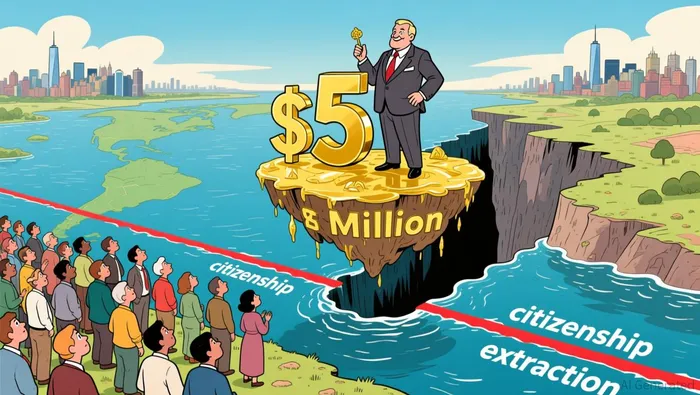
The $5 million threshold is itself a sort of contract. It says: below this line, you are just a regular person with a second home; above it, you are a global elite storing wealth. But wealth storage does not start at $5 million in New York City real estate. A $4 million apartment can sit empty too. The line is where the politics of the tax become manageable-enough homes to raise meaningful revenue, not so many that it looks like a broad property-tax hike.
Meanwhile, New York has been losing high-income residents for years. The state lost nearly $10 billion in annual adjusted gross income from 2021 to 2022 as people moved out. Governor Hochul herself recently told wealthy supporters to "go down to Palm Beach and see who you can bring back home" because the tax base has eroded. So the political calculation is: we need to raise revenue, but we cannot scare away the people who pay the bills. A tax on non-resident second-home owners who do not vote here is safer than a tax on residents who do.
The proposal is still being negotiated as part of the state budget, which was due April 1 and is not done. Whether it passes depends on the usual Albany politics. But the classification game is already happening. The tax draws a line between "us" (real New Yorkers who pay taxes) and "them" (global elites who park money here). The money itself is almost incidental. The point is to define what sort of financial relationship to the city counts as citizenship, and what counts as extraction.