

The powerful rally that has pushed U.S. stocks into historic territory since early April may be entering a more fragile phase as investors confront rising Treasury yields, stubborn inflation and mounting uncertainty ahead of the 2026 midterm elections, according to Chris Maxey, chief market strategist and managing director at Wealthspire.
“The market is really quite interesting right now,” Maxey said in an interview with AInvest's Capital & Power. “It’s not so obvious that we’re going to continue along the path that we’ve been on here recently.”
Maxey said investors should remain constructive on equities over the long term because of the accelerating buildout in artificial intelligence infrastructure, while exercising greater caution over the next six weeks to six months as borrowing costs rise and election-related volatility builds. “When you’re looking at these next six weeks and six months, I would encourage a little bit of caution,” he said, citing “higher interest rates,” elevated oil prices and the approaching midterm elections.
His comments come as Treasury markets are increasingly rattling Wall Street. Reuters reported Monday that the 30-year Treasury yield climbed above 5%, levels not seen since before the 2007 financial crisis, while the 10-year yield continued moving toward 5% amid persistent inflation concerns and rising oil prices tied to the Iran conflict.
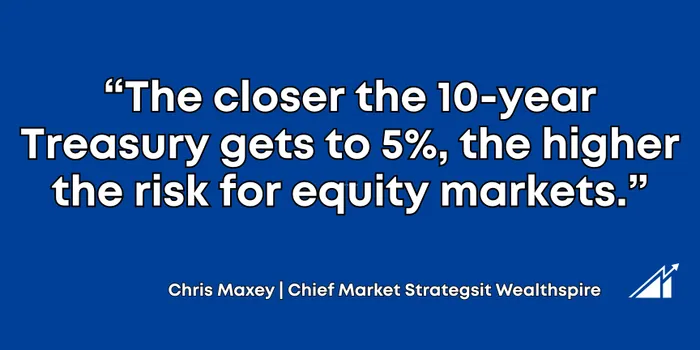
“The closer the 10-year Treasury gets to 5%, the higher the risk for equity markets,” Maxey said, calling that threshold “your line of demarcation” for whether stocks begin reacting negatively to higher borrowing costs.
Maxey argued that AI spending remains a major economic tailwind despite investor anxiety about valuations and debt issuance. Wealthspire estimates hyperscalers including Microsoft, Alphabet, Meta and Amazon are on track to spend nearly $800 billion in 2026 building AI infrastructure, with spending potentially exceeding $1 trillion in 2027.
Reuters reported last week that hyperscalers have already issued roughly $110 billion in bonds this year to help finance AI infrastructure expansion, a sharp increase from prior years.
“We think it is sustainable for the time being,” Maxey said of the spending boom. But he warned that investors are beginning to scrutinize whether those projects will eventually generate sufficient returns. “The market is going to say it’s time for you to show me that the projects you’re investing in and that you’re building have an actual return.”
Rather than focusing solely on earnings, Maxey said investors should increasingly evaluate companies through the lens of free cash flow as capital expenditures surge. “Don’t think of earnings as the primary place that you want to go when you’re doing your analysis,” he said. “Also look at cash flow.”
At the same time, he sees opportunities beyond the largest technology stocks that have dominated markets for years. Wealthspire has favored broader exposure to mid- and small-cap equities as economic activity improves and valuations remain less stretched than the top tier of the S&P 500. “Economic activity is picking up,” Maxey said, pointing to improving labor markets and housing activity.
WATCH:
📺 S&P 600 Small Caps Lead as Rally Spreads Beyond Big Tech
📺 The Nvidia Blindspot: Where the Next 80% of AI Profits Are Hiding
📺 Trump-Xi Summit Gives Investors New China Playbook as AI, Taiwan Risks Loom
Still, he cautioned that history suggests investors should brace for turbulence heading into the midterms. “Go back over the last 50 years and the one thing that we’ve learned is that midterm election years have a tendency of being much more volatile than the average year,” Maxey said.
To navigate the period ahead, he recommended investors consider raising cash levels modestly and adding defensive fixed-income exposure, including Treasury Inflation-Protected Securities. “There is a lot of activity, there’s a lot of news to navigate for the next six months coming into the summer,” he said.