

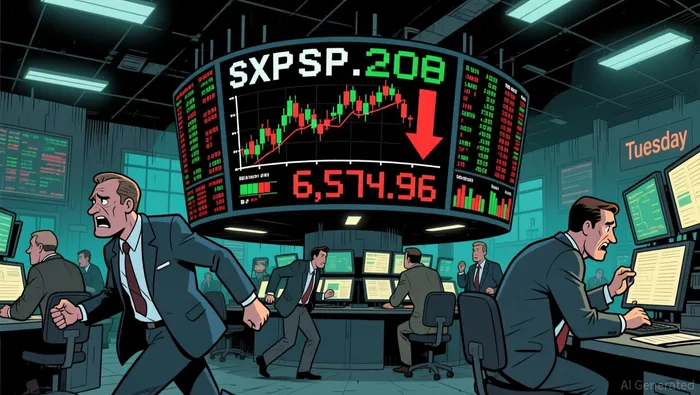
The market opened lower on April 15, 2026, revealing a clear gap between historical patterns and current caution. The S&P 500 opened at 6,574.96, a gap down from its previous session's high of 6,651.62. This sets the stage for a classic expectation game. The setup was simple: April is historically a strong month for the index, with an average gain of 1.4%. That track record creates a baseline expectation for positive momentum to kick off the second quarter.
Yet the market's action suggests that expectation was not fully priced in. After a volatile week where the VIX fear gauge fell from around 60 to about 30, the relief rally from that turmoil appears to have run its course. The opening gap down indicates that investors are not rushing to buy the April narrative. Instead, they are weighing recent headwinds-tariff uncertainty, geopolitical tensions, and a 4.8% drop for the S&P 500 in March-against the historical odds. The cautious start implies that the market's forward view is more focused on near-term risks than on the statistical advantage of the calendar month.
The Catalysts: Earnings Beats vs. Geopolitical and Macro Risks
The market's mixed move on Tuesday was a direct clash between two forces: a positive earnings beat and a new geopolitical risk. Bank of America and Citigroup shares rose 3.6% and 1.8% respectively after exceeding analysts' expectations for the first quarter. This provided a clear "buy the rumor" catalyst, with bank stocks as a whole offering upward momentum. The beat was a relief, confirming that some sectors are navigating the macro fog well. Yet, this positive catalyst was quickly overshadowed by a new negative headline.
Boeing shares slipped more than 2% after a report that Beijing ordered Chinese airlines not to take more of the company's planes. This introduced a fresh geopolitical risk that was not fully priced into the stock. The move highlights how quickly a single, unexpected event can reset expectations, especially for a company with concentrated exposure to a single market. The earnings beat for the banks was a known variable, but the China order was a surprise, shifting the risk narrative.
Beyond this specific news, the broader market context includes elevated oil prices due to Middle East tensions. As noted, this could pressure consumer goods margins and inflation, a risk that remains unpriced for now. The market's muted reaction to the bank earnings beat suggests the positive news was already anticipated. The real story was the new geopolitical friction with Boeing, which created an expectation gap of its own. In this setup, the earnings beat met expectations, but the geopolitical risk reset them lower.
The Market's Verdict: Expectation Gap and Forward Scenarios
The market's flat-to-negative open on Tuesday delivered a clear verdict: the net expectation gap was neutral. The day's action was a classic tug-of-war between a known positive catalyst and a fresh negative headline. The bank earnings beat was largely priced in, leading to a predictable "sell the news" reaction. Bank of America and Citigroup shares rose after exceeding analysts' expectations for the first quarter, but the broader market's decline shows that relief was already in the price. The real story was the new geopolitical risk that reset expectations lower.
The key watchpoint now is which risk gains more traction. The order from Beijing for Chinese airlines to halt Boeing deliveries introduced a tangible, unpriced geopolitical friction. This could be a leading indicator for broader sector guidance resets, particularly for industrials and consumer discretionary stocks with significant China exposure. Yet, the macro risk from oil prices may prove more dominant. Elevated tensions in the Middle East are keeping oil above $100 per barrel, and as Delta Air Lines demonstrated, that directly pressures margins across the economy. The resolution of the Iran conflict and its impact on oil prices will be the dominant external catalyst. If oil stays elevated, the expectation gap for consumer staples and industrials will widen, as companies struggle to pass on costs without triggering consumer pushback.
The bottom line is that the market is waiting for a clearer signal. The recent volatility has subsided, but the underlying crosscurrents remain. Investors are returning to earnings, as noted by analysts, but they are doing so with one eye on the tariff uncertainty and the other on geopolitical shocks. The setup is one of cautious equilibrium, where the next major move will be dictated by which risk narrative-geopolitical friction or persistent inflation-gains more weight in the forward view.