

The question isn't whether the S&P 500 closes up or down today. The question is whether it's still a market at all, or an AI index wearing a market's clothes.
Futures point to about 7,595 at the open. If you own the index, you own a bet that a handful of companies keep spending hundreds of billions on data centers while inflation re-accelerates and the Federal Reserve runs out of reasons to cut rates. Most people think the S&P 500 is a diversification tool. It's stopped being one.
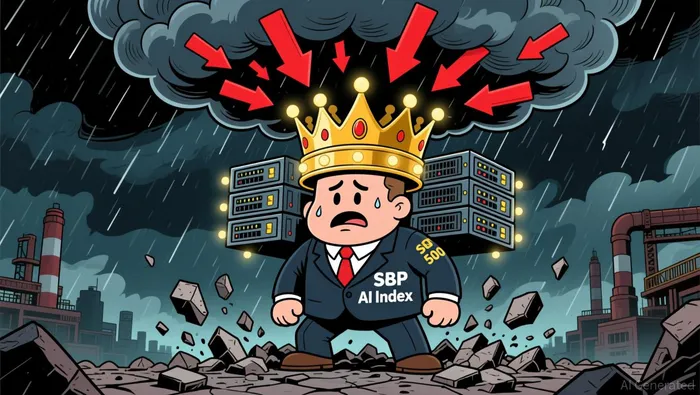
Here's the number that should matter more than today's close. From May 2024 to mid-2026, the S&P 500 returned 142%. Remove the AI stocks and that collapses to 16%. This isn't a broad market having a great run. It's a small group of names carrying 493 others.
AI-related stocks now represent roughly 45% of the index's total market capitalization. That's not concentration. That's a regime change.
The way to evaluate this is not to check whether the index ticks higher today. It's to ask what happens when the two forces propping it up run into each other: valuation and inflation. The S&P 500 Shiller CAPE ratio - which prices earnings over a full business cycle rather than just the current year - sits at about 41.6. The long-run average is 17.3. The only reading higher was the December 1999 dot-com peak. You are paying more than twice the historical average for earnings that are cyclical, not permanent.
That would be bearish on its own if inflation weren't also turning ugly. The Fed's May forecast had inflation tracking at 3.0% over the trailing twelve months. The actual April reading was 3.8%. Then came May's data: CPI jumped 0.6% in a single month, driven by energy and shelter, while producer prices surged 1.4%, pushing annual PPI to its highest level in months. The FOMC minutes from the late-April meeting explicitly noted that inflation had moved up, partly from global energy price increases.
The Fed has effectively stopped looking for a reason to cut rates. When inflation ticks up and the labor market stays solid, the central bank's job description is to hold steady or tighten - not to prop asset prices. Yet the index is being bid as if the Fed will eventually pivot back. The minutes don't say that. The data doesn't say that.
I suspect what's happening is this: the market is pricing a world where AI revenue justifies today's valuations, and where the Fed accepts higher inflation because the alternative - crushing the growth engine - is worse. Neither of those is a given. But both are the only stories that keep this level from looking obviously wrong.
June historically returns about 0.6% for the index, with a 64% win rate. That's noise, not signal. The seasonal pattern is a distraction from the real test. Strip out the AI names and ask yourself: does the remaining 55% of the S&P 500 actually make money in an environment where the Fed is hawkish, valuations are stretched, and inflation is re-accelerating? If the non-AI half continues to lag, the index is just a levered position in four or five stocks - and levered positions break when the thesis cracks.
Analysts at Reuters forecast the S&P 500 to end 2026 slightly higher than current levels. Goldman Sachs has a year-end target of 7,600, up roughly 6% from their April starting point. Both assume the AI story holds. Both assume no sharp macro break. The way those forecasts break is if earnings in the AI names miss while the rest of the market doesn't catch the slack.
Here's the test you can actually run. Watch the S&P 500 ex-Technology over the next two quarters. If it underperforms a Treasury bill while the index itself looks stable, the market remains an AI bet in disguise. If it catches up, then the rally has genuinely broadened and the concentration thesis loses force. Until then, treat the index not as a market but as a position.