

The company secured a $600 million funding round in early 2025, led by major venture firms. This injection, its second major raise in just over a year, pushed its valuation past $7 billion. The capital is being deployed at an aggressive pace, with the explicit plan to open one new location per week.
That expansion target is massive. Wonder aims to scale from 46 locations to over 90 by the end of 2025, a near doubling in less than eight months. This rapid ramp-up is focused on the Northeast, with specific plans to enter Philadelphia and Washington, D.C. The funding also served to nearly fully finance the $650 million acquisition of Grubhub completed earlier that year, alongside other strategic buys like Tastemade.
The sheer scale of capital inflow provides a long runway. However, the path to profitability for its AI-driven food hall model remains unproven. The company has raised over $1.85 billion in total, with $1.5 billion of that in the past year, highlighting the heavy reliance on continuous external funding to support its physical growth and acquisitions.
The AI "Create" Model: Network Effects and Liquidity
The core of Wonder's expansion is its AI-powered launchpad, Wonder Create. The platform's promise is straightforward: anyone can use an AI prompt to design and launch a full restaurant brand in under a minute. This includes creating the name, branding, recipes, and even health information. The goal is to turn the company's kitchen network into a scalable, on-demand restaurant marketplace.
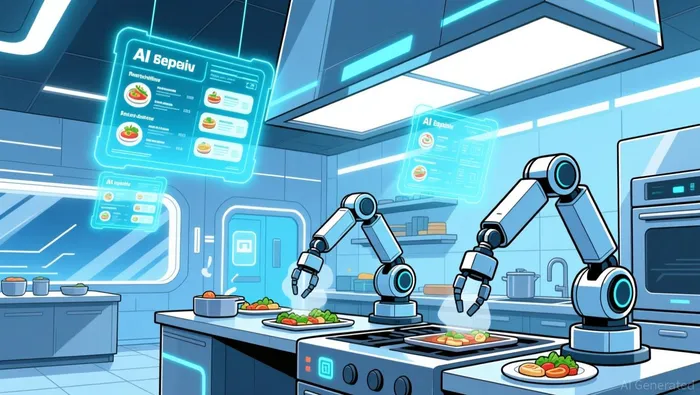
This model creates a powerful network effect. The 120 tech-enabled kitchens, expected to grow to 400 next year, act as programmable cooking platforms. Each location houses multiple AI-generated brands, with the company aiming for up to 1,000 unique restaurants operating within a single 2,500-square-foot space. This infrastructure leverages a 700-ingredient library and increasing automation, like robotic arms and an upcoming "infinite sauce machine," to boost throughput capacity dramatically.
The potential impact on unit economics is significant. By drastically lowering the barrier to entry for new brands, Wonder could accelerate customer acquisition across its network. However, the model's ability to drive sustainable customer loyalty and profitable unit economics remains entirely unproven at scale. The ghost kitchen concept faced similar hurdles in the early 2020s, with operators struggling to build brand equity. Wonder's AI and robotics layer may mitigate some risks, but the liquidity and flow of traffic to these AI-created brands are still a critical unknown.
Profitability Catalysts and Liquidity Options
The primary catalyst for Wonder's path to profitability is scaling its unit economics. The company's model hinges on proving that its AI-powered kitchens can generate positive margins per location. This requires demonstrating that the high throughput capacity-projected to climb from 7 million to 20 million meals per kitchen-translates into higher revenue and lower per-unit costs. The key metric will be whether the volume from 1,000 potential brands per site can cover the fixed costs of the robotic infrastructure and staffing.
The major risk is the historical failure of virtual restaurant concepts. Operators in that space struggled to build customer loyalty despite automation, leading to high churn and marketing costs. Wonder's AI-driven "Create" platform aims to solve this by accelerating brand creation, but the liquidity and flow of traffic to these new, unproven brands remain a critical unknown. Without a proven ability to drive repeat visits and build brand equity, the model risks becoming a high-cost platform for transient, low-margin sales.
For now, the company remains a private entity with no public trading. Shares are only available through secondary markets like Nasdaq Private Market, accessible only to accredited investors. There is currently no IPO price or ticker symbol, meaning the path to liquidity for investors is indirect and limited. The company's focus is on using its $600 million runway to prove the unit economics before seeking a public market exit.