

AAR's new A320 slat repair capability fits an already improving business
A new slat repair permit is not the kind of news that typically sends a stock higher on its own. But in a parts-and-repair business, small capability wins matter because they can keep more workload inside the company's existing network.
AAR is already posting strong underlying demand. Its latest quarter reported 12% sales growth, while adjusted EBITDA rose 18% and adjusted EBITDA margin expanded to 11.7%. Against that backdrop, the new APAC repair capability looks less like a one-off announcement and more like another small tap turned on in a growing market.
The practical upside is straightforward. AAR's Chonburi, Thailand site now offers single-source A320 slat repair for both A320neo and A320ceo aircraft, widening an Airbus proprietary repair portfolio that already includes parts such as rudders, flaps, and sharklets.
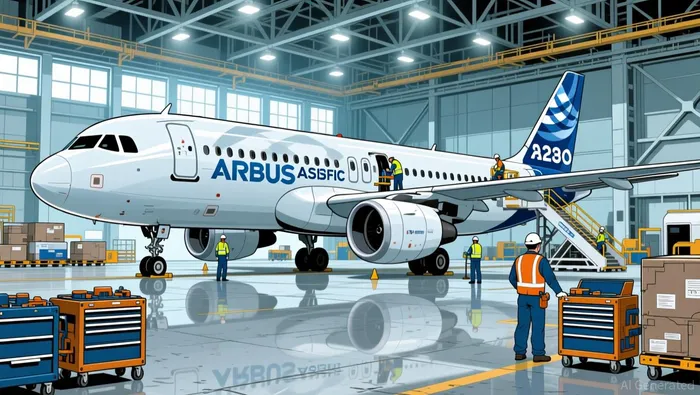
Airlines rarely shop for one part in isolation. They usually prefer a trusted vendor that can handle more of the workload, simplify logistics, and keep aircraft turning faster. This capability strengthens that one-stop appeal.
The timing also matters. The launch coincided with the 10-year anniversary of AAR's collaboration with Airbus in the Asia-Pacific region, which points to a deeper relationship rather than a purely isolated capability add-on.
One repair line is unlikely to move results on its own. But after Investor Day, the updated three-year financial framework, and the wind-down of the Commercial Programs business, investors have a clearer lens: AAR is narrowing its focus around higher-utility aftermarket services. In that context, small capability wins can compound.
The shareholder case is about portfolio expansion, not one part
Shareholders should care less about the word "slat" and more about what the company keeps doing with small capability gains.
Single-source repair can make each site more useful
In MRO, airlines want less hassle, faster turnarounds, and one vendor they can trust across more work. AAR's Chonburi site now offers single-source A320 slat repair alongside existing Airbus proprietary capabilities. Each added capability makes the site more useful to the same customer base.
That is the mechanism investors should watch. More repair types under one roof can pull in more workload from the same airlines, which is typically better for margin and cash conversion than relying on isolated jobs.
Recent results already show operating leverage
AAR's recent quarters suggest this model is gaining traction.
- In the most recent quarter, sales rose 16%, while adjusted diluted EPS increased 31% and adjusted EBITDA margin expanded to 12.1%.
- Earlier in the fiscal year, the company posted 27% adjusted diluted EPS growth and 11.7% adjusted EBITDA margin.
That gap between top-line growth and earnings growth is the clue. When a shop adds work using existing tooling, engineering talent, and airline relationships, some of that extra revenue can flow through more efficiently.
Strategic simplification makes each win more visible
AAR is also trying to make the business easier for investors to value. It held Investor Day and provided updates on long-term strategy and three-year financial framework, while also announcing a segment realignment and wind-down of Commercial Programs business.
That does not make one slat repair line material by itself. But it does reinforce the broader thesis: if AAR keeps expanding what it can do for the same airlines, the upside is not just one more repair job. It is a larger share of work moving into a model that can grow and hold margin better over time.
What to watch next
The key test is simple: does single-source expansion keep showing up in the numbers, not just in press releases?
If it does, investors can start to view AAR less as a collection of unrelated services and more as a compounding player in the aviation aftermarket.
Valuation leaves less room for error
At roughly $110.61, after a 30.98% year-to-date gain and a 71.49% one-year return, AAR is no longer trading like a hidden story. The 6.74% decline over the last 90 days looks like the market asking whether the next leg higher needs more proof. That makes this announcement useful as evidence of execution, not as a reason to chase the stock.
What has to keep showing up
The bull case is straightforward: if AAR keeps adding approved capabilities, it can pull more workload into existing sites and improve the quality of that revenue.
The slat repair launch matters because it expands an Airbus proprietary component repair offering through a Chonburi single-source service centre that supports both A320neo and A320ceo aircraft, and it arrived alongside the 10-year anniversary of AAR's collaboration with Airbus in the Asia-Pacific region.
Where the thesis could break
The bear case does not require a dramatic setback. It only requires the compounding to stall.
Watch for three signals:
- new capability announcements without follow-through in Repair, Engineering, and Software results
- margin expansion stalling after a strong run
- slower progress as the company moves away from commercial programs
That is the real fork in the road. Bulls see a business learning to capture more of the same demand. Bears see a stock that already has momentum and now needs quarter-after-quarter proof to keep going.