

The scale of the KelpDAO attack is staggering. Hackers exploited a cross-chain bridge on April 18, stealing $292 million in rsETH. They then used that collateral to borrow $196 million in real ETH on Aave. In response, Arbitrum's Security Council acted with remarkable speed, freezing $71 million in stolen ETH from the attacker's wallet within 72 hours. This wasn't a decentralized vote; it was a single multisig decision by nine council members.
That immediate freeze created a direct liquidity block. The 30,766 ETH (worth roughly $73-$92 million) was seized and moved into a DAO-controlled wallet, halting any transfer. This froze a critical recovery asset. The legal battle that followed introduced a new friction point. A law firm, Gerstein Harrow, filed a restraining notice in a New York court claiming the ETH is DPRK-linked property for $877 million in default judgments against North Korea. Their motion seeks to block Arbitrum DAO from releasing the funds.
Aave Labs has now filed an emergency motion in a New York court to lift this restraining notice. The protocol argues that stolen assets don't become the thief's lawful property and that the legal claim is based on unproven allegations. This creates a direct conflict: a technical freeze by a governance council versus a legal freeze by a law firm. The immediate flow impact is clear-a $71M asset is immobilized, and its path to victims is now entangled in a court case.
The Legal & Financial Implications
The core legal battle is a clash between two competing claims over $73-$92 million in ETH. Aave argues that stolen assets never become the thief's lawful property, and that the link to North Korea remains unproven allegations. The law firm Gerstein Harrow counters with a restraining notice based on $877 million in default judgments against the DPRK, claiming the seized ETH is DPRK-linked property.
This legal friction directly threatens restitution for victims. The restraining notice could delay or block the transfer of funds to the restitution fund for rsETH holders. Critics warn it may even shift the liability for North Korea's alleged crimes onto the hack victims themselves, a significant financial and reputational risk for the DeFi community.
The broader financial implication is a new operational hurdle for DeFi protocols. Aave warns that upholding the notice could disrupt ongoing recovery efforts and encourage future attacks by making stolen assets harder to recover. The case sets a precedent where legal claims from unrelated, decades-old judgments can freeze assets meant for victim compensation, increasing the systemic risk and legal uncertainty for the entire ecosystem.
The Decentralization Gradient
This freeze is not an isolated event but part of a clear trend: a "freeze gradient" is emerging across the digital monetary system. In the same week as the KelpDAO exploit, three different "freeze buttons" were pulled. Layer 1 (Smart contracts) saw Arbitrum's Security Council freeze $71M in ETH in under 72 hours. Layer 2 (Issuers) saw Tether freeze ~$3.3B across 7,000+ addresses. Layer 3 (Protocol) saw Bitcoin developers publish BIP-361, a proposal that could freeze legacy coins via consensus changes.
This gradient signals a shift in control. Programmable money on L2s like Arbitrum is proving unfreezable only in theory; in practice, it is becoming a regulated asset class subject to governance councils and legal claims. The outcome of this court fight will determine the path for recovered ETH. If the restraining notice stands, it sets a precedent where outside litigation can override victim restitution, making recovered funds a legal liability rather than a recovery asset.
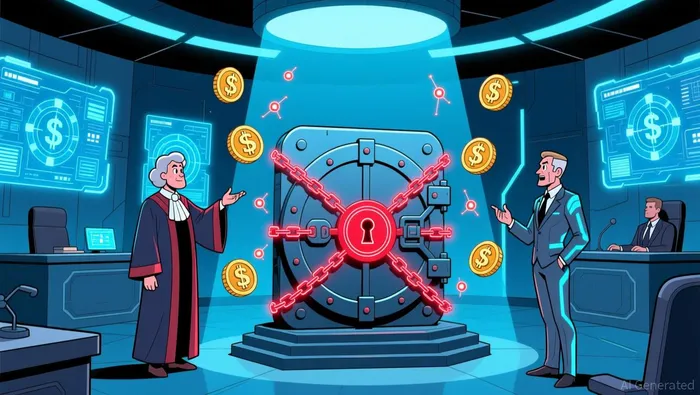
The bottom line is a collision between DeFi's promise of unfreezable money and the reality of layered control. The next decision will test whether recovered ETH returns to users or remains tied to outside litigation. That ruling will define the future of asset recovery and signal how much of the digital monetary system remains truly decentralized.