

The chart people have a word for what they think is happening to BNB right now. They call it an "accumulation zone" - a sideways band where buyers absorb supply before the next leg higher. The monthly chart is said to be setting up a third one of these bands, and the implication is that BNB is quietly gathering strength below the surface.
I don't disagree with the pattern. I just think it's the wrong story.
What the chart captures is real. BNB is trading around $644, roughly halfway between its all-time high of $1,375 in October 2025 and the mid-$300s where it spent much of 2024. That's a wide range, and yes, buyers have absorbed sell pressure in this band. But the reason this range exists isn't chart mechanics. It's because BNB is in the middle of an identity crisis that the market hasn't finished pricing.
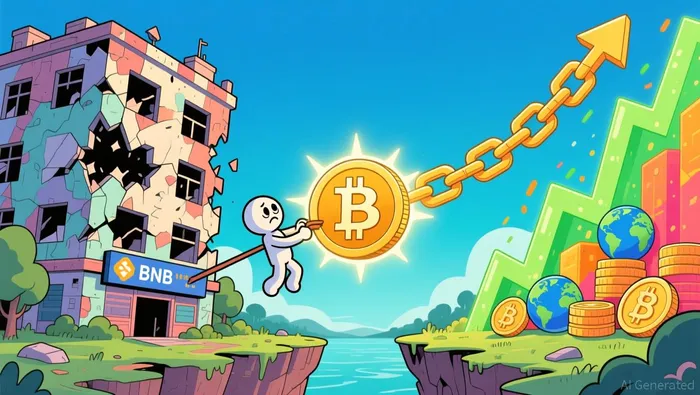
Here's the thing about exchange tokens: their value is supposed to come from one place. The exchange makes money, the token captures some of it, and the token appreciates. That was the BNB thesis from the start. You hold BNB because Binance is growing - because fees are flowing, because the ecosystem is expanding, because the token has utility and a burn mechanism that reduces supply over time.
But the exchange story is fraying. Binance's spot market share fell to 22% in February - its lowest level since October 2020. Total exchange volume dropped 32% in the first quarter of 2026. The broader crypto market cap fell 20% that same quarter, down 45% from its peak. BNB didn't just fall because the market fell. It fell because the engine that was supposed to pull it up is running at a slower pace than it has in years.
If you're looking at this purely as a technical setup, none of that changes your chart. But if you're trying to understand whether this accumulation band will break up or collapse, you need the plumbing story, not the candlesticks.
Which brings me to the less chart-friendly but more important development: BNB Chain's pivot toward real-world asset tokenization.
In the past few months, BNB Chain's RWA TVL - the value of tokenized real-world assets locked on the network - has doubled to $4 billion. The single largest driver is Circle's USYC, a tokenized U.S. Treasury yield product. That matters because it means BNB Chain is becoming a settlement layer for institutional-grade products, not just a venue for memes and yield farms. It's the same move Ethereum tried to make with its own tokenization push, except BNB Chain is doing it with the kind of fee structure and speed that actually appeals to issuers who don't care about decentralization philosophy but do care about cost and throughput.
The BNB Chain team has been pushing this explicitly. They've laid out a 2026 roadmap that includes privacy technologies like zero-knowledge proofs to help financial institutions move onchain, and they've run an RWA incentive program offering liquidity support and compliance resources. This isn't accidental. It's a deliberate repositioning: from the exchange's house token to a chain that earns its keep as settlement infrastructure for tokenized finance.
Why this matters for the price action is simple. When the exchange story dominates, BNB trades like exchange equity - correlated to Binance's fee revenue and market share. When the chain story dominates, it trades like infrastructure - correlated to onchain volume, TVL growth, and developer activity. Right now, neither narrative has full control, and that tension is what's creating the wide sideways band the chart people are calling accumulation.
There's a secondary mechanic at work too, and it's worth noting because it's not on the monthly chart. The BNB auto-burn mechanism adjusts the quarterly burn amount based on BNB's price and the number of blocks produced on BNB Smart Chain. Cumulative burns have exceeded 169.7 million BNB, leaving a circulating supply of roughly 140-145 million. When price drops, the burn slows. When price rises, it accelerates. That creates a natural supply floor during dips - not because of buying pressure, but because the deflationary engine calibrates itself. It's a built-in shock absorber that makes sharp downside moves harder than they would be for a fixed-supply token.
So what am I actually seeing when I look at this "accumulation" chart?
I see a token caught between two identities. The old one - exchange beta - is under pressure from declining trading volume and eroding market share. The new one - RWA settlement infrastructure - is growing but hasn't yet proven it can carry the token's valuation alone. The price is stuck in the middle because the market is trying to figure out which story wins.
There are three plausible outcomes, and they're not equally likely.
The chain story wins: BNB Chain becomes one of the dominant venues for tokenized finance, on the order of what Ethereum aspires to be. In that case, the current band breaks upward, and BNB trades more on its chain economics than its exchange economics. The evidence that supports this is the $4 billion RWA TVL number, the Circle partnership, and the explicit institutional roadmap.
The exchange story loses but doesn't die: Binance remains a top-tier exchange but loses enough share that BNB can never retrace to its peak. The token settles into a lower-growth equilibrium, and this band becomes a ceiling rather than a floor. The evidence for this is the 22% market share number and the 32% volume decline - both directional, not blips.
The regulatory wildcard: Changpeng Zhao's October 2025 pardon - itself a political flashpoint that drew condemnation from 27 House Democrats - cleared one legal overhang but didn't remove the structural tension between Binance and U.S. regulators. Binance has been pushing hard on compliance, reducing sanctions-related wallet exposure from 0.28% in January 2024 to 0.009% by mid-2025, a 97% decrease. But the U.S. political debate over Binance isn't about compliance metrics. It's about whether the most dominant exchange in crypto should be headquartered outside U.S. jurisdiction at all. That question doesn't go away because one administration changed.
I think the chart pattern is real, but it's a symptom, not a cause. What will resolve the band isn't momentum. It's whether BNB Chain's RWA growth can outpace the erosion in Binance's exchange dominance. The $4 billion figure is a start, but it needs to reach the point where it matters to BNB's total valuation, not just to onchain metrics.
Watch what happens when the next quarterly burn number comes out, and whether institutional RWA deployment on BNB Chain accelerates or stalls. The accumulation band will break when one of those forces proves it's the main story. Until then, the chart is just recording the wait.