

A bad week for three very different stocks
ADBE, CHWY, and BSX all hit fresh lows, but the reason behind each drop is different. In each case, investors were less focused on an obvious break in the business model than on what might come next.
Adobe posted strong numbers, but the market looked past them
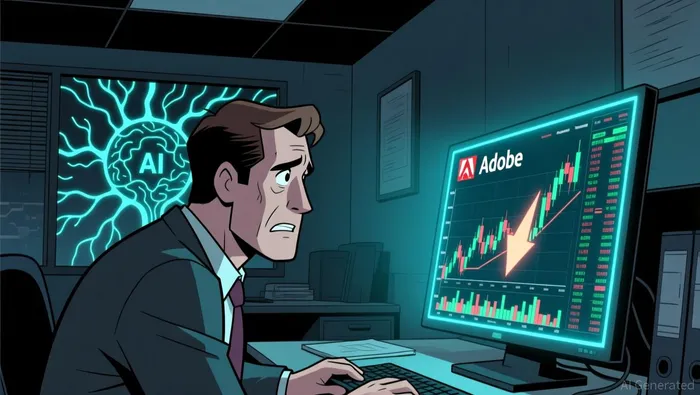
Adobe is the clearest example of a good quarter getting sold anyway. It reported record $6.62B revenue and raised FY26 guidance, yet the stock still fell sharply after already dropping the day before. This was not a story about a bad quarter. It was a sign that investors were focused on leadership noise and AI risk more than on the latest results.
Boston Scientific faced a forward-looking reset
Boston Scientific's selloff looked more like a reset in expectations than a collapse in current operations. Shares fell about 12% to their lowest in more than two years after management flagged declining use of Watchman standalone procedures. The key question became whether this was an isolated slowdown or the start of broader pressure across a premium medtech franchise.
Chewy's quarter looked fine until the outlook changed
Chewy also hit a new 52-week low even after reporting Q1 adjusted EPS of $0.43, revenue of $3.36B, and improved gross margin. But management also pointed to softer consumer spending and trimmed its sales outlook. For a consumer-facing growth stock, that combination is often enough to turn the market against the shares.
Adobe: strong results, weaker confidence
The business still looks intact
Adobe's core operating engine still appears healthy. The company delivered a beat-and-raise quarter and raised its revenue outlook for FY26. Growth also held up across key subscription groups, including business professional and consumer subscription revenue, which rose 16%. On product demand and operating performance, Adobe still looks like a company that had a strong quarter.
The issue was trust, not product failure
The bigger problem was timing. Adobe announced that CFO Dan Durn is leaving on June 15 around the same time management asked investors to lean on its raised outlook. That does not mean the business broke. It means investors now have a reason to scrutinize execution and forecasts more closely.
That skepticism also landed in the AI debate. Adobe said AI-first ARR more than tripled to above $500M, which is encouraging, but still a small share of total ARR. Bulls can view that as early evidence of monetization. Bears can argue it is still too small to offset fears that AI-native tools could pressure pricing power sooner than expected. The market clearly leaned toward the latter reading.
What matters next for Adobe
The near-term test is simple: can Adobe rebuild confidence in execution while showing that AI is becoming a more meaningful revenue driver rather than just a reassuring headline?
Chewy: customer demand looks fine, but the wallet is getting tighter
The quarter itself was not the problem
Chewy still delivered Q1 revenue of $3.36 billion, with adjusted EPS of $0.43 and improved gross margin. Those results do not suggest customers have abandoned the brand. The pressure showed up in guidance instead. Chewy cut its 2026 sales view to $13.4B-$13.55B from $13.6B-$13.75B, and management pointed to softer consumer spending later in the quarter.
Why the stock kept sliding
Investors did not wait for a full year of data. They focused on the part of the story that matters most for the next few quarters: are pet owners still spending freely, or are they starting to hesitate? Management said business was solid for most of the quarter, but then flagged pressure on premium products. That points to a mix issue rather than a collapse in demand.
The stock also came under pressure as CEO Sumit Singh took the stage at the J.P. Morgan conference, and the session did little to calm a skeptical market. That added to existing concerns tied to recent insider selling, regulatory scrutiny, and integration risk from the Modern Animal deal. In that context, investors treated every update as a chance the consumer softness was deeper than hoped.
What matters next for Chewy
The key watchpoint is whether the spending pullback remains temporary or starts showing up more broadly in purchase behavior, product mix, and guidance.
Boston Scientific: why the multiple reset hurt the most
This was a growth-assumption problem
Boston Scientific's selloff felt harsher because investors were not just reacting to one quarter. They were questioning whether a premium medtech compounding story was losing momentum. When management cut its 2026 organic revenue growth guide to 6.5%-8.0% from 10%-11%, it hit the core of that thesis.
Headwinds showed up in more than one place
The cardiovascular segment still posted 13.5% reported growth, which suggests the core franchise is not broken. But the market was paying for more than steady cardiovascular growth. It was paying for a broader high-growth transition. That thesis took a hit from several angles at once: competitive pressure in electrophysiology, declining usage of Watchman stand-alone procedures, and underperformance in urology.
What matters next for Boston Scientific
That is why BSX deserves the most caution of the three names here. ADBE and CHWY still look like businesses investors can evaluate through current operating signals. Boston Scientific is now being judged on whether its procedure-led growth engine can actually restart.
What these 52-week lows are really saying
These drops are not proof that Adobe, Chewy, or Boston Scientific have broken businesses. They are proof that investors are no longer willing to pay premium assumptions without fresher proof.
- ADBE: The business delivered, but leadership turnover and AI uncertainty weakened confidence.
- CHWY: The quarter held up, but softer consumer spending changed the near-term narrative.
- BSX: The reset went deeper because investors questioned whether the growth engine itself was slowing.
For now, the market is asking all three companies to prove that last week's low is a reset in expectations, not the start of a harder de-rating.