

The headline news today was SpaceX. BlackRock placed at least $5 billion in orders for the IPO, which priced on June 11 and began trading on the Nasdaq under the ticker SPCX at a $1.75 trillion valuation. That story is about to dominate the tape. The one worth acting on now is Adobe.
I am rating Adobe a Buy. The stock has fallen 37% in 2026, from its highs above $412 to around $233 as of last Friday's close. The valuation multiple has compressed to 12.7 times trailing earnings - roughly half of what the market was willing to pay six months ago - while the underlying business has not collapsed. Revenue grew 12% in the first quarter of fiscal 2026. Normalized earnings per share grew 19%. Annual free cash flow was nearly $10 billion. The business did not break. The multiple did.
That gap between business quality and stock price is the definition of a mispriced setup. The question is whether the gap has closed enough to act, and whether yesterday's Q2 earnings report confirms the recovery path.
What went wrong
The sell-off was driven by two overlapping fears. First, AI disruption anxiety. Adobe's Firefly AI tools have been integrated into Creative Cloud and Document Cloud, but investors are worried that generative AI competitors - from startups to large tech platforms building their own creative tools - could erode Adobe's subscription moat. The concern is structural, not quarterly. It is the kind of fear that compresses multiples before the revenue impact shows up.
Second, management shot itself in the foot with a $25 billion share buyback program announced in February. The company deployed approximately $23.3 billion of that at an average price near $412 per share - near the top of the 52-week range. That buyback consumed more than 100% of free cash flow in the periods it was active. With shares now around $233, roughly $6 billion of that buyback value has evaporated. That is capital destruction of a magnitude that would embarrass most boards.
Both fears are real. The buyback misstep is a done deal. The AI disruption risk is the uncertainty investors will keep pricing in until Adobe proves otherwise.
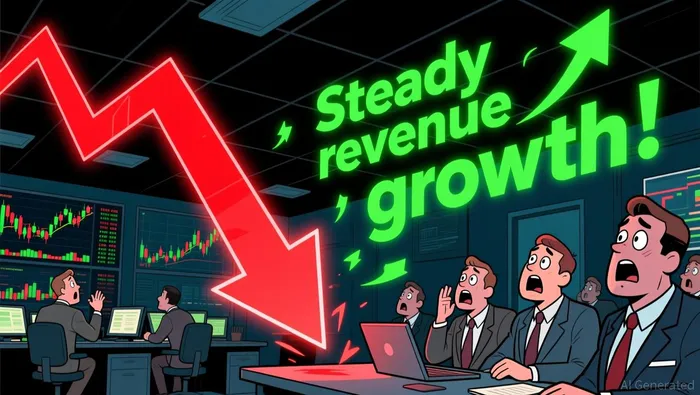
The operating evidence that still works
Here is what the business delivered in the most recent reported quarter:
- Revenue:$6.4 billion in Q1 FY2026, up 12% year-over-year (11% in constant currency). Subscription revenue rose 13%.
- Earnings:Normalized EPS grew 19% to $6.06. That is the kind of earnings acceleration that should not trade at 12.7x.
- Free cash flow:$9.85 billion for the trailing twelve months, up 25% year-over-year. That implies a free cash flow yield of approximately 8% at the current stock price.
- Annual recurring revenue: Adobe told investors that total ARR - annual recurring revenue, the subscription revenue baseline that measures how sticky the customer base is - reached record levels, with management projecting over 10% ARR growth for fiscal 2026.
An 8% free cash flow yield on a company growing revenue at 12% and earnings at 19% is unusual for any software name, let alone one with Adobe's market position. Most mid-cap software stocks that grow at those rates trade at 25x to 40x earnings, not 13x. The multiple compression has been steep enough to create a margin of safety that did not exist three months ago.
Valuation: the bridge between risk and entry
The stock trades at: - 12.7x trailing P/E - 11x to 13x forward P/E - 9.5x EV/EBITDA (enterprise value divided by earnings before interest, taxes, depreciation, and amortization - a rough proxy for cash earnings power) - 4.0x price-to-sales - 0.66 PEG ratio (price-to-earnings-growth, using five-year expected growth)
The PEG ratio below 1.0 is the key metric here. It means the stock is cheap relative to its own expected growth rate. That does not guarantee the growth will materialize, but it means the market is pricing Adobe as if growth is going to decelerate sharply, and even that pessimism may be excessive.
Compare this to where Adobe traded a year ago: multiples in the high 20s and low 30s, on revenue growth that was not materially slower than today. The multiple contraction from roughly 30x to 13x is a 57% compression. Revenue grew 12% in that same period. The stock fell because sentiment shifted, not because the cash register stopped ringing.
That is the risk/reward reset. The valuation has fallen faster than the business has deteriorated. The buyback disaster is baked into the price. The AI narrative fear is baked into the price. What is not baked in is the possibility that Q2 earnings came in solid and guidance held.
The catalyst clock
Adobe reported Q2 FY2026 earnings on June 11 after market close. Consensus estimates projected approximately $6 per share in normalized EPS and continued revenue growth in the low-double-digit range.
This quarter matters for three reasons. First, any sign that subscription revenue and ARR growth are holding steady pushes back the AI disruption narrative. Second, if management reaffirmed full-year guidance - particularly the 10%+ ARR growth target - it signals that leadership sees no structural damage to the growth engine. Third, the market needed proof that the buyback program has been scaled back or restructured so investors are not staring at another $412-average deployment while the stock languishes near $230.
A beat-and-raise outcome unlocks a 15% to 25% re-rating over the next quarter as the multiple drifts back toward the low 20s. A miss pushes the stock toward the $200s, but even there the business fundamentals - $10 billion in annual free cash flow, $24 billion in revenue, a dominant position in creative and document software - provide a floor that has not been tested.
Risks
The thesis has real vulnerabilities. What would break it:
- AI disruption is not hypothetical. If competitors capture meaningful share of creative workflows - particularly in areas where generative AI can replace human designers - Adobe's subscription growth could decelerate faster than management expects. This is the risk that keeps the multiple compressed.
- The buyback damage is real. Deploying $23.3 billion at $412 is not a small mistake. It consumed cash that could have been deployed more efficiently or saved for a worse market. Management's capital allocation judgment is now under scrutiny, and it will take multiple quarters of good stewardship to rebuild credibility.
- Growth deceleration. If Q2 shows revenue growth falling below 10%, the market will conclude the growth story is already breaking. At that point, even a 13x multiple may not be cheap enough.
- No dividend cushion. The buyback was supposed to replace dividend-like returns for shareholders. It failed at that job. There is no yield cushion to hold while the thesis plays out.
Verdict
Adobe is not out of the woods. The AI disruption overhang is real, and management's buyback timing was a costly error. But the stock has been punished enough. At 13x earnings, 9.5x EV/EBITDA, and 8% free cash flow yield, the valuation has already priced in a significant deterioration in growth and margins that has not yet materialized in the operating data.
The Q2 earnings report on June 11 is the inflection point. If revenue holds above 10% growth and guidance is steady, the multiple has room to recover. If it breaks, the free cash flow base provides a floor that makes the downside less severe than the current price decline suggests.
I am rating Adobe a Buy. The risk/reward at this entry point favors the upside, with the Q2 print as the catalyst. The metric to watch is subscription revenue growth. If it stays above 10%, the fear trade is overblown. If it falls below, I would wait for the next valuation reset before adding exposure.
Rating: Buy