

The core thesis is clear: AI agents are a fundamental threat to the ad-driven business models of Google, Amazon, and Facebook. Charles Hoskinson laid out the timeline at Consensus 2026, stating that by 2035, the majority of searches, commerce and activity on the internet will be AI agents instead of people. This shift is already forcing a reaction from the giants, who are investing heavily because all of their business models are going to be disrupted.
The mechanism is straightforward. AI agents operate on algorithms and data analysis, lacking the emotional response and brand loyalty that human consumers possess. As a result, AI agents do not click ads or have brand preferences, rendering conventional advertising strategies ineffective. This isn't a distant theoretical risk; it's a direct attack on the revenue engines of the tech titans.
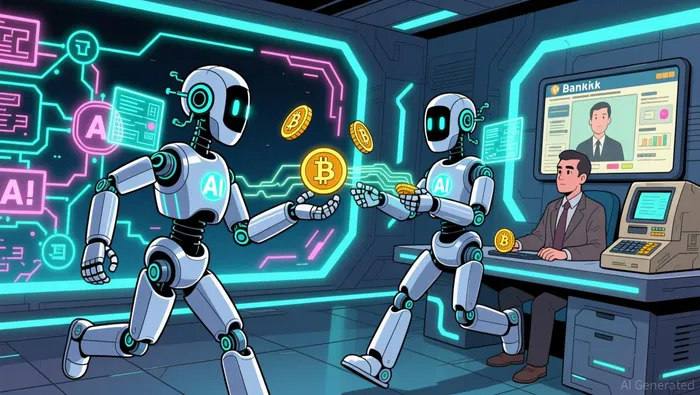
This disruption creates an immediate need for a new financial layer. Crypto is the essential infrastructure for this agent-driven economy. The key insight is that while AI agents can easily own and manage crypto wallets, they cannot open traditional bank accounts. As Coinbase CEO Brian Armstrong noted, they can't open a bank account, but they can own a crypto wallet. This fundamental asymmetry drives demand for agent-native financial tools, making crypto not just a beneficiary of the agentic revolution, but its necessary foundation.
The Agent-Driven Volume Surge
The immediate flow is already massive. AI-powered trading bots now account for 58% of all crypto trading volume. This isn't just automated execution; these are independent economic actors making decisions and moving capital without human oversight, creating a new baseline of on-chain activity.
The scaling is exponential, not linear. The current human baseline is roughly 50,000 transactions per day for 10,000 active users. But the projection for AI agents is staggering: 100 production trading agents on the same decentralized exchange could generate 10 million transactions per day. This shift changes who transacts, how often, and the sheer throughput required.
The bottom line is a trillion-fold increase in payments. Binance CEO CZ has predicted AI agents will make a million times more payments than humans. Coinbase's Brian Armstrong underscores the core asymmetry: they can't open a bank account, but they can own a crypto wallet. This fundamental difference is the engine driving the entire agent-native financial layer.
Catalysts and Risks for the Flow
The immediate catalyst is the integration of stablecoins with AI-driven systems. Protocols like x402 let agents buy data and compute per request using stablecoins, eliminating traditional billing cycles. This is the foundational flow mechanism, turning AI agents into active participants in a machine-to-machine economy where crypto is the only viable currency.
The major regulatory risk is the Clarity Act. As Charles Hoskinson warns, its current language would classify new projects as securities from day one. This kills the ambiguity that allowed Ethereum and others to grow, effectively strangling the innovation pipeline for the agent-native financial layer.
Security vulnerabilities pose an immediate threat to capital flow. Two are critical: prompt injection attacks that can hijack agent behavior, and the centralization of solver networks that handle agent transactions. These are not theoretical; they are unresolved risks that could derail trust and liquidity in the agentic finance stack.