

The competitor headline is about an AI connector. Croft, the most-used H-2A workforce platform, launched the first Model Context Protocol connector so farm employers can ask ChatGPT or Claude questions about their seasonal visa operations. That's the feature.
The feature is not the story. The story is underneath it.
I'm not here to review AI integrations. I'm here to flag something the market hasn't priced because there's nothing to price it on yet. The H-2A visa program - the federal gateway for seasonal agricultural workers - grew 300% over the last decade. It now accounts for 17% of the entire US agricultural workforce. The paperwork around it is a mountain of federal and state compliance that farms manage with family members and overworked agents. And no public company owns the digitization layer.
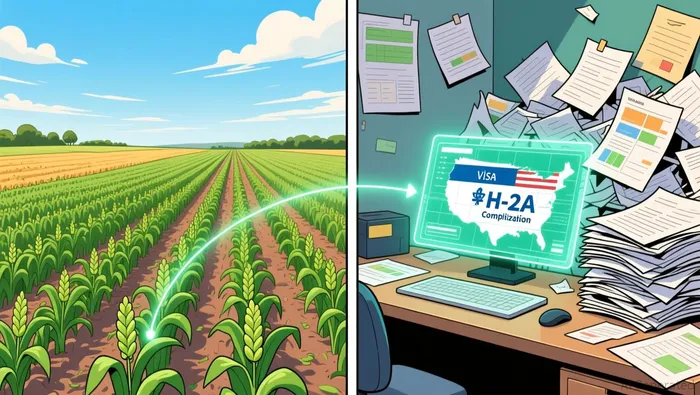
The market is still treating H-2A as a niche immigration footnote. But the numbers already say the program is the backbone of labor in some of the most valuable farmland in the country.
The proof point
In fiscal year 2024, the US government certified 378,513 H-2A positions. In 2010, it was 94,000. California alone saw H-2A usage grow 516% over a decade.
Every single one of those positions requires documented recruiting efforts, housing compliance inspections, wage floor calculations, and correspondence with the Department of Labor and USCIS. Farms don't hire compliance teams. They hire people who learned the forms through trial and error, or they pay labor agents thousands of dollars per season.
This isn't about excitement. It's about a compliance infrastructure that keeps getting bigger while the tools to manage it stay stuck in paper and spreadsheets. The admin cost per worker runs hundreds of dollars. Multiply that across nearly 400,000 positions and you have a compliance management market that's growing organically every season.
Where Croft actually matters
Croft was built through Purdue University's DIAL Ventures accelerator, funded with roughly $2.7 million, and claims 2,000% revenue growth with presence in 45 states. The estimated valuation is around $2.2 million, which is absurdly small for that kind of claimed growth - either this is an untracked early innings market, or the numbers need scrutiny. I don't have independent verification either way.
The MCP connector is a fine feature. But the real value is what happened before the connector: someone digitized H-2A compliance data at scale. The AI wrapper is a downstream benefit of having the data layer first. That's the moat - not the ability to chat with your visa paperwork, but the fact that the paperwork is now digital at all.
The gap
Here's the thing that should keep you looking at this space: there is no public vehicle. Croft is private. No listed ag-tech company has material revenue tied to H-2A compliance management. The infrastructure is growing 300% over a decade and the stock market can't trade it.
I can be wrong about how this resolves. Maybe Croft never goes public. Maybe the political wind shifts - immigration policy can turn faster than a ten-year trend, and if Congress caps H-2A volumes, the whole compliance digitization thesis shrinks with it. That's the tripwire for anyone tracking this.
But if the trend continues, the H-2A program will clear 500,000 positions within a few years at the current growth rate. The compliance paperwork is a math problem that gets worse every season. Whoever owns the digital layer - whether through Croft going public, an acquisition by a larger ag-software player, or a new entrant - will face a customer base that has almost nowhere else to go.
This is worth tracking, not trading. The invalidation condition is clear: if H-2A volumes plateau or decline due to policy, the signal turns to noise. Until then, the paperwork keeps growing, and the data layer keeps getting harder to displace.