

Dreamland Ltd., a Hong Kong-based event management company, traded 121.46 million shares today against a $17.46 million market cap. That is weird. The average volume is about 547,000 shares, so today's trading represents something like 220 times normal activity for a company that organizes trade shows and conferences.
Dreamland appears on a list of five stocks supposedly "on investors' radars today" alongside Oklo (a nuclear power startup), Nextpower (a solar tracker company), SanDisk (a memory chip maker), and Tesla (the electric vehicle and energy storage company). The obvious theme connecting four of them is AI energy infrastructure: nuclear power for data centers, solar tracking for clean energy, memory storage for AI workloads, and battery storage for grid stability. Dreamland manages corporate events.
The odd thing is not that someone put these stocks together. The odd thing is what the grouping reveals about how market narratives get constructed. When there's a hot theme-AI energy demand, in this case-analysts and writers will gather stocks that sort of fit, plus maybe one or two that don't but have interesting price action. Dreamland is the "interesting price action" part. Its 121.46 million share volume today suggests something is happening, even if that something has nothing to do with nuclear reactors or data center power.
The other four actually do have recent catalysts. Oklo, which is developing small modular nuclear reactors, just reported first-quarter earnings today, beating estimates by a penny while reporting $0 in revenue (which is what you expect from a pre-revenue company). It also recently announced a partnership with Nvidia to use AI for nuclear fuel research. Nextpower, which makes solar tracking systems, reported strong Q1 results last week. SanDisk has been on a 1,747% rally over the past year as memory storage becomes a bottleneck for AI. Tesla's energy storage business is growing even as its auto business faces challenges.
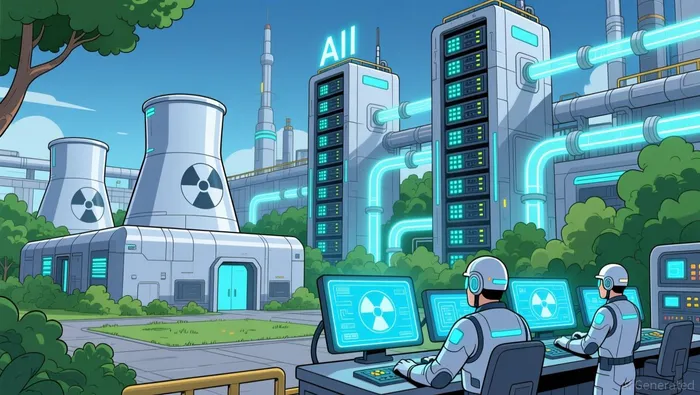
These are all plausible AI energy infrastructure plays. Dreamland is a company with 12 employees that plans conferences.
The mismatch tells you something about the list-making process. Investor: "We need stocks that are getting attention around the AI energy theme." Writer: "Oklo, Nextpower, Tesla, SanDisk fit." Investor: "What else is moving?" Writer: "This tiny Hong Kong event company is trading 200 times normal volume." Investor: "Add it to the list."
This is not necessarily bad analysis. It is just a different kind of analysis than the headline suggests. The headline says "these five stocks are on investors' radars because of the AI energy theme." The reality is closer to "four of these stocks are connected to AI energy, and one is a microcap with bizarre trading volume that someone noticed." The list is really about recent attention, not thematic coherence.
There is a familiar financial game here: when a theme gets hot, everything that can be vaguely connected to the theme gets grouped together, and the grouping itself reinforces the theme. Nuclear power, solar tracking, energy storage, and memory chips are all parts of the AI infrastructure buildout. Event management is not, unless Dreamland is secretly running AI energy conferences. (Maybe it is! But probably not.)
The mechanical point is about how market narratives get assembled from available parts. You take a real trend-AI data centers need massive amounts of reliable power-and you collect companies that benefit from that trend. Then you add whatever else is moving because, well, investors are looking at it too. The final list looks like a coherent thematic analysis but contains one element that exposes the construction.
Anyway, the economic point is that Oklo, Nextpower, Tesla, and SanDisk are all playing in some version of the AI energy trade. Dreamland is playing in the "tiny stock with extreme volume" trade. Both can be interesting, but they are different trades. The list pretends they are the same trade, which is how you get a $17 million event company grouped with a $12 billion nuclear startup and a $16 billion solar tracker company.
One final note: I could not get current price data for Oklo from the market tools, which is itself a sort of data gap that fits the theme. Sometimes the narrative is clearer than the numbers.