

You read headlines like "5 Dividend Stocks to Own If the AI Trade Ends" and the instinct is to file them under contingency planning. But the question you should be asking is sharper: why are you waiting for the AI trade to end before you look for cash flow?
The AI trade's most generous beneficiaries are already reducing the very shareholder returns you depend on. Companies spent $550 billion on buybacks in early 2025, then that spending flatlined in the second quarter as AI-driven capital expenditures jumped 24%. One headline from the period captured the dynamic perfectly - "Companies Are Spending So Much on AI That They're Cutting Dividends." The Wall Street Journal ran a piece titled "Blame AI for the Strange Death of Dividends," noting that excitement about the technology has pushed companies to plow profits back into capital spending instead of returning cash to shareholders.
That is not a prediction. That is happening now.
Four big tech companies alone are expected to spend more than $670 billion on data centers and AI infrastructure this year. As a percentage of GDP, that rivals the most momentous capital efforts in U.S. history. The result? Analysts warn that big tech free cash flow - the actual cash left after funding operations and investments, which is what pays dividends and buybacks - could drop by as much as 90% in 2026 as capital expenditure dramatically outpaces revenue growth from still-nascent AI products.
Think about what that means for your income. The stocks that pushed the S&P 500 higher, the ones making up roughly 34% of the index by market cap, are increasingly cash-flow-negative on a free-cash-flow basis. You can own Nvidia and love the thesis and still acknowledge that the company's cash returns to shareholders are being funneled into servers, not your brokerage account. The Magnificent Seven group that represented about 28% of the S&P 500 at the end of 2023 is now closer to a third. The index has become an AI capex fund with a few other names tacked on.
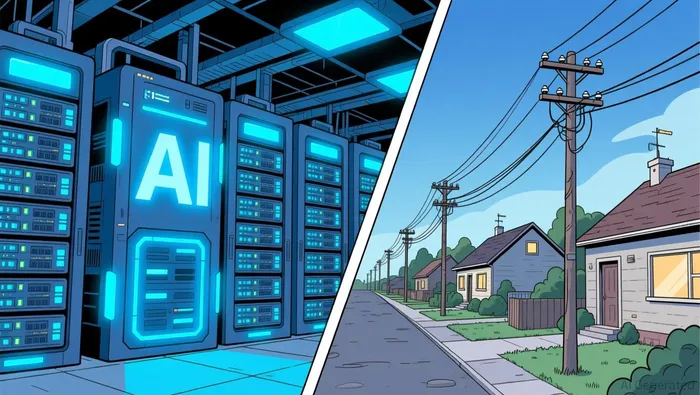
But here is the part most commentary skips: if you are living on dividend income, the AI trade was never your friend. It was your distraction.
Take a deep breath and look at what is actually producing the income. The sectors that have nothing to do with training large language models are where the payout discipline lives.
Utilities operate under regulated rate structures. They don't need to outspend each other on data centers. They collect approved returns on the pipes, wires, and infrastructure people use regardless of the macro backdrop. Utility stocks trade at yields that make them relevant for portfolios built around funding expenses rather than chasing paper gains. When Morningstar highlights the best utility stocks to buy, dividend yield is the first criterion.
Consumer staples - Procter & Gamble, Johnson & Johnson, the cohort that makes up the "Dividend Aristocrats" (companies with 25+ consecutive years of dividend increases) - have business models anchored to household habits that don't accelerate or decelerate with AI sentiment. People buy toothpaste, prescription drugs, and cleaning supplies whether hyperscalers are in a spending frenzy or a spending pause. The cash flow that funds those raises is boring, regulated by competitive economics, and completely uncorrelated to the AI buildout.
REITs with 6% plus yields and strong dividend growth have been sitting there, undervalued, while capital chased the narrative. Morningstar identified two top undervalued REITs yielding over 6% with strong dividend growth during the "great rotation" discussion earlier this year. The properties produce rental income that has nothing to do with semiconductor cycle timing.
Healthcare dividend growers, including AbbVie and Johnson & Johnson, fund their payouts from drug pipelines and branded pharma cash flows that are driven by patent expirations and FDA timelines, not data-center capex cycles.
Now for the counterpoint, because the AI bull has a real argument: what if the AI spending pays off exactly as management promised? What if the productivity gains arrive, margins recover, and the free cash flow that dried up in 2025-2026 comes roaring back?
That's a fair question. But even in that scenario, your income portfolio doesn't lose. Those same non-AI dividend streams keep paying. The utility dividends keep rising. The REIT rents keep collecting. The staples keeps the increases coming. You aren't shorting AI. You're just not building your retirement on a single theme that currently requires free cash flow to collapse for two years in order to materialize.
And if the AI thesis breaks - if the returns on that $670 billion don't arrive on schedule, if the bond market angst over big tech spending sustainability turns into a repricing - then the income investor who owns real-economy cash flows is the one who keeps getting paid while everyone else is explaining why the story changed.
What should you do with this?
If your portfolio is still tilted heavily toward the growth names that carried the market through 2024 and 2025, take stock of how much of your "dividend exposure" is really just growth stocks that happen to pay a token dividend while reinvesting every spare dollar. Then build the balance. Add positions in regulated utilities, consumer staples aristocrats, healthcare income growers, and well-managed REITs. Not as a hedge. As the core. The AI trade can do whatever it wants. Your income stream should be running on a different engine.
The Magnificent Seven may yet deliver on the AI promise. They may not. That debate belongs to growth investors. Income investors have a simpler metric: did the check arrive, is it growing, and can I explain where the cash came from? If the answer is yes to all three, you don't need to be right about artificial intelligence. You just need to own the things that keep paying.