

The headlines say airlines are breaking. Spirit Airlines shut down in May after jet fuel prices nearly doubled and crushed its low-cost model. IATA warned on June 7 that airline profits will be cut in half this year as fuel spending jumps from $252 billion to $350 billion. The industry chief is predicting failures and consolidation.
None of that is wrong. But if you sit on the other side of the barrel, the exact same fuel shock looks like the most profitable refining environment in a decade. The question for oil and gas investors isn't whether the airline crisis is real. It's how long the cash flow boom on the refiner side lasts before the very demand destruction that kills airlines works backward on the margins fueling the earnings surge.
Let me start with the mechanism. The Iran war and the disruption of Strait of Hormuz flows created a refined product squeeze. Crude supply from the Middle East - traditionally a major feedstock for global refining - became unreliable. U.S. Gulf Coast refiners, which can process domestic crude, gained a geographic and operational advantage. The result: the Brent 3-2-1 crack spread - which measures the margin between crude oil input costs and the combined value of gasoline, diesel, and jet fuel output - climbed $27 from the start of the year to hit $42 per barrel in late March. At a $40 crack spread, the implied annual gross refining margin for U.S. refiners runs to roughly $27.4 billion, against an $8.6 billion run rate at the end of 2025. That's a three-fold expansion in the paper margins on every barrel processed.
The cash flow numbers confirm the math. Valero Energy - the largest independent U.S. refiner - reported $1.3 billion in net income for the first quarter, or $4.22 per share. That beat analyst expectations of $3.16 by more than 33%. A year earlier, the company was posting a quarterly loss. Valero called the quarter "excellent." Its shares, along with Phillips 66 and Marathon Petroleum, have climbed more than 20% year-to-date. These are companies whose entire business model is buying crude and selling refined products. When the spread between the two widens this fast, their earnings don't just improve. They transform.
Now let's talk about the airline side, because the numbers there are equally stark and they're the counterweight. Jet fuel on the U.S. Gulf Coast surged from roughly $2.50 per gallon before the crisis to $4.88 by early April - a 95% jump. U.S. airlines paid an average of $3.13 per gallon in March, up 31% from the prior year. Fuel is typically the single largest operating cost for an airline, often 25% to 30% of total expenses. When that line item nearly doubles without warning, there's no hedging contract or route adjustment that absorbs it.
Spirit Airlines is the Exhibit A. The carrier entered Chapter 11 in November 2024 with a restructuring plan that assumed jet fuel costs of about $2.24 a gallon in 2026. Prices climbed past $4.50. Its lawyer told the bankruptcy court that the airline faced hundreds of millions of dollars in unabsorbable fuel costs. Spirit shut down in May, ending a 34-year run and becoming the first airline casualty of the Iran war fuel shock. J.P. Morgan analysts estimated that sustained high fuel prices would have pushed Spirit's costs up by $360 million - far more than a cash-strapped bankrupt carrier could raise. Spirit's fate isn't an outlier. It's a stress test result.
So here's the contradiction that carries this piece. The refiner boom and the airline bust are the same phenomenon, viewed from opposite sides of the same transaction. Refiners sell expensive product; airlines buy it. The money flowing out of the airline industry's P&L is flowing into refiners' operating cash. That's the direct pipeline.
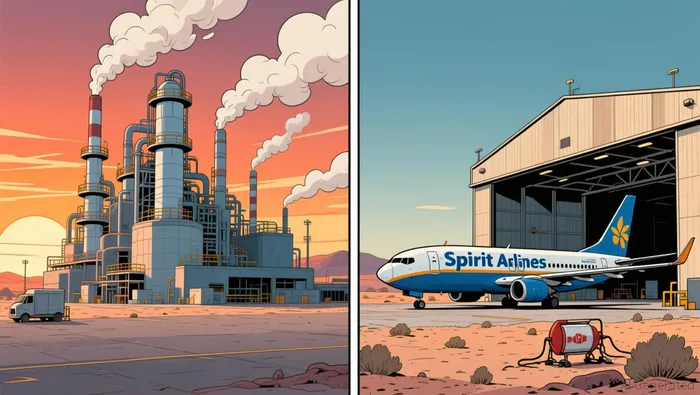
The hidden risk is in the feedback loop. Refining margins are high because demand for refined products - including jet fuel - is still strong enough to support the price. But if enough airlines fail, if capacity gets cut deeply enough, jet fuel demand falls. IATA says industry operating margins have already slumped from about 4% to near zero. That doesn't happen without service reductions, route cancellations, and fewer flights. Fewer flights means less jet fuel demand. Less demand eventually pushes crack spreads lower. The boom feeds its own expiration date.
Even if that loop tightens, the timing works in refiners' favor. Supply disruptions from the Iran conflict are structural, not transient. The Strait of Hormuz carries roughly a fifth of global oil flows. As long as those flows remain constrained, the product squeeze persists. Crack spreads don't collapse just because airlines fly fewer routes - other sectors (trucking, shipping, heating) still consume diesel and gasoline. The margin compression from airline demand destruction would be partial, not total. And refiners with integrated operations, strong balance sheets, and diversified product slates are the ones positioned to survive a pullback and come out with market share from weaker competitors.
From a valuation perspective, the refiner names have already run. Valero at $4.22 a share in a single quarter is generating cash at a rate the market hadn't priced in six months ago. The 20% year-to-date moves reflect that repricing. The question isn't whether these stocks are cheap. They aren't anymore. The question is whether second-quarter margins hold near first-quarter levels, and whether the Iran situation stays unresolved long enough for a full-year earnings number that justifies the multiple expansion.
All things considered, the cash flow reality on the refiner side is compelling while it lasts. The airline crisis is the same fuel shock that's printing money upstream - a reminder that in commodity markets, someone's pain is always someone else's revenue. For oil and gas investors, the refiner supercycle deserves conviction as long as the Hormuz disruption holds, but the demand destruction feedback loop means this isn't a position you hold with your eyes closed. Watch capacity cuts. Watch crack spreads. When the margin expansion starts to plateau, the earnings supercycle is ending.
For airline-exposed names and thin-margin carriers still flying, there are better opportunities elsewhere in the energy sector right now.