

Alaska Air appointed Mike Sievert - the former T-Mobile CEO who built the "Un-carrier" strategy that stole market share from bigger rivals - to its board on June 1. The stock was at $47. Nothing moved.
That reaction is worth paying attention to. Investors aren't indifferent because Sievert is uninteresting. They're indifferent because board appointments don't change the P&L. And the P&L right now is telling a story Alaska's integration milestones are trying to distract from.
Here's the arithmetic. Full-year 2025 net income was $100 million, or $0.83 per share. A year earlier it was $395 million, or $3.08 per share. That's a 75% drop. Then Q1 2026: a $193 million net loss, or $1.68 per share. Revenue grew 5% to $3.3 billion and unit revenue was up 3.5%, which means demand wasn't the problem. The problem was costs - integration expenses, higher-than-expected fuel, and operational disruptions in Hawaii and Puerto Vallarta.
Meanwhile, management's "Alaska Accelerate" plan, announced in December 2024, promises $1 billion in incremental pretax profit and $10 adjusted EPS by 2027. You need to hold that number against the actual numbers. From $0.83 earnings per share in 2025 to $10 by 2027 is roughly a 12x increase in two years. That is not a projection. It's a prayer.
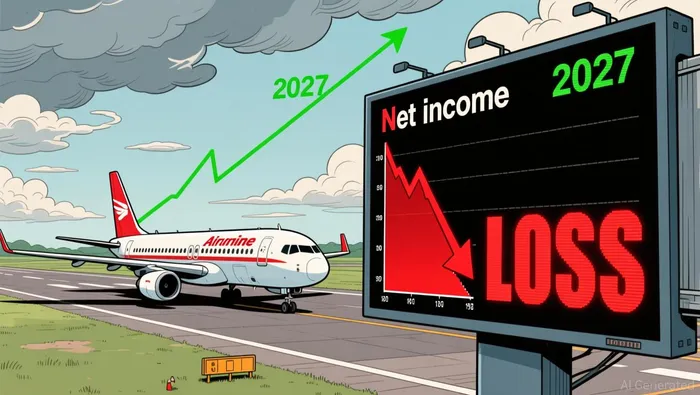
The way to get from $0.83 to $10 is not to announce milestones. It's to actually cut costs and capture revenue. So let's look at what's real and what's theatrical.
The single operating certificate, achieved in October 2025, was the regulatory milestone the FAA needed to let Alaska and Hawaiian fly under one umbrella. Then in April 2026, Hawaiian flights transitioned from the "HA" code to Alaska's "AS" code - ending 97 years of Hawaiian's independent flight numbering. Both are real achievements. Neither produces a dollar of cash flow.
What produces cash flow is the synergy math. Alaska told investors in its Q4 2025 results that Hawaiian integration synergies "remain on track or ahead". That's the kind of sentence management uses when the actual savings are lagging but they're not ready to say so yet. The 2025 $100 million result - down from nearly $400 million - was supposed to be the trough, with integration costs burning themselves out. Instead, Q1 2026 was worse.
I suspect the real question isn't whether Sievert can help. He was good at T-Mobile - the Un-carrier approach worked because telecom was a stale three-way oligopoly where undercutting on price and perks was a genuine disruption. The airline industry is different. It's not an oligopoly with fat margins to raid. It's a commodity business where the margin pool is already compressed, fuel is the dominant variable cost, and every carrier is running lean.
That doesn't mean Sievert is useless. Board directors who've run pricing wars in other industries can spot when an operator is leaving money on the table through lazy yield management or misaligned incentives. But a board seat isn't a CEO role. He doesn't set ticket prices or renegotiate maintenance contracts.
The test for this stock is narrow. Alaska needs to show that Q1 2026's $193 million loss was a bottom, not a pattern. If Q2 comes in with even a modest profit - adjusted EPS in positive territory, with integration costs clearly trending down - the market will reprice. If Q2 is another loss, the $10 EPS by 2027 target goes from ambitious to impossible.
The $47 stock price implies the market expects some recovery but doesn't trust the timeline yet. That's the right posture. The milestones - Sievert, the single certificate, the AS code - are checkboxes. The real question is whether Alaska can do the unglamorous work of making a $1.9 billion acquisition actually earn its keep.
Watch the next earnings print. Not the board composition. Not the flight codes. The number that matters is Q2 adjusted EPS, and whether the integration cost line item shrinks by a meaningful amount quarter over quarter. If it does, you buy the recovery. If it doesn't, the $10 story collapses before it gets off the runway.