

Allspring Absolute Return's recent lead raises the process question
This looks more like beta from a cooperative market than clean alpha. The fund is already 16.0% year to date, so allocators have to judge the process now rather than wait for a cleaner regime.
The bull case is straightforward. Allspring is built as a fund of funds that pursues positive total returns through dynamic allocations to equity, fixed income, and alternative investments. Its stated edge is a differentiated return source with low correlation to equities and fixed income, with downside risk explicitly managed through proprietary put replication and cross-asset trend strategies. If that system is working, the recent outperformance may reflect portfolio construction rather than a one-way call on stocks or bonds.
The bear case is about latitude. The fund can hold up to 60% of the fund's total assets in U.S. and non-U.S. equity, up to 60% in fixed income, and up to 60% in alternative investment funds. That flexibility can create alpha, but it can also mask beta. The next few reports need to show whether the fund still delivers better risk-adjusted results when the market stops cooperating.
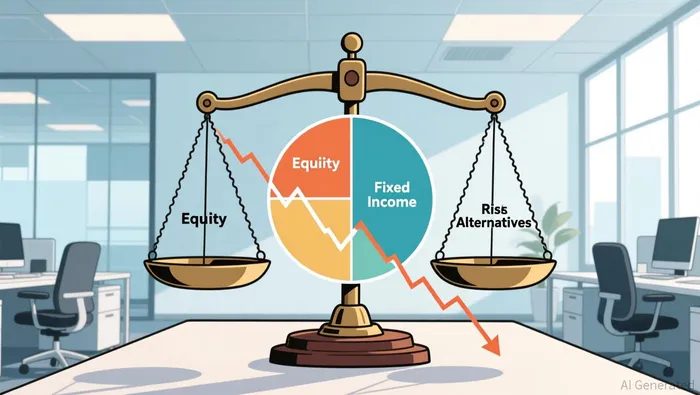
How the strategy is supposed to work across market turns
The key question is not whether the fund can participate in a good market. It is whether the return engine is repeatable when conditions change. Allspring's edge, on paper, comes from portfolio construction rather than single-factor direction. The vehicle is a fund of funds that pursues positive total returns through dynamic allocations to equity, fixed income, and alternative investments, and it can shift meaningfully across those buckets because it is allowed up to 60% of the fund's total assets in U.S. and non-U.S. equity, along with similar ranges in fixed income and alternatives.
The return engine is allocation, not single-bet conviction
Allspring says it uses a multi-asset, multi-style approach through affiliated and unaffiliated mutual funds as well as exchange-traded funds. In theory, that should reduce dependence on any one return pool. If equities narrow, fixed income or alternatives can offset. If rates are unhelpful, other sleeves may carry more of the load. The appeal is not maximum upside; it is a smoother risk-adjusted return stream with low correlation to equities and fixed income.
Downside control is part of the design
What sets this apart from a generic allocation fund is the explicit focus on drawdown control. Allspring says downside risk is managed through proprietary put replication and cross-asset trend strategies. That does not guarantee lower drawdowns, but it does make risk management part of the strategy rather than an afterthought.
Process discipline matters in a tactical wrapper
Allspring also emphasizes a transparent and consistent process designed to minimize behavioral bias while balancing macro and style exposures. In a tactical allocation structure, that matters because flexibility can slide into reaction risk if discretion is not constrained by process.
The main watchpoint is simple: does the fund still show lower correlation and better drawdown behavior when the category is moving sharply, rather than only when conditions are broadly supportive?
What the Q1 commentary needs to clarify
One useful next step is to stop judging the tape and start judging the system.
Process
The cleanest test is whether the strategy sounds like a repeatable process or just a flexible mandate. Allspring says the vehicle uses a dynamic blend of systematic and fundamental strategies, manages downside with proprietary put replication and cross-asset trend strategies, and relies on a transparent and consistent process to limit behavioral bias. That is the right architecture in theory. The practical test is whether the process actually constrains discretion. The commentary should explain how put replication, trend signals, and the fundamental overlay interact, rather than simply asserting that they do.
Team
The team lens is the weaker link. The fund has 4 members of the management team with an average tenure of 1.78 years. That is not a deep bench with a long shared history, and tenure matters more in actively managed funds. If recent returns came from the right call on equities, rates, or alternatives, shorter tenure makes it harder to separate skill from timing.
Parent
The parent lens is a partial support case. Allspring has research, risk, and sub-advisory infrastructure behind it, and the fund invests across affiliated mutual funds as well as affiliated and unaffiliated exchange-traded funds. That can help with execution and access to in-house strategies, but it can also blur the line between platform capability and manager-specific alpha.
What would improve the case
A stronger allocation case would show: - clearer decision rules for when put replication or trend sleeves take over - evidence that the team is adjusting style and macro exposures, not just shifting asset-class buckets - proof that parent or platform resources are improving selection or hedging, not just lowering operating friction
What would weaken the case
A weaker case would show: - heavy reliance on broad tactical shifts that could mirror factor beta - vague language around how systematic hedges interact with fundamental positions - no discussion of how process stability survives team turnover, given the relatively short management tenure
Allocation use case: hedge only if returns stay decoupled
Allspring can earn a portfolio slot, but the slot should be as a hedge allocation, not as a core return vehicle. The fund is built to be a differentiated return stream through a dynamic blend of systematic and fundamental strategies, with explicit attention to low correlation to equities and fixed income and downside management via put replication and cross-asset trend strategies. That is the right design for a diversifier. The question is whether realized returns have been decoupled enough to trust that design when correlations spike.
The cleanest way to frame the verdict is through the internal rating framework of Process, People, and Parent. For an allocation hedge, process should carry the most weight because it shows whether returns come from repeatable portfolio construction rather than a favorable factor tape. People matters too, since the team has 4 members and 1.78 years average tenure. Parent is supportive, but it does not substitute for manager-level alpha.
Include it as a satellite hedge only if the next few reports show: - lower correlation to broad equity and rates moves, not just strong absolute performance - evidence of hedging in action, especially when the market is rising - process clarity that compensates for the team's relative inexperience
Invalidation: if outperformance fades mainly because the fund had less equity or rates exposure, the strategy is still flexible, but it is not yet proven as a true low-correlation alpha sleeve.