

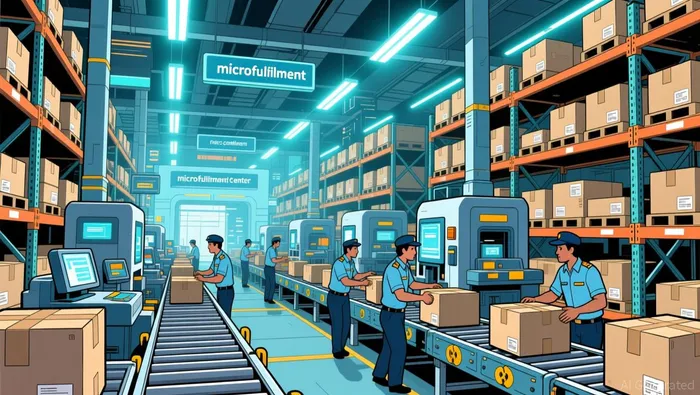
Amazon's move to 100 cities is a classic, capital-intensive growth bet. This isn't about quick profits; it's a deliberate investment to build an unassailable physical and operational moat in a market where e-commerce is still in its infancy. The company is committing more than $300m in India to fuel this expansion, with the core of that investment being a network of over 1,000 micro-fulfilment centres (MFCs). These compact, tech-enabled facilities are the literal backbone, placing inventory closer to customers to enable the rapid delivery that defines the service.
The strategic shift is equally important. Amazon is moving beyond its initial, concentrated hubs in Mumbai, Delhi-NCR, and Bengaluru. The new plan targets a broader mix of metro and smaller cities, including names like Chennai, Hyderabad, Jaipur, and Pune. This geographic spread is designed to capture the next wave of growth, which is increasingly coming from smaller urban centers and middle-income groups. By building MFCs in these locations, Amazon is positioning itself to be the default choice for "need-it-now" purchases long before competitors can scale to match.
This aggressive build-out reflects Amazon's view of India as a long-term investment with substantial headroom. As a senior executive noted, retail and within that e-commerce is just about getting started. With e-commerce currently representing a single-digit percentage of total retail, the runway is vast. The company's own expansion of zero-fee coverage to over 125 million products signals a focus on seller incentives and customer value, further fueling the ecosystem. For the growth investor, the $300 million+ spend is a calculated wager on this long-term trajectory. The immediate returns may be muted by the costs, but the goal is clear: to dominate the infrastructure of India's rapid-commerce future.
Market Penetration and Revenue Growth Levers
The expansion to 100 cities is more than just a geographic bet; it's a multi-pronged engine designed to drive both top-line growth and deeper market penetration. The specific levers are becoming clear, each targeting a distinct but scalable revenue stream.
First, the move unlocks a powerful new supply chain for high-margin fresh goods. By scaling its micro-fulfilment centres to over 1,000, Amazon Now can now enable more than 16,000 farmers to sell produce directly to customers. This creates a unique, tech-driven supply chain for perishables, a category with strong margins and high customer loyalty. It also deepens the platform's relevance for daily essentials, moving beyond convenience to necessity. For the growth investor, this is a classic "flywheel" play: better supply attracts more sellers, which attracts more buyers, which justifies further infrastructure investment.
Second, the expansion fuels a highly scalable B2B model. Amazon Business India reported a robust 35% year-on-year sales increase in 2025, with adoption particularly strong in tier-2 and tier-3 cities. This growth is directly tied to the same infrastructure build-out, as businesses in these smaller centers gain reliable access to a vast, curated catalogue. The platform's success here is a critical indicator of scalability beyond the consumer market. It shows Amazon's ecosystem can capture business spending, a more stable and recurring revenue stream, across a broad geographic footprint.
Finally, the company is aggressively incentivizing its core marketplace. The expansion of "zero referral fee" coverage to 12.5 crore products is a direct seller incentive designed to accelerate inventory depth and drive sales volume. The positive seller response signals that this fee reduction can be a powerful growth catalyst, encouraging more sellers to list and pass savings to customers. This move directly supports the "speed, selection, convenience, and prices" promise, making the marketplace more competitive and attractive as the 100-city network scales.
Together, these levers-fresh goods, B2B sales, and marketplace incentives-create a diversified growth portfolio. They show Amazon isn't just building a delivery network; it's building an entire ecosystem of commerce, each segment capable of scaling with the underlying infrastructure. The path to dominance is becoming clearer, one city and one revenue stream at a time.
Financial Impact and Scalability Metrics
The financial calculus of Amazon's 100-city push hinges on transforming a massive, upfront investment into a scalable engine for market dominance. The base is solid: Amazon India generated ₹25,406 crore in revenue for FY24 and holds a commanding 30-35% share of the e-commerce market. This positions it as the second-largest player, with a clear target to widen that gap. The expansion is designed to accelerate growth by capturing the next wave of users and spending from smaller cities.
A key metric for measuring success is the volume of rapid deliveries, which directly correlates with customer retention and higher order values. In 2024, Amazon facilitated 41 crore same/next-day deliveries. The new network of over 1,000 micro-fulfilment centres is explicitly aimed at increasing this volume. More deliveries mean more customer touchpoints, higher platform engagement, and a stronger flywheel effect. The goal is to make ultra-fast delivery the default expectation, locking in users and driving them toward more frequent, higher-value purchases.
The critical question is whether the $300 million+ investment can yield a sustainable competitive advantage. The answer lies in the scalability of the micro-fulfilment model. Unlike traditional, capital-heavy warehouses, these compact centres are built to be deployed quickly and efficiently in new cities. Their technology-driven inventory systems allow for localized, demand-responsive fulfilment. This model is inherently scalable: each new MFC adds capacity without requiring a proportional increase in fixed overhead. It justifies the upfront cost by creating a dense, low-latency network that competitors would find extremely difficult and expensive to replicate.
For the growth investor, the setup is clear. The financial impact will be lumpy in the near term, with costs pressuring margins as the network builds. But the long-term payoff is a defensible infrastructure moat. By capturing the growth from smaller cities and scaling delivery volume, Amazon aims to not just grow its revenue base but to fundamentally reshape the competitive landscape. The scalability of the MFC model is the linchpin, turning a $300 million bet into a potential multi-decade growth engine.
Catalysts, Risks, and What to Watch
The growth thesis for Amazon's 100-city push now enters a critical validation phase. The company has laid the groundwork with a $300 million+ investment and a network of over 1,000 micro-fulfilment centres. The forward view hinges on whether this infrastructure can successfully convert into scalable market dominance.
Key catalysts are already in motion. The official expansion to 100 cities, including Pune, Hyderabad, and Chennai, is the first major test. The successful launch in these new markets will demonstrate the operational model's ability to ramp quickly. Equally important is the integration of the 1,000+ MFCs, which must deliver on the promise of ultra-fast, reliable fulfilment to justify the capital outlay. Early signs are positive, with a "very encouraging" seller response to the zero-referral-fee program, indicating the ecosystem is beginning to attract more participants.
The major risk, however, is the sheer scale of the capital expenditure. The company must show that the increased customer and seller base leads to unit economics that eventually justify the investment. This is a classic growth-versus-cost trade-off. The high upfront costs will pressure near-term margins, making it essential that the expansion drives not just volume, but also higher customer lifetime value and seller engagement. The risk is that the network grows without a proportional increase in profitable transactions.
For investors, the metrics to watch are clear. Monitor the growth of Amazon Business, which already showed 35% year-on-year sales increases in 2025 and strong adoption in smaller cities. This B2B segment is a key indicator of the platform's scalability beyond