

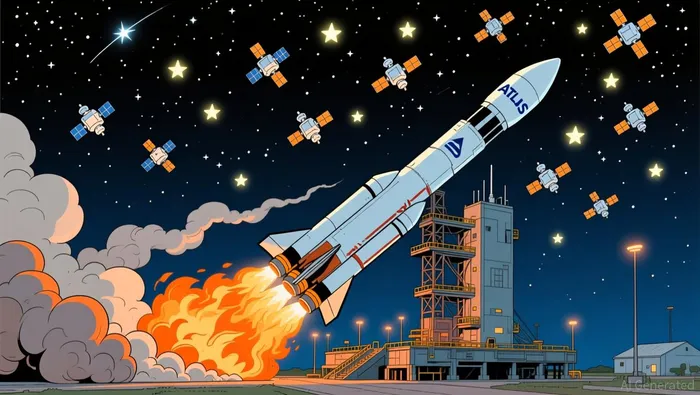
United Launch Alliance (ULA) successfully launched 29 Amazon broadband satellites into low-Earth orbit aboard an Atlas V rocket from Cape Canaveral Space Force Station on Monday, April 27, 2026. This critical mission, designated Leo 6, marks the second consecutive launch in a rapid deployment sequence designed to accelerate the expansion of Amazon's Project Kuiper constellation. The aggressive timeline underscores Amazon's commitment to establishing a robust global broadband infrastructure, aiming to deliver high-speed, low-latency internet to underserved and remote communities worldwide.
The Atlas V rocket lifted off at 8:53 p.m. equipped with five side-mounted solid rocket boosters to provide the necessary lifting power for the heavy payload. As the rocket rose to the northeast, it successfully deployed the satellites before jettisoning its payload fairing and boosters. The launch was widely visible across the Eastern United States, with observers reporting sightings from states including South Carolina, North Carolina, Virginia, Washington DC, New Jersey, and Massachusetts, confirming the pre-launch visibility predictions issued by ULA.
Notably, this specific deployment tied a payload-weight record for the Atlas V vehicle, demonstrating the rocket's continued capability to handle massive commercial payloads despite the intense competition in the launch industry. The success of the Amazon Leo 6 mission stands in sharp contrast to a concurrent scrub of a SpaceX Falcon Heavy mission from NASA’s Kennedy Space Center on the same day. The Falcon Heavy, which was scheduled to carry a Boeing-built Viasat broadband satellite, was scrubbed due to unspecified issues, with SpaceX rescheduling the attempt for April 29, 2026.
Did Amazon ULA Atlas V Launch 29 Satellites for Leo Constellation?
The Amazon Leo 6 mission represents the sixth launch for the Amazon Leo constellation executed by ULA, a joint venture between Lockheed Martin and Boeing. This deployment follows a similar 29-satellite mission conducted just 23 days prior, highlighting the company's accelerated strategy to build out its competitive broadband infrastructure against rivals like SpaceX's Starlink. The rapid succession of these launches is a direct response to the company's legal obligations to operate half of its planned 3,236-satellite constellation before mid-2026.
By accelerating the schedule for operating its high-speed internet service globally, Amazon is ensuring timely infrastructure completion and broadband coverage expansion. These intensive launch efforts are designed to meet strict regulatory requirements while simultaneously scaling the network to provide reliable connectivity. The successful deployment of these satellites is a critical step in enhancing the company's low Earth orbit network, ensuring that the Project Kuiper internet provider can meet the growing global demand for broadband services.
Why Is ULA Atlas V Tying Payload Weight Record for Amazon Mission?
The technical achievement of tying a payload weight record for the Atlas V highlights the rocket's enduring utility in the commercial space sector. Equipped with five side-mounted solid rocket boosters, the vehicle provided the necessary lifting power to place the 29 satellites into their intended orbits. This capability is particularly significant as the launch industry sees increasing competition from SpaceX's more frequent launch cadence and reusable rocket technology. Despite these challenges, ULA's successful mission underscores its role in supporting major internet infrastructure projects.
The mission's success ensures continued progress in Amazon's plan to provide global broadband connectivity, specifically targeting the Asia-Pacific region in future geosynchronous transfer orbit deployments. The ability to launch heavy payloads efficiently allows Amazon to deploy its constellation more rapidly, which is essential for achieving economies of scale and network density. This operational efficiency is crucial for the company's long-term strategy to compete effectively in the global telecommunications market, where latency and coverage are key differentiators.
What Are Amazon Leo Satellite Deployment Timeline and Market Implications?
The global Low Earth Orbit (LEO) satellite market is expected to reach approximately USD 58.8 billion by 2036, up from USD 17.8 billion in 2026, representing a compound annual growth rate (CAGR) of 12.7%. Key growth drivers include accelerating global demand for broadband connectivity and the rapid expansion of mega-constellations by major players like SpaceX, Amazon, and OneWeb. North America currently holds the largest market share due to massive investments in satellite constellations and the presence of leading aerospace companies, while the Asia-Pacific region is expected to witness the fastest growth.
In terms of application, the communication segment dominates due to mega-constellations for global broadband, while Earth observation sees rapid growth. Small satellites hold the largest market share in 2026, though CubeSats and nanosatellites are expected to grow at the fastest CAGR. Amazon's aggressive launch cadence is a direct response to these market dynamics, aiming to secure a significant share of the expanding broadband market. The successful deployment of these satellites positions Amazon to capitalize on the rising demand for high-speed internet in remote and underserved areas, driving revenue growth and market expansion for the company.
The competitive landscape is intensifying as both Amazon and SpaceX race to deploy thousands of satellites. Amazon's focus on a structured, record-setting launch sequence demonstrates a methodical approach to scaling its network. Meanwhile, SpaceX continues to leverage its high launch frequency to maintain its lead in the Starlink deployment. Investors are closely watching these developments as the LEO satellite market matures, with connectivity and coverage becoming the primary metrics for success. The mid-2026 regulatory deadline adds a layer of urgency to Amazon's deployment schedule, ensuring that the company remains at the forefront of the global broadband revolution.
As the constellation expands, the implications for global connectivity and telecommunications infrastructure will be profound. The ability to provide reliable, high-speed internet to remote regions opens up new markets and use cases, from telemedicine to remote education. This expansion not only drives revenue for Amazon but also contributes to the broader digital economy. The successful execution of these launches is a testament to the engineering and logistical capabilities of ULA and Amazon, setting the stage for the next phase of the space economy.