

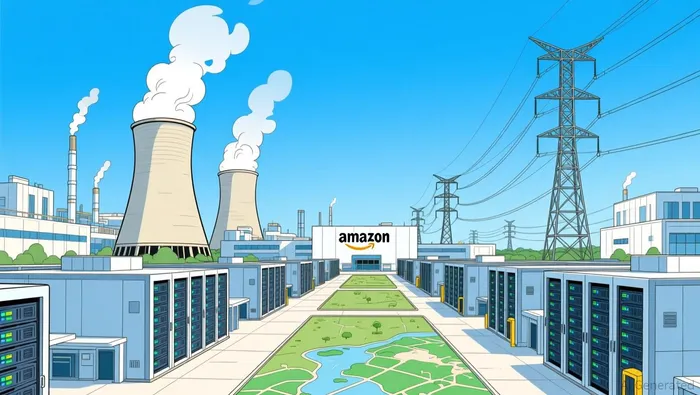
Amazon's decision to double down on Mississippi-from $10 billion to $25 billion in just two years-sends an unambiguous signal to the market: the race for data center capacity has accelerated beyond anything the industry anticipated. This isn't a incremental adjustment. It's a strategic escalation driven by a simple reality-hyperscalers are rushing to secure physical infrastructure ahead of surging AI inference demand that will define the latter half of this decade.
The numbers speak for themselves. Amazon Web Services is committing $25 billion across four Mississippi facilities, creating 2,000 high-skilled jobs and deploying 3.9 gigawatts of power capacity across Madison, Hinds, and Warren counties. But the Mississippi story is merely the most visible chapter in a much larger narrative. Globally, AWS has reaffirmed its intention to spend $200 billion on data center expansion in 2026 alone according to CEO Andy Jassy's shareholder letter, building on the 3.9GW it deployed in 2025. The company explicitly aims to double its data center footprint by the end of 2027.
What's striking is the velocity of commitment. The jump from $10 billion to $25 billion in a single state within 24 months reflects a fundamental shift in how hyperscalers approach capacity planning. Two years ago, Amazon's initial $10 billion announcement represented confidence. Today's $25 billion signals urgency. The company is not waiting for demand to materialize-it is building ahead of it, securing power, land, and grid connections in markets like Mississippi where infrastructure can be deployed at scale with eight confirmed data centers now in planning or construction.
This acceleration has a specific driver: AI inference. While training workloads dominate headlines, the real volume growth over the next three to five years will come from inference-the real-time processing that powers everything from chatbots to recommendation engines. Inference is less compute-intensive per operation but exponentially more frequent. It demands proximity to end users and massive distributed capacity. Amazon's Mississippi expansion, with its 1,700 acres in Madison County alone spread across two industrial parks, is designed precisely for this workload profile.
For investors evaluating data center REITs, the implication is clear: the structural shortage of colocation capacity is not a short-term imbalance. It is a multi-year secular trend with hyperscalers locked into multi-decade leases. The question is not whether demand will materialize-it is already being contracted. The question is whether current valuations adequately reflect the compounding opportunity created by this infrastructure gap. Amazon's $25 billion bet says the shortage is real. The market has until 2027 to position accordingly.
The Wide Moat: Why Data Center REITs Are Irreplaceable Infrastructure for Long-Term Compounding
Amazon's $25 billion commitment validates the demand thesis. But for the value investor, the more important question is whether any competitor could displace the players who already own this infrastructure. The answer, when examined through the lens of competitive moats, is a clear no.
Data center REITs like Equinix and Digital Realty possess structural advantages that grow stronger with scale-not weaker. Equinix operates more than 260 data centers across 33 countries, while Digital Realty runs over 300 facilities in 50 metro areas worldwide. These aren't just buildings with servers. They are densely interconnected ecosystems where over 500,000 active interconnections allow enterprises, cloud providers, and network carriers to link directly without leaving the facility.
This is where the moat deepens.
The co-location model generates stable, long-term lease revenue with multiple tenants per facility. But the real competitive advantage lies in the interconnection network itself. When a company houses its infrastructure in one of these facilities, it gains direct access to hundreds of other enterprises, cloud platforms, and networks. Switching costs become enormous over time-dismantling hundreds of direct relationships is not a decision any customer makes lightly. This creates a self-reinforcing ecosystem where customers become deeply embedded, exactly the kind of switching cost Buffett-style moat that protects cash flows for decades.
Neutrality amplifies this advantage. These REITs serve AWS, Azure, Google Cloud, Apple, Meta, Microsoft, Oracle, and enterprises simultaneously. They do not compete with their customers-they enable them. This position as neutral ground makes them indispensable to the entire ecosystem. As tech titans from Amazon to Oracle all use REIT-owned data centers, the REIT captures demand regardless of which cloud provider wins the market. The investor does not need to bet on a winner; the REIT profits from all of them.
For long-term compounding, the financial profile matters. The business demonstrates a 13% three-year dividend per share compound annual growth rate-ranking in the top 20% of all dividend stocks. Its beta of 1.03 means it tracks the broader market without dramatic amplification of volatility. Digital Realty brings its own strength: 20 years of consecutive revenue growth and an investment-grade credit rating that provides flexibility to compound further.
The AI boom adds a new layer of structural demand. While training workloads occur in massive hyperscale campuses, AI inference must happen close to end users-precisely where these data center REITs are positioned. The same facilities that serve enterprise multi-cloud architectures today are built for the inference economy tomorrow.
This is the width of the moat: scale, interconnection density, neutrality, and a business model designed for multi-decade leases. For the patient investor seeking to compound capital over long cycles, these are not speculative bets on which technology wins. They are ownership stakes in the physical infrastructure upon which the entire digital economy-and the AI revolution-depends. Amazon is building ahead of demand. The data center REITs already own the ground beneath that demand.
The Recommendation: Digital Realty Offers the Best Combination of Yield, Moat, and Valuation for Compounding
Having established both the structural demand thesis and the width of the competitive moat, the final question is straightforward: which data center REIT offers the superior intrinsic value opportunity for the long-term compounding investor? The answer is Digital Realty.
The case rests on three pillars: yield advantage, dividend safety, and valuation. On yield, Digital Realty's current payout of 2.69% dividend yield substantially exceeds Equinix's 1.92%-a meaningful difference that compounds significantly over time. To put this in context, the S&P 500 yields less than 2% overall, while the broader REIT sector offers yields of 5% or higher across the asset class. Digital Realty sits at the intersection: a yield that exceeds the market average while maintaining the growth profile of a hyperscaler-backed infrastructure play.
But yield alone is insufficient. The value investor must ask whether the dividend is safe and, preferably, growing. Digital Realty's 20-year streak of consecutive revenue growth provides the cash flow foundation necessary to sustain and increase distributions. When combined with its investment-grade credit rating, the trust possesses the financial flexibility to continue investing in high-demand markets while returning capital to shareholders-a rare combination in volatile markets.
This is where the moat translates directly into shareholder value. The same interconnection density and neutrality that make Digital Realty indispensable to hyperscalers also generate the stable, multi-decade lease revenue that protects dividend payments. Amazon, Microsoft, Oracle, and the full spectrum of cloud providers have no practical alternative but to lease space in these facilities because tech titans from Amazon to Oracle all use REIT-owned data centers. The revenue is contracted. The cash flows are predictable. The dividend is supported by real assets in high-demand locations.
For the patient investor, the implication is clear: treat price volatility as noise. The compounding occurs through dividend reinvestment over years, not days. Digital Realty's combination of above-market yield, dividend growth track record, and intrinsic value protected by a wide moat represents the optimal entry point for long-term capital deployment. Amazon is building ahead of demand. Digital Realty already owns the infrastructure that demand requires-and pays you to wait while it compounds.
Risks and Catalysts: What Could Break the Thesis and What to Watch
No investment thesis is without risk, and the value investor must name them plainly. For data center REITs, the primary vulnerability remains interest rate sensitivity. As with all real estate plays, higher borrowing costs compress valuations and can pressure funds from operations. This is not theoretical-interest rates and market oversupply present financial risks to the sector's profitability. Any sustained period of elevated rates creates headwinds that the broader market will punish, regardless of underlying business strength.
Yet here lies the critical distinction: the structural demand shortage from AI and cloud expansion provides a powerful counterbalancing force. Unlike generic real estate, data center REITs serve a market where supply cannot keep pace with demand-not this year, not next, and likely not through the end of the decade. Amazon's own timeline confirms this. The company's $25 billion Mississippi commitment, with construction already underway across multiple sites in Madison, Hinds, and Warren counties, represents just one piece of a much larger hyperscaler spending surge. The capacity shortage is not speculative; it is being contracted today.
So what should the long-term investor watch? Three things.
First, monitor for oversupply in specific markets. While the aggregate picture shows a structural deficit, localized gluts can emerge-particularly in markets where multiple developers have broken ground simultaneously. The key is whether hyperscaler demand continues to absorb new inventory as it comes online.
Second, track the pace of hyperscaler capital expenditure. Amazon's announcements through 2027 suggest demand ahead of supply for at least the next two years. But the thesis strengthens if other hyperscalers-Microsoft, Google, Meta-continue to announce comparable capacity commitments. Each new announcement validates the shortage narrative and reinforces the pricing power of existing infrastructure owners.
Third, watch for dividend growth signals. Digital Realty's investment-grade credit rating and 20-year revenue growth streak provide the foundation for sustained distributions. But actual dividend increases-like the recent raises from TE Connectivity and other data center beneficiaries tied to accelerating AI demand-confirm that cash flows are not just stable but expanding.
The Buffett/Munger approach to risk is not avoidance-it is understanding what could go wrong and monitoring those variables deliberately. For this position, the risks are manageable and partially offset by structural tailwinds. The catalysts to watch are concrete and measurable. Amazon's 2026 capex deployment rate will either validate or undermine the capacity shortage thesis. Additional hyperscaler announcements will either reinforce the demand picture or reveal cracks. Dividend growth or stagnation will confirm or challenge the cash flow story.
The patient investor does not need to predict these outcomes. She needs only to monitor them while holding the position through volatility. The compounding occurs through years of dividend reinvestment, not daily price movements. As long as the structural demand thesis holds-and Amazon's $25 billion bet says it does-the risks remain contained. The wider concern is not that the thesis will break, but that the investor will abandon it during the inevitable periods of market noise.