

Amazon's $11.57 billion acquisition of Globalstar is a capital-intensive bet to vertically integrate its satellite infrastructure, directly enabling and scaling Apple's existing satellite service growth. This move transforms Amazon Leo from a nascent LEO network into a full-featured, multi-service platform by securing the critical physical assets and spectrum needed for Direct-to-Device (D2D) connectivity.
The strategic context is set by Apple's prior commitment. The tech giant has already invested about $1.5 billion in Globalstar, a deal that includes a $1.1 billion prepayment for expanded satellite services and a 20% equity stake. That investment was specifically to fund a new constellation and secure capacity for Apple's services, which currently consume about 85% of Globalstar's network capacity. Apple's exclusive network deal with Globalstar has been the backbone of its iPhone satellite texting and emergency SOS features since 2022.
Amazon's acquisition now provides the infrastructure to scale this model. By integrating Globalstar's satellites, radio frequency spectrum, and operational expertise, Amazon Leo gains the immediate capability to add D2D services to its future LEO network.
This is not just about building new satellites; it's about leveraging an existing, proven system to rapidly deploy a service that Apple has already proven in the market. The new Amazon Leo D2D system is explicitly designed to help mobile network operators extend coverage where terrestrial networks fail, a direct complement to Apple's vision for keeping users connected anywhere.
For Amazon, this is a calculated vertical integration. It secures the essential hardware and spectrum for its Leo D2D ambitions while simultaneously locking in a major customer-Apple. The $11.57 billion price tag is a bet that Amazon can now scale this service far beyond Apple's current footprint, capturing a larger share of the growing D2D market and accelerating the growth of its own satellite business.
Market Opportunity and Scalability: Capturing the High-Growth TAM
The strategic bet hinges on a market that is itself on a steep growth curve. The global satellite data services market was valued at $12.1 billion in 2024 and is projected to nearly double to $29.6 billion by 2030, expanding at a robust 16.3% compound annual rate. This represents a massive, high-growth Total Addressable Market (TAM) for connectivity services, driven by demand from commercial, defense, and environmental sectors. For Amazon and Apple, the opportunity is to capture a significant slice of this expanding pie, particularly in the Direct-to-Device (D2D) segment where they are now aligned.
Scalability is the core investment thesis. Amazon's acquisition of Globalstar provides a near-term platform to scale D2D services, but the model's ultimate reach depends on the underlying infrastructure. Here, the competitive landscape is defined by scale. SpaceX's Starlink, the current market leader, operates a constellation of about 10,000 satellites and is anticipated to generate more than $9 billion in revenue this year. Its sheer size and customer base create a formidable barrier. Amazon, with its Amazon Leo network, is still building and has asked for an extension on its FCC deadline to deploy its initial 1,600 satellites. In this context, Globalstar's existing network of 31 satellites and its role as the exclusive provider for Apple's services offer a different kind of scalability: rapid deployment of a proven, narrowband service.
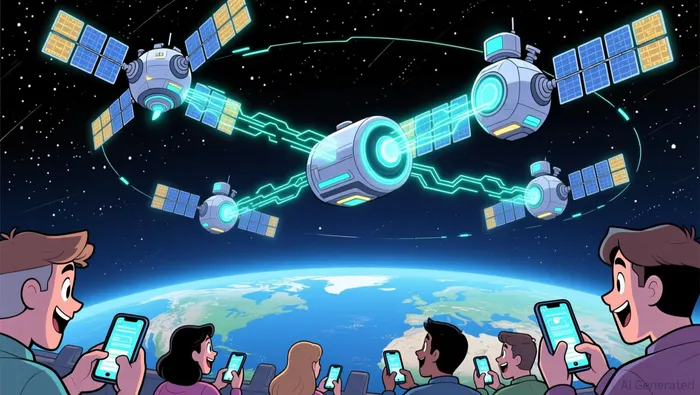
The key differentiator is Apple's exclusive capacity deal. Globalstar has committed to allocating about 85% of its network capacity to Apple for the foreseeable future. This is a critical lock-in that gives Apple a guaranteed, high-quality service tier for its emergency and messaging features. For Amazon, this means the Globalstar network is not just a competitor's asset but a strategic partner's infrastructure. By acquiring it, Amazon secures the physical assets needed to scale its own D2D ambitions while simultaneously fulfilling a major customer commitment. The scalability of the Amazon-Apple partnership lies in this vertical integration: Amazon can now leverage its customer-obsession and innovation to scale the service beyond Apple's current footprint, potentially offering the same capabilities to other mobile network operators and expanding the total user base.
The bottom line is that the TAM is large and growing fast, but capturing it requires both technological leadership and strategic positioning. Amazon's move is a bet that it can use Globalstar's existing assets to accelerate its entry into the D2D market, competing on the basis of integration and partnership rather than just constellation size. The path to dominance will be measured by how quickly it can scale beyond Apple's exclusive deal and compete with giants like Starlink on price, coverage, and reliability.
Financial Impact and Execution Risks
The strategic vision for Amazon's satellite ambitions is clear, but the path to execution is paved with immense capital requirements. The company's $11.57 billion acquisition of Globalstar represents a significant outlay for a business still in its early stages. While the market value of Globalstar was about $9.4 billion at the time of the deal, the final price tag underscores the premium Amazon is paying to secure critical infrastructure and spectrum. This is a major capital commitment for a fledgling operation like Amazon Leo, which is still building its own constellation and has asked for an extension on its FCC deployment deadline.
The high cost of securing satellite capacity is not new. Apple's prior investment of about $1.5 billion in Globalstar provides a stark example. That deal required a $1.1 billion prepayment for expanded services and a 20% equity stake, locking in capacity for its own services. For Amazon, acquiring the company that provided that capacity means inheriting both the asset and the financial obligations of that partnership. This vertical integration is expensive, and the return on that investment will depend on Amazon's ability to scale the service beyond Apple's exclusive footprint.
The primary risk here is the extreme capital intensity and long payback period inherent in building and operating a competitive satellite constellation. Amazon is entering a market dominated by a giant like SpaceX's Starlink, which operates a constellation of about 10,000 satellites and is anticipated to generate more than $9 billion in revenue this year. Competing on scale requires deploying thousands of satellites, a process that demands years of sustained investment before achieving meaningful revenue. The Globalstar acquisition provides a near-term platform for Direct-to-Device services, but the long-term financial model for Amazon Leo will hinge on its ability to deploy its own large-scale LEO network efficiently and capture a significant share of the growing market.
In practice, this means Amazon must manage a dual financial burden: funding the integration and scaling of Globalstar's existing narrowband services while simultaneously financing the multi-year build-out of its own broadband Leo constellation. The execution risk is high, as any misstep in cost control, launch cadence, or customer acquisition could stretch the capital outlay far beyond initial projections. For a growth investor, the bet is on Amazon's unparalleled financial resources and operational scale to eventually turn this massive capital investment into a dominant, profitable business. The timeline, however, is measured in years, not quarters.
Catalysts and Growth Trajectory
The growth thesis for Amazon's satellite ambitions now hinges on a clear sequence of near-term milestones. The first major catalyst is the timeline for Amazon Leo's D2D service launch, beginning in 2028. This is not a distant promise but a concrete target that will validate Amazon's ability to integrate Globalstar's assets and deliver on its partnership with Apple. The service must be operational and scalable by that date to capture the projected market expansion.
A key performance indicator to watch is the integration of this service with Apple's iPhone ecosystem. The agreement for Amazon Leo to power satellite services for supported iPhone and Apple Watch models is the initial customer and proof point. Success here will be measured by user adoption of features like Emergency SOS via satellite and the expansion of messaging capabilities. Any delays or technical hiccups in this integration would directly challenge the scalability narrative.
Parallel to the D2D launch, the execution of Globalstar's own constellation refresh is critical. The company has 17 satellites on order with MDA Space, with the first launch set for next year. These new satellites are essential for maintaining and expanding the capacity that supports Apple's exclusive 85% allocation. Monitoring the on-time deployment of these 17 satellites will provide a real-time gauge of Amazon's operational capability post-acquisition.
Equally important is the expansion of ground infrastructure funded by Apple. The $1.5 billion Apple committed to Globalstar explicitly includes funds to expand its ground infrastructure. This network of ground stations is the vital link between satellites and end-users. Progress here will determine the reliability and capacity of the entire system, especially as demand from Apple's user base grows.
Finally, the broader trajectory depends on Amazon's reported progress on its low-Earth orbit network, Amazon Leo. While the Globalstar acquisition provides a near-term platform, the long-term growth story requires Amazon to deploy its own large-scale constellation. Any updates on its FCC deadline extension, launch cadence for its initial 1,600 satellites, or overall build-out plan will be a key indicator of Amazon's commitment and capability to compete with giants like SpaceX's Starlink. The path from a $11.57 billion acquisition to a dominant satellite business is paved with these specific, trackable milestones.