

HSBC downgraded AMD to Hold. Northland Capital followed with a Market Perform cut. Meanwhile, Intel sits at roughly $120 a share - still losing money, still burning through its foundry bet. The market is treating these two names as the same conversation: which AI chip stock has more downside? That framing is backwards. AMD and Intel are on opposite sides of the AI infrastructure transition right now - and they require opposite trade theses.
The numbers tell two different stories
Let me lead with what actually happened in the last earnings window, because the contrast is starker than the downgrade chatter suggests.
AMD reported Q1 2026 revenue of $10.3 billion - up 38% year-over-year, beating the $9.9 billion consensus estimate. Data Center revenue hit $5.8 billion, up 57%, driven by EPYC CPUs and the continued ramp of its Instinct MI300 and MI350 AI GPU series. Non-GAAP EPS came in at $1.37 versus $1.29 expected. The stock soared 16% the next day. Then over the following weeks, AMD rallied roughly 63% in a month - and that's when the analysts started blinking.
HSBC called the 136x P/E stretched. Northland flagged the same thing with a $260 target. These aren't arguments about AMD's architecture or its competitive position. They're arguments about timing - and about whether a stock that has already delivered 63% in 30 weeks still has the best risk/reward left on the table.
Now look at Intel. Q1 2026 GAAP EPS: a loss of $0.73 per share. Net loss widened to $4.28 billion. The Foundry division - Intel's moonshot to become TSMC's competitor - lost $2.4 billion in operating profit for the quarter, even though management is pointing to sequential improvement of $72 million. Intel's AI accelerator story? Gaudi 3's 2025 shipment target was cut from 300,000–350,000 units down to 200,000–250,000. The next-gen Falcon Shores accelerator keeps sliding down the roadmap. Management promised an "annual predictable cadence" at CES 2026, but that's management language, not delivered silicon.
Put plainly: AMD's problem is that it's winning faster than the valuation can comfortably absorb. Intel's problem is that it hasn't proven it can compete in the AI accelerator market at all.
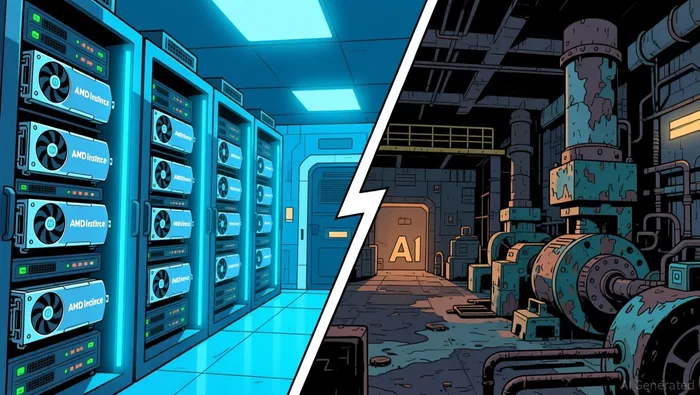
Where this splits: training versus inference, architecture versus balance sheet
The AI compute cycle is still in its early innings, and the transition from training-dominated demand to inference-dominated demand is the structural shift I watch most closely. Here's where AMD and Intel land.
AMD sits in the second tier of training hardware but is pushing hard into inference economics.The MI350 series claims up to 2.8x faster AI training in MLPerf benchmarks. AMD has been making the argument that its AI servers deliver better inference performance per total cost of ownership than Nvidia's platforms - and that matters because inference is where the TAM expansion is accelerating. AMD's ROCm software stack still trails CUDA in developer adoption, but it's no longer a show-stopper for enterprises that prioritize cost efficiency over ecosystem convenience. AMD gets foundry capacity from TSMC - a clean supply chain with no node-gap risk.
Intel has an AI accelerator product that nobody is asking for at scale.Gaudi 3 is available through Dell, HPE, Lenovo, and IBM Cloud - but availability through partners isn't the same as demand. Cutting the shipment target by roughly 35% is the kind of signal that tells me the market is voting with its wallet, not its press releases. Intel's bigger issue is structural: the company is simultaneously running a $2.4 billion-per-quarter foundry operation that is years away from profitability while trying to develop AI accelerators on its own process nodes. That's capital allocation whiplash - and in the AI hardware game, you can't afford to be fighting on two fronts.
The architecture comparison is the wrong way to compare these two. AMD is an AI competitor trying to take share from Nvidia. Intel is a legacy CPU company trying to survive the AI transition while its foundry burns cash. They require completely different investment frames.
Valuation - and why it's not the full story
AMD trades at roughly 75x trailing earnings as of late May 2026, on a market cap of approximately $762 billion. That looks expensive by any traditional measure. But AMD expects profit to triple by 2030, and the AI chip market is projected to exceed $500 billion by 2028. For a company growing data center revenue at 57% with sequential acceleration, the P/E is a trailing mirror - it reflects last quarter's earnings, not the trajectory.
What I actually watch here is the opportunity cost question: the stock has already run 63% in a month. Much of the next 12 months of growth is likely priced into that multiple. I believe AMD's long-term thesis is intact - the MI350/MI450 roadmap is credible, the inference economics argument is real, and the TSMC supply chain is clean. But the return curve is probably back-half weighted. A large allocation right here, after that rally, is where the risk lives.
Intel, at roughly $120 per share with a $600 billion market cap, trades at a negative P/E because it's still losing money on a GAAP basis. Some analysts project a turnaround by 2028, with forward P/E estimates around 22x. The stock rose 24% after Q1 earnings on foundry sequential improvement. The debate is not whether Intel is cheap - it is whether $2.4 billion in quarterly foundry losses, compounding, are worth the speculative payoff of a future TSMC rival.
In my opinion, Intel's valuation is a trap. It's cheap because it's broken - not cheap because the market is misreading a hidden winner. The foundry bet requires sustained billions in investment with no near-term path to positive returns. In an AI infrastructure cycle where capital efficiency matters more than ever, that's a structural disadvantage.
What I'm watching
The signals that would change my thesis on each:
AMD - what would break the bull case: MI350 fails to show the inference cost advantages in real-world deployments, or ROCm's developer adoption stalls while CUDA extends its lead through software monetization. Either of those would mean the architecture gap doesn't narrow when it matters most. On the capital allocation side: if AMD's supply commitments surge without commensurate demand - that leverage risk becomes a warning.
Intel - what would make the turnaround credible: Foundry losses start a sustained downward trajectory (not just $72 million sequential improvements), Gaudi 4 ships on the 2H 2026 roadmap with actual customer pull, and management commits to exiting or drastically reducing the foundry burn rather than defending a losing strategic bet. Until I see those three signals, Intel is a speculation, not an investment.
The allocation question
The market keeps asking "AMD or Intel" as if they're in the same category. They're not.
AMD is an execution risk with a valuation timing problem. The company is on the right side of the AI infrastructure transition - second in the GPU market, pushing into inference economics, with a clean TSMC supply chain and accelerating revenue. But after a 63% one-month rally, the capital I'd deploy here would be a smaller position, sized for the idea that the thesis needs more time to catch up to the stock price.
Intel is a structural risk with a turnaround story that hasn't started yet. The company is losing $2.4 billion per quarter on its foundry bet, cutting its own AI accelerator shipment targets, and sliding its next-gen roadmap. The stock is cheap for reasons that are still playing out. That's not the same as undervalued - it's the same as "unproven."
The debate is not about whether one of these has more downside. The debate is about which thesis actually deserves your capital. Right now, AMD's risks are timing and valuation digestion. Intel's risks are fundamental - and they haven't shown signs of resolution. That's the distinction that matters.
I'd rather sit in a trimmed AMD position that's already winning and wait for a better entry, than speculate on Intel's foundry turnaround while the AI infrastructure cycle is still accelerating past it.