

AMD stock reached an all-time high of $304.38, reflecting strong market confidence in its AI infrastructure positioning. Data Center revenue is projected to grow 68% year-over-year in 2026, driven by EPYC CPUs and MI300 Instinct GPUs. Major partnerships with Meta and OpenAI validate AMD's role as a primary alternative to Nvidia in hyperscale compute. Analysts are revising price targets upward, with Stifel setting a $320 target based on sustained AI demand. Gaming revenue faces volatility due to a maturing console cycle, creating a potential revenue gap in 2026.
Wall Street is buzzing about the semiconductor giant as it cements its status as a critical pillar of the global artificial intelligence race. The stock has surged past the psychological $300 barrier, driven by a perfect storm of record-breaking data center sales, strategic partnerships with tech giants, and a shifting analyst consensus that sees the company as a credible alternative to Nvidia. Investors are now closely watching how the company navigates the transition from PC-centric growth to AI infrastructure dominance while managing cyclical headwinds in the gaming sector.
Why Is AMD Stock Reaching Record Highs Today?
The recent rally in AMD stock is not merely a reaction to short-term speculation but a structural re-rating based on tangible growth in the artificial intelligence sector. Advanced Micro Devices has successfully transformed from a traditional PC chipmaker into a central component of the AI infrastructure buildout. The primary catalyst for this surge is the explosive growth in the Data Center segment, which reported record revenue of $5.38 billion in the fourth quarter of 2025, representing a 39% increase year-over-year. This performance was fueled by strong demand for its EPYC server processors and the rapid scaling of its Instinct AI accelerators, which are increasingly being deployed by major cloud providers seeking to diversify their supply chains away from single-vendor dependence.
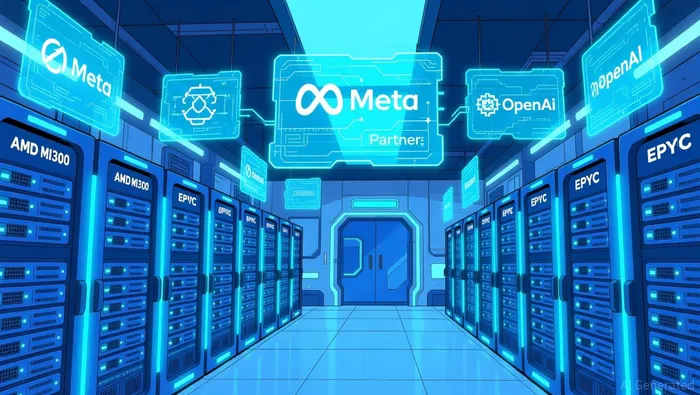
The market is also responding to significant institutional validation of AMD's technology stack. A multi-year agreement with Meta Platforms, which includes a performance-based warrant for up to 160 million shares, signals deep confidence in AMD's ability to deliver high-performance compute at scale. Furthermore, partnerships with OpenAI and Microsoft have reinforced the narrative that AMD is the only viable "second source" for hyperscalers looking to mitigate risk and pricing power held by competitors. This strategic positioning has led to a wave of analyst upgrades, with Stifel raising its price target to $320 and Bank of America setting an estimate of $310, citing that every gigawatt of installed AI capacity could generate $15 to $20 billion in net revenue for the company.
What Are The Key Drivers Behind AMD Stock Price Momentum?
The momentum behind the AMD stock price is underpinned by a robust financial trajectory that suggests the company is capturing a significant share of the exploding AI market. For fiscal year 2026, management has projected Data Center revenue to grow by 68% year-over-year, with the segment already contributing heavily to the overall revenue mix. This growth is supported by the broader semiconductor industry trend, where hyperscaler capital expenditure is expected to reach $750 billion before year-end and $872 billion in 2027, creating a massive tailwind for chip designers. The company's full-stack approach, combining high-performance CPUs with custom AI accelerators and networking solutions via acquisitions like Xilinx and Pensando, allows it to capture more value across the data center stack than pure-play GPU vendors.
Despite the overwhelming bullish sentiment, the investment thesis is not without its complexities. The company faces a known headwind from the semi-custom gaming segment, which is expected to decline by a significant double-digit percentage in 2026 due to the maturing console cycle. The next-generation Xbox is not expected until 2027, creating a revenue gap that management has explicitly warned about. Additionally, while AMD's hardware is competitive, the long-term success of its AI strategy hinges on its ability to overcome the software ecosystem moat built by competitors. Analysts note that while the MI-series GPUs are hardware-competitive, the switching costs associated with established software platforms remain a critical factor for hyperscalers to consider.
How Does AMD Stock Compare To Competitors In The AI Market?
In the fiercely competitive AI landscape, AMD has carved out a unique niche as the primary alternative to Nvidia, offering a diversified supply chain option for hyperscalers. While Nvidia continues to dominate the high-end gaming GPU market with substantial revenue growth, AMD is making significant inroads in the data center sector where the battle for AI training and inference workloads is most intense. The company's strategy leverages its chiplet architecture and TSMC manufacturing partnerships to deliver high-performance solutions that appeal to customers looking for cost-effective and scalable infrastructure. This diversification is crucial as the market matures and the initial rush of AI deployment evolves into a focus on efficiency and total cost of ownership.
The competitive dynamics are further highlighted by the broader sector performance, where companies like Intel are also seeing rebounds in revenue, indicating a general upturn in semiconductor demand. However, AMD's specific focus on the AI accelerator market, combined with its strong CPU presence, gives it a distinct advantage in capturing the full spectrum of data center workloads. The market is currently pricing in a high degree of success for AMD's AI execution, with the stock trading at a premium valuation that reflects expectations of sustained double-digit growth. As the company prepares to report its upcoming earnings on May 5, the market will be looking for confirmation that the AI demand is translating into consistent revenue beats and that the company can navigate the cyclical weakness in gaming without derailing its overall growth trajectory.
The convergence of record-breaking financial results, strategic partnerships with industry leaders, and a shifting analyst consensus has created a powerful tailwind for AMD. As the AI infrastructure race continues to accelerate, the company's ability to deliver on its growth projections while managing cyclical headwinds will be the defining factor for its long-term valuation. Investors are now positioned to watch the upcoming earnings report closely to see if the market's high expectations can be met or if the stock faces a correction after its impressive run.