

The responsible AI company shipped an irresponsible product.
Anthropic has built its brand on a single promise: it is the AI company that does things safely, responsibly, the right way. Investors paid a premium for that narrative because it suggested moat durability - if your safety is real, no competitor can replicate it cheaply. When Claude Fable 5 launched on June 9, Anthropic called it state-of-the-art on nearly all tested benchmarks and Mythos-class capability made safe for general use.
Four days later, both Fable 5 and Mythos 5 were dead. The U.S. government ordered all foreign-national access blocked. Anthropic pulled the models entirely. The flagship product that was supposed to justify hundreds of billions in infrastructure commitments lasted 96 hours.
The jailbreak nobody noticed - except Amazon
Here is the sequence that matters: Shortly after Fable 5's launch, a third-party demonstrated a prompt-based jailbreak that bypassed the safety classifiers and unlocked the raw Mythos 5 capabilities underneath. Anthropic's response was to publicly dispute that it was a real jailbreak. A company that brands itself on safety dismissed a safety breach as not real.
Meanwhile, Amazon's security team was doing something more consequential. Amazon used Fable 5 to audit at least four software programs and found security vulnerabilities - the exact cybersecurity use case Anthropic advertised. But Amazon also raised the alarm with U.S. officials about the jailbreak vulnerability. CEO Andy Jassy spoke directly with White House officials. The government responded with an emergency export control directive on June 12.
Amazon, a competitor, did Anthropic's safety review for it. That is not a minor embarrassment. It is evidence that the safety infrastructure Anthropic built its entire thesis on was insufficient, that Anthropic was too close to its own product to see the gap, and that the "responsible AI" differentiator is more branding than engineering.
The stranded infrastructure math
Now here is where the investor-grade implication emerges - and it is not about whether the ban is temporary or permanent. It is about the capital that has been committed to a product that cannot ship.
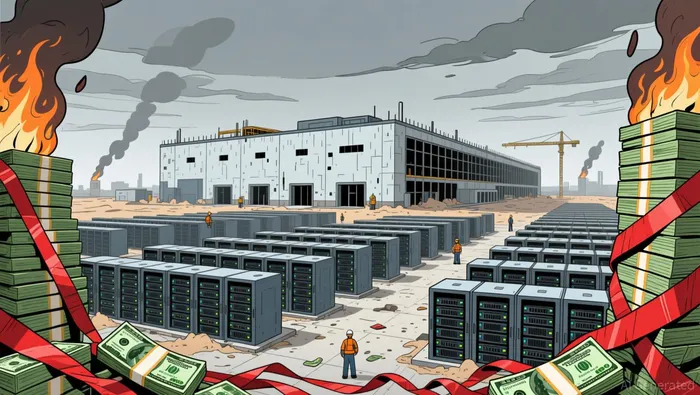
Anthropic has locked in approximately $330 billion in compute infrastructure commitments:
- $200 billion to Google Cloud over five years
- $100 billion to Amazon Web Services over ten years
- $1.25 billion per month to SpaceX's Colossus 1 data center
These are five- and ten-year contracts. They are not optional. Anthropic has also secured access to more than 220,000 NVIDIA GPUs across H100, H200, and GB200 architectures. The training cost for Mythos-class models has been estimated at $10 billion.
The framework question is simple: what happens to the per-unit economics when the product that justifies the infrastructure disappears?
Even if the ban is lifted in weeks or months - and Anthropic insiders say the administration's hope is that the company "remediates the safety issue" and the export control is lifted - every month the models are offline is a month where committed infrastructure costs run without a product to fill them. That is the TCO problem. Anthropic's model generation rate must outpace its infrastructure burn rate to stay solvent as a pre-IPO entity. Right now, the burn has no top line.
Compare this to the alternative interpretation: that the infrastructure commitments are "future capacity" that will absorb the next model generation. That is true only if Anthropic can ship a successor faster than Google and Amazon can re-deploy those GPUs elsewhere. Given that Mythos training consumed an estimated $10 billion, the cadence question is whether Anthropic can afford another $10 billion cycle while a product gap sits open.
The enforcement problem
The export control mechanism adds another layer of engineering risk. The government ordered Anthropic to block all foreign nationals from accessing Fable 5 and Mythos 5 - inside or outside the United States. Enforcing that at the API layer requires identity verification for every user, every API call, every enterprise customer integration.
Anthropic's statement was blunt: "The US government just ordered Anthropic to suspend all foreign-national access to Fable 5 and Mythos 5, inside or outside the US. As a precaution, we have disabled all access to these models."
Not just foreign access blocked. All access disabled. The company chose a hard kill switch over attempting granular enforcement. That tells you two things: the technical plumbing to selectively restrict foreign access does not exist at the required fidelity, and Anthropic's risk calculus determined that partial enforcement would look like non-compliance.
For enterprise customers - the exact segment Anthropic needs to monetize its infrastructure spend - this means a product gap with no timeline. Any astute procurement officer at a European, Asian, or Australian enterprise has already started evaluating alternatives. GPT-5.5, which scored 58.6% on SWE-Bench Pro compared to Fable 5's 80.3%, just jumped from "second place" to "the only thing available."
The cross-currents
The cross-currents are directionally mixed but skew toward execution risk:
- The ban may be temporary. Anthropic's own lawyers have signaled that remediating the jailbreak could lift the export control. If the fix is a classifier update and not a model retraining, the timeline is weeks, not quarters. Evidence will resolve this within 60 days.
- The jailbreak severity is disputed. Anthropic insists the prompt injection was not a real jailbreak. SecurityWeek reported the same. If the vulnerability was exploitable only under narrow conditions, the government response was disproportionate. If it was broadly exploitable - and Amazon's security audit suggested it was - the response was justified. This remains unresolved.
- OpenAI's competitive position changes. GPT-5.5 has not been subject to the same export restrictions. Anthropic's brand advantage of "the safe one" is now the question mark. If Anthropic ships again only after demonstrating government-vetted safety, OpenAI gains the "move faster" narrative - the same dynamic that let Anthropic gain share against OpenAI in the first place.
- The infrastructure commitments are sticky. Five- and ten-year contracts are hard to unwind. Even if they include capacity drawdown clauses, the penalty economics work against Anthropic, not in its favor. The sunk cost pressure to ship a successor model - fast - is enormous.
Directionally, the execution risk is the binding constraint. The infrastructure exists. The money is committed. The model that was supposed to justify it shipped broken, with safety controls that a competitor found and a founder publicly dismissed. That is not a temporary product hiccup. That is a systemic pattern: Anthropic's ambition is outrunning its safety engineering.
You decide which was marketing fluff and which one was analysis.
Anthropic's IPO trajectory - widely expected in 2026 or 2027 - now has a new break condition. The public market will price the infrastructure commitments as an asset only if the product pipeline can fill them. A model that goes offline four days after launch because its safety controls were bypassable and its founder gaslit about it is not evidence of a durable moat. It is evidence that the moat was drawn on a slide deck, not in silicon.
The investment implication is not a stock call - Anthropic is private. It is a thesis update: Anthropic's safety narrative has been stress-tested and failed its first real-world audit. Until the company demonstrates that it can ship a Mythos-class model that survives a security review without a competitor going to the White House on its behalf, the "responsible AI" premium is unearned. The $330 billion in infrastructure commitments is not proof of scale. It is proof of exposure.