

Why APA's Alaska Deal Looks Like Optionality, Not an All-In Bet
APA's Alaska move looks more like measured optionality than a grand all-in wager. The company is paying about $70 million in upfront consideration, plus additional contingent payments tied to future development, as it works toward closing. For that cash, investors are getting a closer look at a larger eastern North Slope opportunity.
APA says the acquired infrastructure should support 2026-2027 exploration and appraisal activities and improve future development flexibility. That makes this less about buying a story and more about buying time, access, and a clearer path to test what lies underground.
What investors can evaluate right away
This is not just acreage speculation. APA is acquiring tangible infrastructure and a live operation:
- Badami facilities with nameplate production capacity of approximately 40,000 barrels of oil per day
- the Nutaaq Pipeline providing access to the Trans-Alaska Pipeline System
- about 1,500 barrels of oil per day of production
That matters because, if reservoir performance improves, APA will not need to build the entire production backbone from scratch.
The main bull and bear arguments
The bullish case is straightforward: if the wells show volume and the existing infrastructure holds up, APA may have secured a development pathway at a reasonable price.
The bearish case is simpler: this is still high-risk Alaska exploration, and the seller's history keeps the risk premium visible. Even so, the acquired assets are operational rather than purely theoretical, which gives investors something more concrete to judge than a map.
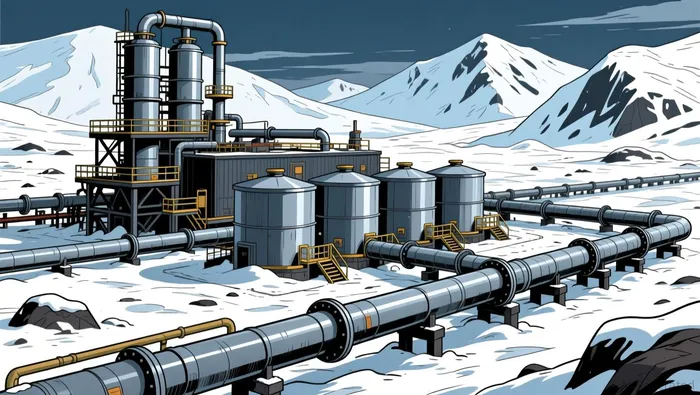
Badami Infrastructure Changes the Development Math
The core question is practical: does this deal give APA better tools for the next phase, or just more paper backing for barrels that may never appear?
On the face of it, the answer leans toward utility. APA is not just buying acreage; it is taking control of Badami facilities with 40,000 bbl/d nameplate capacity, the Nutaaq Pipeline, and a small but existing production base. That is real equipment, real flow paths, and a working field operation.
Why ownership of the hardware matters
This is where the deal stops being just an acreage grab. In Alaska, future well economics often depend as much on separation, transport, and injection assets as on what sits underground. If new wells can tie into existing infrastructure, APA may be able to develop additional volumes more efficiently than if it had to build greenfield facilities.
APA's own description says the transaction should enhance development flexibility, accelerate project timelines, and lower future development costs. It also adds approximately 104,000 gross acres directly connected to that infrastructure. That makes the real question less about one isolated well and more about whether a larger patch of ground can be developed more cheaply because key exit infrastructure already exists.
Why this is still an option, not a near-term earnings story
It is still important to keep expectations in check. Current output is only about 1,500 bbl/d, which is a starting point rather than a game-changing cash engine. And the larger capacity figures describe potential, not proof of what the reservoir can sustainably deliver.
That is why the upcoming drilling program matters so much. APA says the acquired infrastructure is expected to support 2026-2027 exploration and appraisal activities. Those results should do more than confirm presence; they should help define whether the resource base is large or productive enough to justify a broader development plan.
What to watch next
The bullish case strengthens if:
- closing proceeds on schedule
- the facilities prove usable for a real drilling campaign
- the next wells show meaningful upside
If those conditions do not materialize, the deal is more likely to look like an expensive side project than a catalyst for a valuation rerating.
APA's Dividend Gives Investors Time to Wait for Proof
What the market may be underestimating is that investors do not have to fund this Alaska bet entirely on hope. APA has a 25-cent quarterly dividend payable in August. That does not guarantee success, but it does mean the company is not asking investors to finance the story without any current cash return.
The valuation opportunity, if there is one, will depend less on adding more acreage to the map and more on changing how Alaska is perceived. If closing happens, the infrastructure proves useful, and the drilling program delivers meaningful results, investors may start to view Alaska as a step-by-step de-risking process rather than a one-off gamble.
What would break the thesis
The setup weakens materially if:
- closing slips significantly
- the facilities prove too limited or too costly to support a meaningful campaign
- the next wells fail to show meaningful upside
In that scenario, APA would remain a dividend-paying oil company with an Alaska option, not a company heading for a near-term rerating.