

The IEEPA refund battle is about yesterday's tariffs. The structural split is being written today.
The Trump administration announced on May 30 that it will appeal a Court of International Trade order requiring nationwide refunds of tariffs imposed under the International Emergency Economic Powers Act (IEEPA). The government's argument is procedural: it contends refunds should be limited to importers who file individual lawsuits, rather than flowing automatically to all eligible parties. The appeal will land at the Court of Appeals for the Federal Circuit and could take months to resolve.
That is the headline. It is not the driver. The driver is what happens when you look past the IEEPA refund dispute and map the tariff regime that remains in force - and the one that was just created. The IEEPA tariffs are the only ones being refunded. Section 301 tariffs on Chinese goods, including semiconductors, were never touched. And a new 25 percent Section 232 tariff on advanced computing chips took effect on January 14. The tariff landscape has not been simplified. It has bifurcated.
The two tariff tracks
The Supreme Court ruled on February 20 that IEEPA does not authorize tariffs. The Court of International Trade followed by ordering refunds on March 4. Phase 1 of the refund process launched April 20 and processes claims within 60 to 90 days. The government's appeal challenges the scope - whether refunds are automatic for all importers or limited to those who litigated. That is a dispute about backward-looking cash flows.
The forward-looking regime is a different structure entirely. Section 301 tariffs on Chinese semiconductor imports were doubled to 50 percent effective January 2025. These tariffs are unaffected by the IEEPA ruling and remain in force. They apply to the full range of semiconductor imports from China. Separately, the January 14 Section 232 proclamation imposes a 25 percent tariff on a narrowly defined set of advanced computing chips and derivative products. Products subject to the Section 232 semiconductor tariff are excluded from reciprocal tariffs, which prevents double-stacking but does not eliminate the charge.
This creates a three-track system: refunded IEEPA duties on past imports, standing Section 301 duties on current Chinese imports, and new Section 232 duties on advanced chips regardless of origin. The market is treating the IEEPA appeal as the story. It is not. The three-track system is the story.
The business model split
The structural implication follows directly from how these tariffs map to business models. Semiconductor companies fall into two categories under this regime. The distinction is not about market capital or product mix. It is about where wafers are physically fabricated.
Companies that manufacture in the United States - Intel at its Ohio and Arizona facilities, TSMC at its Arizona fab once operational, Samsung at its Texas campus - are shielded from import tariffs. They absorb the capex burden of domestic construction and receive the policy payoff of tariff immunity. TSMC, as a Taiwanese firm actively building a U.S. fab, received explicit exemption language in the Section 232 framework.
Companies that outsource fabrication are exposed. The fabless model - design a chip, send it to a foundry in Taiwan, Korea, or China, then sell the finished product - now carries tariff risk on every imported die. NVIDIA, AMD, Qualcomm, and Broadcom all rely on TSMC, Samsung, or SMIC for manufacturing. Their chips cross a U.S. border and encounter a tariff. The exemption for TSMC's U.S. facility helps to the extent that capacity exists domestically. It does not help until the fab reaches volume.
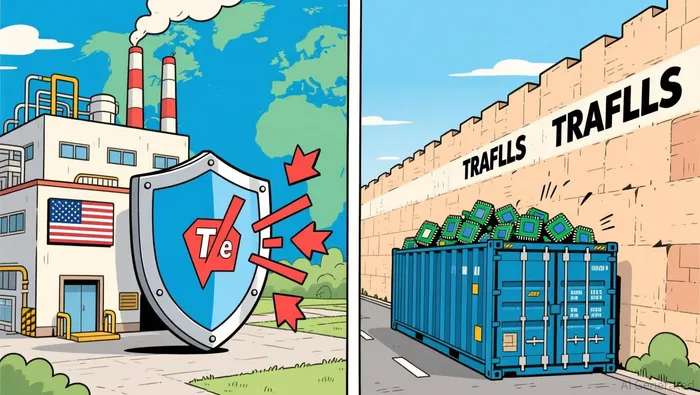
The split is not symmetrical. Domestic manufacturers face execution risk on construction timelines and yield ramp. Fabless companies face margin compression on every shipment that clears customs under Section 301 or Section 232. One risk is delayed. The other is immediate.
What the appeal obscures
The government's procedural argument - that refunds should go only to importers who sue - has an unintended consequence. If the appeal succeeds in narrowing refund eligibility, semiconductor companies that did not file individual refund claims will be excluded from recovering IEEPA duties they already paid. That creates an uneven playing field among importers based on litigation resources, not business fundamentals.
But the more important dynamic is what the appeal achieves for the administration. It extends the period of uncertainty. Refund claimants cannot finalize their cost models while the appeal is pending. Procurement teams cannot decide whether to accelerate imports or delay shipments. For semiconductor companies operating on thin margins at the foundry interface, this limbo period is itself a cost.
The administration has also signaled it is evaluating follow-on actions under Sections 232 and 301. Those statutes survived the Supreme Court's IEEPA ruling and are being positioned as replacement authority. The structural trajectory is clear: even if IEEPA tariffs are fully refunded, the tariff mechanism persists under different legal headings.
Investor Takeaway
The IEEPA refund appeal is a dispute about money already collected. The investment-relevant question is whether the three-track tariff regime accelerates the structural migration of semiconductor manufacturing to U.S. soil and penalizes the fabless model in the interim.
Companies with U.S. fabrication capacity - Intel, TSMC (once Arizona reaches volume), Samsung - are structurally shielded. Companies that import finished dies are structurally exposed. The Section 232 exemption for TSMC's Arizona fab is a forward-looking signal about where the policy is pushing, not a current shield for existing import volumes.
The key issue is not whether the administration's appeal succeeds. The more important question is whether Section 301 and Section 232 tariffs persist as the durable framework for semiconductor trade policy. If they do, the business model split between domestic and import-dependent manufacturers becomes a permanent feature, not a cyclical deviation. Investors should price exposure accordingly - not by reacting to the refund appeal, but by mapping each position against the tariff regime that is already in force.