

Apple closed 1.9% lower at $301.54 on Nasdaq Monday after the company unveiled a long-delayed Siri overhaul at WWDC. The stock reaction mattered because the same session was friendly to the broader AI tape, with S&P 500 technology up 1.5% and the Philadelphia SE Semiconductor Index up 5.6% as chip shares rebounded from Friday's rout.
Apple previewed the next generation of Apple Intelligence and introduced Siri AI across iOS, iPadOS, macOS, watchOS and visionOS, giving the company a clearer answer to a two-year product delay. The market question is now narrower. AAPL no longer lacks a visible AI product path, but the stock still has to show that Siri AI can reach enough devices and regions, change daily usage, and support the iPhone and Services engine that already carries Apple's valuation.
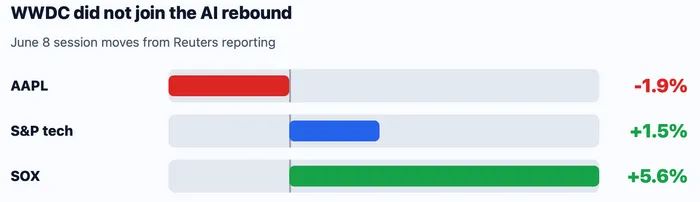
Sources include Reuters market reporting for AAPL, S&P 500 technology and the Philadelphia SE Semiconductor Index. Symbol AAPL. Date range June 8 2026. Interval one market session. Basis reported session move and Nasdaq close. Links include Apple Siri reaction and technology rebound.
The price split puts execution ahead of keynote relief
The Siri AI launch came after Apple first promised major upgrades two years ago and then delayed them repeatedly. That history explains why Monday's price action was harsher than a simple product-news reaction. The event gave the market a real product skeleton, yet the stock fell while semiconductors and technology recovered. A product reveal that only resets credibility can still leave the valuation burden intact.
Apple's prior market assumption was that WWDC could repair the company's AI gap by putting Siri back at the center of the interface. The new evidence is more conditional. Siri AI can analyze screen content, search across personal context, use web knowledge and work across apps, according to Apple's release. That is enough to challenge the view that Apple has no answer, but it is not enough to show that the answer changes upgrade timing, Services use, developer behavior or gross-margin economics.
Monday's negative move against a positive technology tape therefore reads as an execution premium being withheld. AI chip names could rebound because Friday's selloff looked too broad after the rout. Apple needed the market to believe a delayed assistant can become a platform lever. Beta performance, regional rollout and user adoption still have to make the reveal more than a shift from product absence to product conversion.
Availability keeps the reset from becoming a revenue story
Apple said new software features are available for developer testing starting today, public beta starts next month and free software updates arrive this fall. That calendar gives the market defined checkpoints, but it also limits how much Monday's announcement can do for near-term revenue. Developer testing and a later beta are evidence of progress, not evidence that consumers will upgrade devices, add paid services or change usage in the current quarter.
Regional and device gates matter because Apple's operating base is already large. Apple reported $111.2 billion of fiscal second-quarter revenue, up 17% year over year, and a new all-time high for its active-device installed base. A feature that reaches that base can become valuable quickly, but only if eligibility is broad and practical. Apple said Siri AI in iOS 27 and related platforms will be available on selected iPhone, iPad, Mac, Vision Pro and Apple Watch hardware, while iOS and iPadOS users in the EU will not have Siri AI initially and the features will not be available in China while regulatory requirements are pending.
Eligibility constraints turn the AI story into an installed-base conversion question. Apple's supportive case is that privacy, on-device processing and deep app integration can make AI useful inside devices people already own. Some of the company's biggest markets and older devices may not carry the full experience at launch, which delays any read-through to iPhone replacement, app engagement or Services attachment.
Platform leverage depends on users and partners
Apple described Siri AI as deeply integrated across iPhone, iPad, Mac, Apple Watch and Vision Pro, with personal context, screen awareness, a dedicated Siri app and systemwide writing tools. That design makes the strategic case more credible than a standalone chatbot would. Apple is trying to make AI part of the operating system, not a separate destination that competes with the iPhone interface.
Partner reliance complicates the margin and control read. The Reuters report said Apple is leaning on Google Gemini technology for some models and Nvidia chips for larger cloud models. Google is the model partner, Nvidia is a cloud-compute supplier and SOX is only a sector proxy for Monday's tape. Apple still controls the device interface, privacy architecture and distribution, but the economics are less automatic. If third-party model and compute costs rise faster than user engagement or paid-service attachment, the AI layer can improve product relevance without immediately improving profit quality.
The next validation should be specific. Developers need to show whether app actions and Siri workflows become worth building around. Beta users need to show whether personal-context search, camera intelligence and writing tools work reliably enough to change habits. Apple needs a path for EU iPhone and iPad users and China availability, while future earnings commentary needs to connect Siri AI to usage or Services behavior. The stronger verdict is not that WWDC failed. Apple moved from missing-product risk to conversion risk, and Monday's tape says the market still wants the second part proved.