

Market Snapshot
Applied Digital Corporation (NASDAQ: APLD) experienced a slight pullback in trading activity on May 8, 2026, with its shares declining 0.67% for the session. Despite the minor dip in share price, the stock maintained significant market attention, recording a trading volume of $0.81 billion. This turnover represented a 23.39% decrease compared to the previous day's levels, yet it remained the highest trading volume across the entire market for the day, underscoring the intense investor interest in the company's recent strategic developments. The high liquidity indicates that while the immediate upward momentum may have paused, the stock remains a central focus for traders assessing the long-term implications of its corporate restructuring and capital expansion plans.
Key Drivers
The recent trading activity and broader market sentiment surrounding Applied Digital are heavily influenced by a dual catalyst of corporate restructuring and significant debt financing. The company recently completed the spin-off of its cloud business into a new Nasdaq-listed entity, ChronoScale Corporation. This separation allows Applied Digital to focus exclusively on its core AI data center hosting infrastructure while retaining an approximate 97% ownership stake in ChronoScale. This structural change is designed to unlock value by creating two distinct publicly traded vehicles, each with optimized capital priorities. Investors are viewing this simplification favorably, as it separates the capital-intensive cloud compute operations from the stable, long-duration cash flows of data center hosting.
Concurrently, Applied Digital closed a $300 million senior secured bridge facility led by Goldman Sachs to fund the construction of its third AI data center at the Polaris Forge 1 campus in North Dakota. This financing is critical to the company's near-term growth narrative, providing the necessary liquidity to accelerate the delivery of revenue-generating capacity. The 364-day loan, carrying an interest rate of SOFR plus 275 basis points, was described by management as a disciplined step toward expanding capacity while preserving future financing flexibility. This influx of capital directly addresses the immediate needs of the Polaris Forge project, which is a key catalyst for bringing new AI infrastructure online.
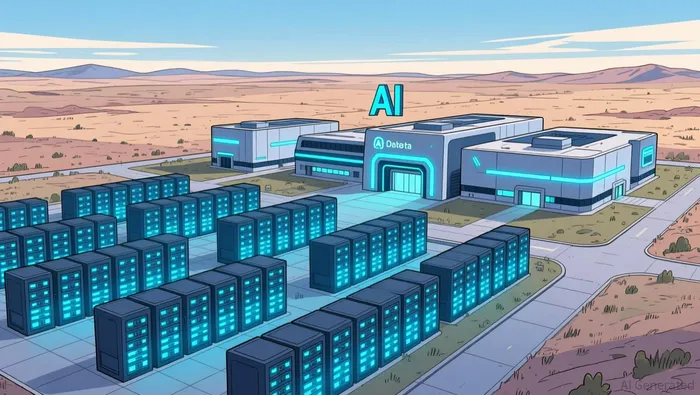
The strategic shift is further bolstered by substantial long-term lease agreements that enhance revenue visibility. Applied Digital recently secured a 15-year, $7.5 billion lease with an investment-grade hyperscaler at its Delta Forge 1 campus. This agreement lifts the company's total contracted lease revenue above $23 billion, significantly reducing demand risk for new capacity and validating the company's campus strategy. The combination of high-value contracts and fresh financing has led analysts to project substantial revenue growth, with forecasts suggesting $2.5 billion in revenue and $194.4 million in earnings by 2029.
However, the aggressive expansion strategy introduces notable risks that temper the bullish sentiment. The reliance on bridge financing amplifies concerns regarding rising leverage, with the debt-to-equity ratio standing at approximately 1.65. While the current balance sheet strain is being managed through strategic debt issuance, investors remain cautious about the need for further funding if utilization rates or new contract signings fall short of expectations. The company's negative earnings and high beta continue to contribute to volatility, meaning that any delays in project execution or tenant rollouts could result in significant downside pressure.
Technical indicators suggest that the stock is in a strong momentum phase, trading well above its 20-day and 200-day simple moving averages. The formation of a golden cross in June 2025 and positive MACD readings indicate that upside pressure is rebuilding. Nevertheless, the stock is currently extended, trading approximately 22% above its 20-day SMA. This technical positioning highlights the tension between the strong short-term momentum driven by the spin-off and financing news, and the fundamental risks associated with high debt levels and execution uncertainty. Investors are thus weighing the potential for continued upside against the complexities of owning a majority stake in a spun-off entity while managing a highly leveraged infrastructure buildout.