

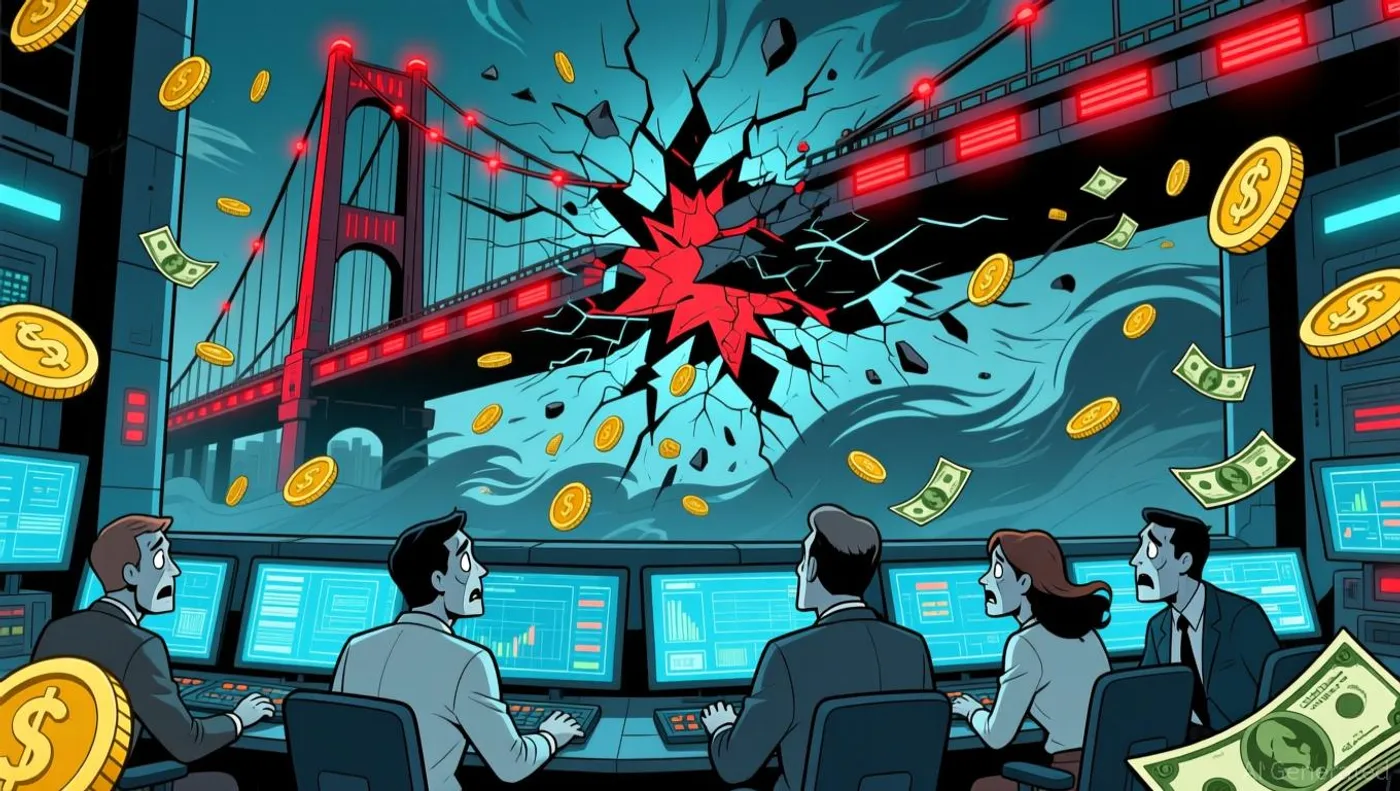
The scale of April 2026's exploit wave is a direct liquidity shock. Protocols lost over $606 million to hacks in just 18 days, making it the single worst month for attacks since February 2025. This isn't a scattered series of incidents; the damage is hyper-concentrated. The attacks on Drift Protocol ($285 million) and KelpDAO ($292 million) alone account for 95% of the month's losses, with both being the year's largest single hacks.
The surge is even more striking when compared to the prior quarter. April's total has already eclipsed the first quarter's $165.5 million haul, representing a roughly 3.7x increase in monthly exploit activity. This pace dwarfs the previous year's trend, where monthly losses had consistently held under $240 million.
The immediate flow impact is clear. Following the KelpDAO breach, DeFi total value locked (TVL) fell by more than 7% over the past 24 hours. The drain on protocol reserves and the resulting market panic demonstrate how a concentrated exploit event can trigger a rapid, systemic liquidity withdrawal.
The Systemic Flow: From Exploit to DeFi TVL Collapse
The $292 million bridge exploit at KelpDAO triggered a direct and massive capital outflow from the DeFi ecosystem. The stolen rsETH was used as unbacked collateral on lending protocols, creating a systemic risk of bad debt. In response, platforms froze affected markets, sparking a cascade of user withdrawals that drove a $13.21 billion slide in total value locked (TVL) across DeFi over 48 hours.
Aave was the epicenter of this collapse, losing $8.45 billion in deposits during the same period. This massive outflow from the leading lending protocol was the primary engine behind the broader TVL decline, which saw total DeFi value fall from $99.5 billion to $86.3 billion. The mechanism was straightforward: unbacked collateral triggered protocol freezes, which in turn forced a wave of user withdrawals, demonstrating how a single exploit can rapidly transmit liquidity stress.
The price impact on core DeFi tokens was muted compared to the deposit drain, with AAVE, UNI, and LINK each slipping less than 3% over 24 hours. This divergence highlights that the shock was a flow event, not a broad-based price collapse. The real story is the systemic capital outflow from protocols, underscoring the vulnerability of DeFi's tight interconnections and the critical importance of cross-chain bridge verification.
The Recovery Flow: Asset Seizures and Market Sentiment
Arbitrum's Security Council has executed a significant counter-flow, freezing 30,766 ETH worth about $71 million linked to the KelpDAO exploit. This action recovers roughly a quarter of the stolen assets and places the funds in a governance-controlled wallet, preventing the original exploiter from accessing them. The move, taken with law enforcement input, was completed on April 20 and did not impact other Arbitrum users or applications.
Yet this recovery has not lifted market sentiment. The mood across crypto is described as "grim," with users questioning the trade-offs of decentralized technology. Despite the $71 million seizure, the mood is at an 'all-time low', with some framing the event as a potential "DeFi's Lehman moment." The paradox is clear: a tangible recovery of capital is overshadowed by a deep crisis of confidence in the system's resilience and decentralization promises.
The Drift Protocol hack, which occurred earlier in April, highlights a persistent and evolving risk. The attack vector involved a fake token and pre-signed transactions, exploiting human judgment rather than code. This social engineering tactic, which allowed attackers to gain admin control and drain $285 million, underscores that the attack surface extends beyond smart contract audits to include governance and user trust.