

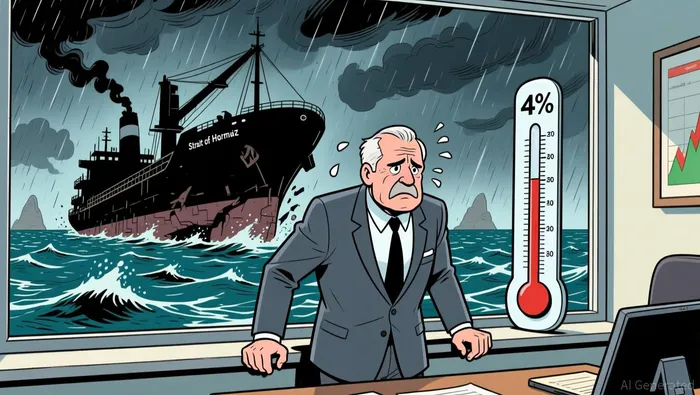
The immediate macro drivers for April are a stark oil price shock and the first hard data on its economic impact. Oil prices surged from the low $70s at the end of February to above $118 by the end of March, driven by tensions over the Strait of Hormuz closure. This is a direct supply shock, with roughly 20% of global oil passing through that chokepoint, and uncertainty over its reopening is keeping energy markets tight.
The first test of this shock's impact arrives with the April 1st ADP and ISM manufacturing data. These reports will show whether higher energy costs are already beginning to weigh on business activity and hiring. The Fed's view is that this is a supply shock it cannot control, but it carries a clear risk: inflation is likely to test 4% as a result.
The bottom line is a more challenging macro backdrop. Higher input costs are feeding into inflation while beginning to weigh on economic growth expectations, creating a difficult standoff for central banks.
Labor Market Flow: The "Low-Hire, Low-Fire" Stabilizer
The labor market is acting as a critical stabilizer, but its support is becoming more concentrated. Data shows a persistent "low-hire, low-fire" environment, where companies are neither aggressively adding staff nor laying off workers. This creates a floor for consumer spending and helps contain wage pressures, supporting the Fed's view that inflation may be transitory. However, the flow of new jobs is increasingly concentrated in specific sectors, which could signal underlying fragility.
The first hard test of this stability arrives with the April Non-Farm Employment and Unemployment Rate data. The market will watch for signs that the oil shock's demand destruction is beginning to bite, potentially pushing the unemployment rate higher. A sustained rise in jobless claims, as seen in the Unemployment Claims (USD) report, would confirm this pressure. For now, the low-fire dynamic is holding, but it is a fragile equilibrium.
Weaker consumer spending from higher energy costs could ultimately help cap core inflation, supporting a late-2026 rate cut. As noted, higher energy costs are likely to be demand destructive, which will help keep a lid on core inflation pressures. If tensions ease and oil prices drop in the second half of the year, this dynamic could accelerate, giving the Fed the room it needs to begin cutting rates. The labor market's current stability is a key part of that setup.
Crypto Liquidity and the Global Debt Backdrop
The global financial system is entering a critical refinancing cycle, with trillions in debt maturing over the next few years. This creates a fundamental tension: the world's total debt is on track to reach $65 trillion in refinancing needs by 2030, and the only viable path out is monetary debasement through inflation. That pressure is the primary driver for crypto assets, which are priced on global liquidity flows.
Bitcoin's recent price action, up 1.28% yesterday to $74,786.04, reflects this split in liquidity. The market is dividing between a gold-backed Eastern system and a stablecoin-powered Western system. While Bitcoin trades 10.82% below its level one year ago, it has already priced in a recession that has not yet arrived, suggesting a gap between current price and future liquidity levels that tends to close quickly.
Crypto is positioned to navigate this systemic tension. As central banks face the standoff between higher inflation and the need for cheaper money, assets like Bitcoin serve as a hedge against the inevitable dilution of paper currency. The setup is for a transition period where the direction of liquidity is not yet decided, but the long-term flow toward hard assets is clear.