

Arcutis' pullback comes with a broader dermatology push
Arcutis may look more interesting after the stock has fallen 27% year to date. Even with the pullback, the company is still pushing a topic that could broaden how psoriasis care is discussed: genital psoriasis affects approximately two-thirds of the nine million individuals with plaque psoriasis in the U.S., and the latest manuscript offers clinicians practical guidance on recognition, diagnosis, and management.
This is more than a single education headline
Skeptics can argue that a journal publication has no direct revenue link, and that is fair. But the strategic point is broader than one press release. Arcutis is helping shape how this underrecognized area of psoriasis is discussed through expert guidance and 14 consensus statements covering diagnosis, patient conversations, quality of life, and treatment decisions.
Commercial infrastructure makes the education more credible
What makes this worth watching is that the education effort is happening alongside real commercial buildout. Arcutis reported continued strong demand for ZORYVE, maintained positive operating cash flow, and began building a primary care and pediatrics-focused organization. That does not prove a revenue lift from genital-psoriasis education, but it does suggest the company is investing in reach beyond a single dermatology indication.
Why clinician education could matter in genital psoriasis
The core issue is identification, not just awareness
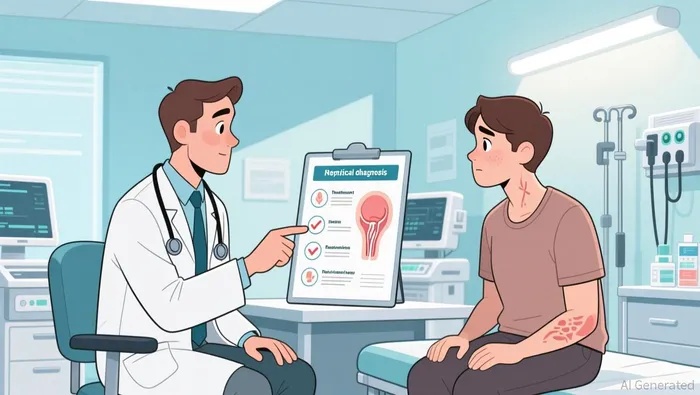
Genital psoriasis affects an estimated six million Americans, yet it remains underreported and undertreated because the topic is sensitive and clinicians often do not know how to begin the conversation. That creates a gap between the number of patients who could benefit and the number who actually receive targeted care.
The new guidance tries to close that gap at the point of care. The consortium's statements focus on physical diagnosis and patient conversations, quality of life and interpersonal relationships, and treatment decisions. In practical terms, that is an effort to make a previously awkward topic more routine in dermatology visits.
Consensus statements could broaden the treated population
The recommendations encourage: - customized, comprehensive skin examinations that capture all affected sites - earlier normalization of genital exams with dialogue guides - clearer guidance that biopsy is reserved for uncertain cases - age-appropriate approaches for pediatric, adult, and older populations
If those habits spread, more patients may be asked about symptoms, more cases may be documented more accurately, and more visits may move toward active treatment. That is a plausible way education can expand demand without creating a new disease.
What the evidence can and cannot support
A publication does not guarantee prescriptions, and consensus guidance is not the same as a reimbursement win. Still, when a condition lacks standard operating guidance, early recommendations can influence clinical habits over time. These statements also are not a one-off awareness push; this is the second published manuscript from the Genital Psoriasis Wellness Consortium, which suggests a longer-running effort to build a care framework.
The key watchpoint is whether diagnosis and documentation improve before investors expect a major revenue impact.
Does the education support a broader ZORYVE expansion?
The core franchise already has commercial traction
The education story matters most if it connects to Arcutis' larger business. Arcutis reported Q1 2026 ZORYVE net product revenue of $105.4 million and is still guiding to 2026 net product sales of $455–$470 million. This is not a biotech asking investors to imagine demand from scratch; the business already has commercial momentum to build on.
That helps explain why genital-psoriasis education looks strategically useful rather than purely academic. Arcutis has completed expansion of its dermatology sales force and started building a primary care and pediatrics-focused organization, while also advancing ZORYVE beyond its current plaque psoriasis footprint through an sNDA for atopic dermatitis in infants and Phase 2 proof-of-concept trials in vitiligo and hidradenitis suppurativa. If clinicians begin to associate Arcutis with treatment in sensitive skin areas, that could help other indications gain traction over time.
Platform logic: teach the disease space, then expand the molecule
Arcutis has a topical roflumilast pipeline that includes programs in plaque psoriasis, atopic dermatitis, seborrheic dermatitis, scalp and body psoriasis, hidradenitis suppurativa, and vitiligo, alongside the investigational biologic ARQ-234 for atopic dermatitis. That gives the company a broader dermatology platform to support if education helps doctors look more carefully at psoriasis overall.
If education improves identification in genital psoriasis, Arcutis may be better positioned to keep those patients within its treatment ecosystem as labels expand and field capabilities widen.
What investors should actually watch
The real test is not one journal article. It is whether this effort starts to show up across the rest of the pipeline and commercial plan:
- evidence that education is tied to prescribing behavior, not just visibility
- conversion from new indication approvals into repeatable demand
- continued investment in coverage, field structure, and patient-touch points
If those signals emerge, a niche education push could become a meaningful lever for franchise expansion. If they do not, the effort may remain a science and awareness story with limited business impact.
What would validate or challenge the thesis?
The bull case is straightforward: better clinician education can improve identification in a sensitive, overlooked area and give Arcutis a wider opening as labels and field capabilities grow. The bear case is just as clear: improved conversations do not become durable revenue if prescribing habits remain unchanged.
Near-term catalysts
- An update on the sNDA for atopic dermatitis in infants
- Progress in the pediatric MUSE trial in scalp and body psoriasis
- A status update on ARQ-234 in atopic dermatitis
- Management commentary that connects genital psoriasis guidance to a broader franchise opportunity rather than treating it as a standalone education headline
Practical signposts
- Broader indication approvals as Arcutis pursues 2026 label-expansion efforts
- Traction from the primary care and pediatrics-focused organization
- Sustained ZORYVE growth that extends beyond the current dermatology base
The decision framework is simple: watch for evidence that awareness is changing documentation first, then prescribing, then repeat business across more patient segments. If that chain holds, the education push could matter more than it appears today.