

ARK Invest sold another chunk of Rocket Lab on Monday - 33,029 shares across two ETFs. It followed a sale of 50,312 shares in late April, and dozens more tranches over the past year. The headline machinery has already spun it into "Cathie Wood heads for the exit." But ARK isn't exiting. It's trimming. And the amount of attention this selling gets is precisely the kind of noise that lets the actual operating question slide past without inspection.
The real issue isn't who's selling. It's what Rocket Lab is spending, how fast it's spending it, and whether the revenue machine firing right now can survive the dilution hammer coming at it from both directions.
The revenue story is legit
Rocket Lab's first quarter of fiscal 2026 closed at $200.3 million in revenue - up 63.5% year over year. GAAP gross margin hit 38.2%, with non-GAAP gross margin at 43.0%. The backlog expanded to $2.2 billion. This is not a company whose business is stalling.
Full-year 2025 revenue came in at $602 million, up 38% from 2024. The Space Systems segment - which builds satellite components and structures - is the margin engine, and it's growing fast enough that the overall gross margin has been expanding even while Rocket Lab pours capital into developing its Neutron heavy-lift rocket.
KeyBanc analyst Michael Leshock downgraded the stock to Sector Weight back in January, arguing that after a 263% rally, the growth catalysts were already baked in. That's the kind of call that sounds sharp at the time and becomes irrelevant within a quarter when the numbers keep accelerating past the thesis.
But here's where it turns.
The cash-flow path tells a different story
Despite record revenue, Rocket Lab used $77.4 million in non-GAAP free cash flow during Q1 2026. Operating cash flow was a use of $50.3 million. Full-year 2025 free cash flow was -$321.8 million. Capital expenditures alone ran $156.3 million for the year.
Rocket Lab holds $829 million in cash. At a $77.4 million quarterly burn rate, that's roughly 10-11 quarters of runway - assuming the burn doesn't accelerate as Neutron development ramps and the company hits its peak capital intensity. That sounds like plenty. Except the company just registered $3 billion in stock under an ATM equity distribution agreement on May 21. Shares fell 6.6% the same day.
An ATM program lets a company sell shares into the market gradually through a broker, rather than in one big offering. $3 billion is the registered ceiling, not a commitment - but at a $76 billion market cap, even executing a fraction of that is dilution of a meaningful scale. The company already raised $474 million through a prior ATM offering that closed in April.
This isn't about whether Rocket Lab can pay its bills. It's about how much of today's equity gets absorbed by tomorrow's buildout, and whether the revenue growth is actually growing fast enough to outpace it.
Neutron is the promise and the risk
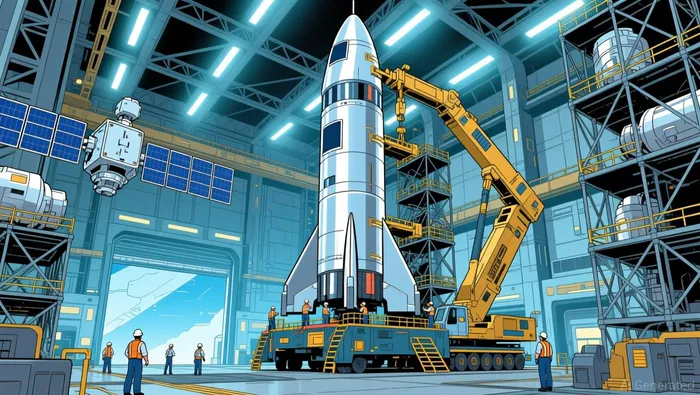
Neutron is the heavy-lift rocket that would put Rocket Lab in direct competition with SpaceX's Falcon 9. First launch is now scheduled for no earlier than Q4 2026 - delayed after a static fire test failure in February. The market priced the delay, then priced the recovery, and now is pricing what happens after that.
If Neutron launches on its current timeline and begins recurring missions by 2027, the launch business becomes a multi-billion-dollar addressable segment. The backlog already reflects some of this demand. But Neutron is also the primary reason the burn rate is where it is. Until it's flying regularly and generating revenue, every dollar spent on it is an investment against a future that hasn't arrived.
That's not a reason to dismiss the company. It's a reason to keep your eyes on the burn trajectory and the dilution math.
What to watch over the next 12 months
Revenue growth is the leading indicator. If Q2 and Q3 stay in the 50-60% year-over-year range or better, the revenue machine justifies a lot. If it slows toward 30% or below, the $78 billion market cap becomes very hard to defend without Neutron revenue to prop it up.
Free cash flow is the lagging proof. A quarter where operating cash flow turns positive would be the first sign that the business can stand on its own. That's the inflection point the market hasn't reached yet.
Dilution is the risk nobody's pricing correctly. The ATM program is a facility, not an execution. But if Rocket Lab draws down $1 billion or more of it - easily conceivable given the Neutron capex cycle - that's 1.3% to 2%+ of the market cap being created out of thin air. Not catastrophic on its own, but meaningful when the stock is already trading at a negative P/E and a valuation built on future launch revenue.
What would change my mind
I can be wrong on this. The setup is: revenue is growing fast enough that the burn is a development phase, not a structural problem. If Q2 revenue clears $220 million and gross margins expand another notch, the trajectory starts looking like it can support today's valuation even with Neutron still in the build phase.
On the flip side, if the quarterly burn stays near $75-80 million while revenue growth decelerates below 40%, the math starts getting uncomfortable. The $3 billion ATM program would then look like management hedging against a runway problem rather than opportunistic capital raising.
The invalidation point is clear: two consecutive quarters of sub-40% revenue growth combined with cash burn above $70 million, and the thesis that today's revenue machine justifies the valuation starts breaking. At that point, you're buying a Neutron lottery ticket at $78 billion.
ARK's selling pattern is irrelevant to the operating case. It's a fund manager taking profits and rebalancing. The question you should be asking is whether Rocket Lab's revenue growth can outrun its own spending for long enough to make the dilution fade into the background. Right now, the revenue says yes. The cash flow says not yet. The next two quarters decide which one wins.