

The CEO of Arm Holdings said something interesting after the company's latest earnings. "It's nice to see the rest of the market catch up," Rene Haas told analysts when asked about competition from AMD, Intel, and Nvidia. The market took this as confidence. But it's worth asking what he really meant.
Most people are asking whether Arm's position in AI CPUs is eroding. That's the wrong question. The real question is whether Arm knows what kind of company it wants to be.
For 35 years, Arm was an IP company. It designed chip architectures and licensed them to others. Its customers-Apple, Qualcomm, Nvidia-took those designs and made chips. Arm collected royalties. This was a high-margin business with relatively low risk. You didn't need factories. You didn't need to compete with your customers.
Now Arm is making its own chips. The company is reportedly competing with its own clients, including Qualcomm, to sell chips to data center customers. Meta Platforms is one of its first customers for this new business. Arm is no longer just the neutral architect. It's a player.
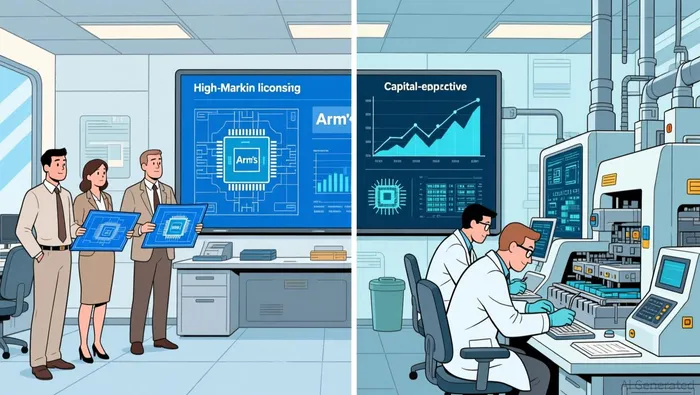
This isn't erosion. It's transformation. And transformation is riskier.
The numbers tell part of the story. Arm trades at 278 times trailing earnings and 51 times sales. Those are IP company multiples. Chipmakers don't get those valuations. They have factories. They have inventory. They have capital intensity. If Arm succeeds as a chipmaker, its multiples should compress. If it fails, they should collapse.
The market seems to think Arm is defending a niche. It's not. It's trying to build a new one while keeping the old one.
There's a pattern here. Companies that change their business model often underestimate how hard it is. The skills that made you good at licensing IP are not the same skills that make you good at manufacturing and selling chips. The economics are different. The customer relationships are different. The risks are different.
Arm has advantages, of course. Its power efficiency is real. Google says its Arm-based Axion CPUs offer up to 65% better price-performance and 60% better energy efficiency versus x86 alternatives. In a world where data centers are hitting power constraints, that matters. And AI agent workloads are increasing the importance of CPUs, which should help all chipmakers.
But those are advantages for Arm the IP company. For Arm the chipmaker, the question is different. Can it manufacture at scale? Can it win deals against companies that have been doing this for decades? Can it do this without alienating the customers who still license its IP?
The CEO's comment about the market "catching up" is revealing. It suggests he sees Arm as ahead. But ahead in what? In IP design, maybe. In chip manufacturing and sales, Arm is just starting. Intel's data center executive recently dismissed Arm's AGI CPU claims as "a marketing stunt". That's the kind of criticism chipmakers face, not IP licensors.
I suspect the market is asking the wrong question because it's easier. Measuring erosion is straightforward. You look at market share. You look at pricing. You look at competitive wins and losses.
Measuring transformation is harder. You have to ask whether a company can do something it has never done before. You have to ask whether the new business will cannibalize the old one. You have to ask whether management understands the risks.
Arm's recent earnings show the tension. The company beat revenue estimates and gave strong guidance, sending shares higher. But then the stock reversed when executives said they haven't secured enough supply for their new chip. That's a chipmaker problem, not an IP problem.
The way to think about Arm isn't to ask whether competition is eroding its position. It's to ask whether the company can successfully become something else. The evidence so far is mixed. Major customers are buying. But the economics are changing. The risks are increasing.
Most investors treat business model shifts as incremental. They're not. They're existential. When a company changes what it is, everything changes-the multiples, the risks, the competitive landscape. Arm isn't defending a niche against AMD and Intel. It's trying to build a new company while the old one still pays the bills.
That's much harder. And much more interesting.