

SanDisk's A+ valuation grade does not settle the price debate
The screen is doing something tricky: it ranks SanDisk higher than Arrow on valuation, but that does not automatically mean SanDisk is cheaper at today's price. On the same valuation screen, SanDisk carries an A+ valuation grade while Arrow gets an A valuation grade. That one-letter gap is the heart of the debate.
That grading system has a limitation. It is based on both current and forward estimates, so a hot stock can still look attractive if expectations are already running high. That is a clue to dig deeper, not proof of a bargain. On raw multiples, SanDisk still looks expensive: a market cap of 260.87B and a P/E ratio of 58.92.
SanDisk's recent results give bulls a real case. The company just posted blowout March-quarter results, with revenue rising 250% year over year and non-GAAP gross margin expanding 557 basis points to 78.4%. Bulls argue the business is moving upmarket into enterprise storage. Bears counter that SanDisk still operates in a commoditylike NAND flash business, with little differentiation or pricing power and Very High uncertainty.
SanDisk's quarter was strong, but the moat is still the argument
What the quarter actually proved
SanDisk's latest results were unusually strong. Revenue rose 250% year over year to $5.95 billion, and non-GAAP gross margin expanded 557 basis points to 78.4%. For investors looking for a moat, that margin improvement matters. It suggests the business is not just benefiting from a demand spike; better mix and better economics may be improving the profile of the business.
The bull case has a clear mechanism. SanDisk is pushing into enterprise SSDs for cloud infrastructure, which should be less tied to consumer device cycles and more tied to durable data-center spending. If that shift continues, today's 78.4% gross margin becomes more than a quarter-specific outlier. It becomes evidence that the business may be moving up the storage value chain.
Why the moat is still debatable
Bears are not arguing from ignorance. They argue that SanDisk still operates in a market built on commoditylike NAND flash memory chips, where companies often have little differentiation or pricing power. That matters because moats are tested in the downturn, not just in a supercycle.
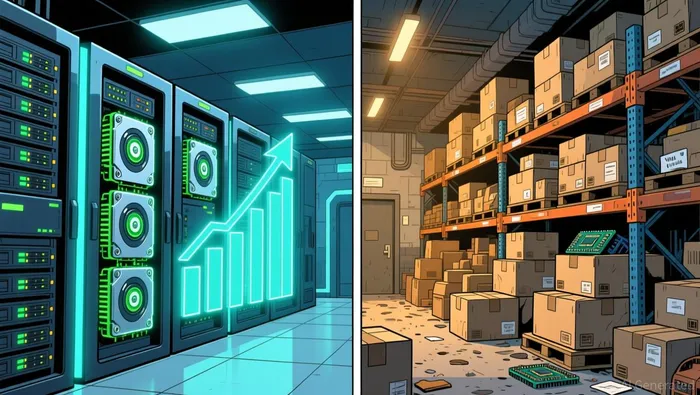
If the cycle turns, the key watchpoint is margin durability. A company can post 78% gross margins in a tight market and then see them compress quickly if product mix slips back toward more commoditized ends of storage. SanDisk's Very High uncertainty rating is a reminder that investors are still paying for a transformation, not a fully proven one. In other words, the quarter supports the possibility of a wider moat; it does not settle the debate.
Valuation still asks for more proof
This is where the valuation math reappears. SanDisk still carries a PE Ratio (TTM) of 60.24 and a market capitalization around 260.85B. One published analyst target is $1,609.27, while the stock recently traded as high as $1,804.00. That does not mean the stock cannot stay elevated. It does mean the market is still paying for future mix improvement, future enterprise traction, and future resilience.
SanDisk may well deserve a premium valuation over time if its enterprise mix keeps lifting profitability. But calling it attractively valued right now is harder to defend. The current numbers look more like evidence that a higher multiple can stay alive than proof that the business is already priced in line with its intrinsic value.
Arrow's appeal is not that it is more exciting than SanDisk. It is that it looks more disciplined at the price the market is asking.
Why a lower multiple matters here
Arrow is an electronics-distribution and solutions business with a market cap of 6.62B and a Price-Earnings ratio of 14.18. It also sits close to the top of its recent range, with a 52 Week high of $134.74 versus a 52 Week low of $86.50. That matters. You are not buying Arrow because it is beaten down into distress; you are buying it because a mature business is still being priced as if upside is limited.
That is a better setup for a value investor. SanDisk still gets the cheaper-looking grade on the screen only because the model folds in both current and forward estimates. Arrow's case is simpler: even without the benefit of a growth narrative carrying the valuation, it still rates valuation grade A.
Why the business deserves patience
Arrow's moat is not flashy, but it is real. The company supplies products, services, and solutions to industrial and commercial users of electronic components and enterprise computing solutions, across both Global Components Business and Global Enterprise Computing Solutions. That broader supply-chain role matters because it can soften the kind of single-product-cycle shock that can hurt more pure-play storage names.
In a trading business, the real test is how well management runs working capital, inventory, and customer economics. A lower multiple only becomes interesting if it is attached to that kind of operational discipline. Arrow looks like the cleaner fit for that description.
What to watch over the next few quarters
The valuation screen is a starting point, not a verdict. A grade built from both current and forward estimates can still describe a stock the market already respects. So the next step is simpler: watch what actually widens the margin of safety over the next few quarters.
SanDisk
- Aug. 24 report: Bulls think the business is moving into a better storage mix; bears still see a commodity-heavy cycle. Trigger: guidance suggests demand is broadening beyond the current surge.
- Enterprise SSD mix: This is the real moat test. Trigger: management shows enterprise SSD is becoming a steadier, more meaningful part of the business.
- Gross-margin durability: One spectacular quarter does not settle the debate. Trigger: margins hold up across multiple quarters, not just one.
- Invalidation: If leadership leans on the stock's rich multiple to justify expectations, patience is probably still the right stance.
Arrow
- Order growth: In distribution, demand visibility comes first. Trigger: shipments and customer orders stay firm.
- Inventory health: A cheaper multiple only matters if working capital is disciplined. Trigger: inventory does not build faster than demand.
- Higher-value service mix: This is how a mature supplier improves earnings quality. Trigger: services and solutions play a larger role in results.
- Invalidation: If growth softens and the business looks more like a plain trading vehicle, the appeal narrows.
My clean choice: Arrow has the better price-and-safety balance today. SanDisk's next earnings date arrives with higher expectations already in the stock, so patience may still be the better stance.