

The quick take:
- Asia chip stocks are pulling back after a historic AI-driven run - but the pullback exposes a valuation gap worth acting on
- US semiconductor ETFs like SOXX trade at ~42x forward earnings after a 101% year-to-date surge. Asian memory giants - Samsung, SK Hynix - trade at roughly 20x P/E while posting profit growth that dwarfs their US peers
- Iran tensions are weighing on sentiment, but oil has already retreated 20% from 2026 highs on ceasefire progress. The geopolitical noise is masking a structural mispricing
- The AI capex machine hasn't stalled. Hyperscalers are spending $690B+ in 2026. The question is where to ride it at a valuation that doesn't require perfection
The chip rally is cooling - which is exactly the point
I've been puzzled by the panic in Asia this week. Headlines scream that the semiconductor rally is over because chip names are dipping alongside US-Iran tensions. Well, let me ask the question nobody in the consensus is asking: what if the cooling rally is the entire opportunity?
The iShares Semiconductor ETF (SOXX) - the flagship US semiconductor trade - is up 101% year-to-date. It trades at a forward P/E near 42x, with a trailing P/E of roughly 76x. That is a number that assumes perfection. It assumes every AI data center dollar keeps flowing into NVIDIA, Broadcom, and AMD at an accelerating clip, forever. One stumble, one quarter of "moderate" guidance, and that multiple compresses fast.
This is not a contrarian contrarian play. I'm not saying the AI trade is dead. I'm saying the math on the US-end of it has arguably baked in a doomsday-free future. The forward P/E of 42x is not GARP territory. It's momentum territory - and momentum is exactly what breaks when the headline says "rally cools."
The valuation gap nobody is discussing
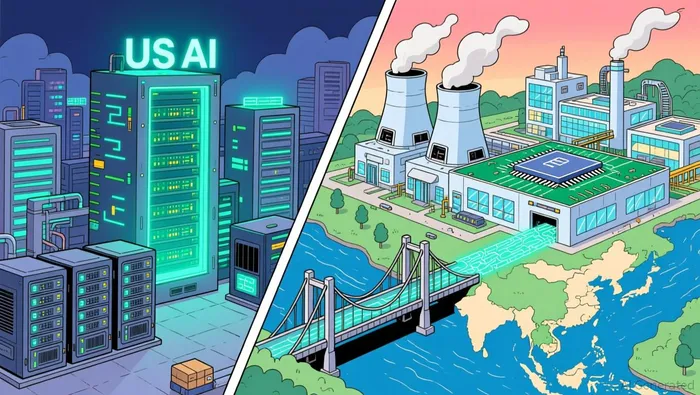
Now flip across the Pacific. Samsung Electronics posted ₩57.2 trillion in operating profit for Q1 2026 - a 756% year-over-year surge, larger than its entire annual profit for 2025. The stock trades at roughly 20x P/E.
SK Hynix, the HBM (high-bandwidth memory) leader that NVIDIA literally cannot build its GPUs without, trades at roughly 19x P/E. These two companies have contributed up to 70% of the KOSPI's gains in 2026. SK Hynix is approaching a $1 trillion market valuation, and yet the multiple barely budges from low double digits.
Here's the disconnect: these memory giants are selling the shovels to the same AI gold rush that's inflating US semiconductor valuations to stratospheric levels. HBM demand is the bottleneck in every hyperscaler's data center build. NVIDIA's FY2026 revenue hit $215.9 billion, with $197.3 billion from data center alone. None of that happens without HBM, and none of that happens without Samsung and SK Hynix.
A stock growing operating profit by 756% shouldn't trade at half the multiple of a sector index growing at a fraction of that rate. That is the GARP entry point. Forward valuation compressing to 20x while growth explodes - the market has arguably priced in a scenario these numbers don't support.
Iran is the amplifier, not the driver
Yes, US-Iran tensions are weighing on Asia. The Strait of Hormuz closure in March 2026 was the largest energy supply disruption since the 1973 oil embargo. But here's what the tape has already told us: oil prices have fallen roughly 20% from their 2026 peak as a tentative US-Iran ceasefire framework took shape. A 60-day extension and nuclear talks are on the table.
The geopolitical risk is real, but it's being used as cover to exit semiconductor positions at the wrong level for the wrong reason. If the ceasefire holds - or even if tensions stay contained - the pressure lifts. If it breaks, sure, volatility spikes. But the HBM demand curve doesn't bend because of a diplomatic squabble in the Gulf. Hyperscalers are spending $690 billion on AI infrastructure in 2026. That pipeline is two to three years deep.
The moat check
Let me address the obvious concern: can Samsung and SK Hynix keep this up? Memory is historically cyclical. That was the play before AI. But HBM is not the same commodity DRAM of 2018. The technical barriers to producing competitive HBM3E and HBM4 are enormous. SK Hynix is still the volume leader, and Samsung is rapidly closing the gap. TSMC and SK Group just announced accelerated cooperation on next-generation HBM at Computex Taipei. The moat here is manufacturing yield - and that takes years, not quarters, to replicate.
China can't compete on advanced HBM due to export restrictions. The US just closed a loophole that allowed AI chip exports to Chinese firms operating outside mainland China - hundreds of thousands of chips may have already shipped through that gap. That restriction protects the incumbents. It narrows the buyer pool for HBM to the same handful of hyperscalers who are already spending like there's no tomorrow.
So what do investors do?
I don't think you chase SOXX here at 42x forward earnings. The setup isn't constructive. If the AI capex story stumbles - and remember, Wall Street is already asking whether hyperscalers can show ROI on that $690B spend - that multiple compresses fast. I'd wait for a deeper pullback in US semiconductor names, or reassess if the sector finds a floor and price action confirms a bear trap.
The better risk/reward right now is in the Asian memory trade. Samsung at 20x with 756% profit growth. SK Hynix at 19x sitting on the bottleneck product every AI data center needs. These aren't momentum plays stretched thin on narrative. They're GARP setups where the fundamental growth rate dwarfs the valuation multiple. Don't let this buying opportunity go to waste.
I'd reassess if HBM pricing turns cyclical - meaning if hyperscaler spending actually slows and memory prices crack. Until then, the sector tide is lifting the right boats at the right prices, and they happen to be flying Asian flags.