

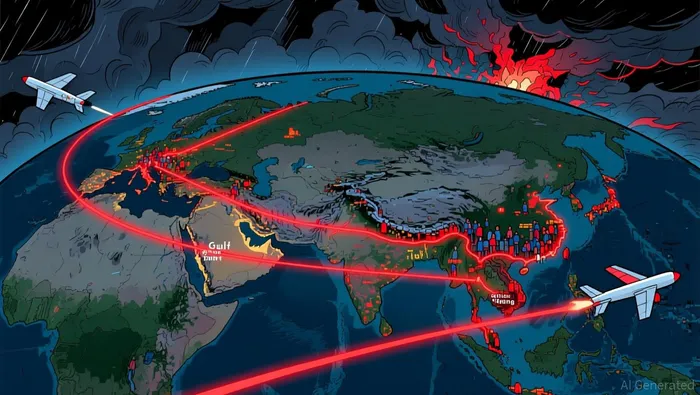
The core event here is a durable, high-margin traffic shift to Asian carriers, framed as a potential sector rotation catalyst. This is not a fleeting rerouting but a fundamental reallocation of premium long-haul traffic away from congested Gulf hubs and into the Asian network. The catalyst is clear: Middle East airspace closures have forced a massive, sustained rerouting of Asia–Europe travel. As a result, several Asian carriers have added flights and are reporting strong demand for these segments, while Gulf carriers like Emirates and Qatar Airways have scaled back services.
This shift is already translating into concrete, high-quality growth for key Asian players. Cathay Pacific's January 2026 traffic figures are a leading indicator. The group carried a combined total of more than 3.3 million passengers, an 11% year-on-year increase. More telling is the context: this growth was driven by a significant increase in transit traffic as Cathay added frequencies, and it culminated in a new single-day passenger record for the group. This isn't just volume; it's premium, high-yield traffic flowing through a strategically positioned hub.
The scale of the disruption underscores the structural nature of this tailwind. The operational paralysis at Gulf hubs is severe, with tens of thousands of passengers remaining stranded weeks into the conflict. This creates a clear demand vacuum that Asian carriers are well-positioned to fill. For institutional investors, this presents a conviction buy in premium traffic exposure. The shift benefits carriers with strong network connectivity, premium cabin strength, and operational flexibility-exactly the quality factors that command a risk premium in a volatile sector. The setup is for a sustained period of outperformance as this rerouted traffic becomes a permanent fixture in the new travel map.
Financial Impact: Weighing the Quality Factor Against Cost Inflation
The institutional view on this tailwind hinges on a critical tension: robust, high-quality revenue growth versus severe, inflationary cost pressure. The numbers tell a story of underlying strength being actively compressed.
On the positive side, Cathay Pacific's 2025 results demonstrate a resilient quality factor. The airline posted its biggest profit since 2010, with net income climbing almost 10% to HK$10.8 billion and revenue surging 12% to a record HK$116.8 billion. This beats analyst estimates and reflects the premium traffic shift's tangible benefit. The quality is further underscored by a strong balance sheet and a 30% fuel hedge on near-term needs, providing a crucial buffer.
Yet this strength is being actively eroded by a powerful headwind. The global average jet fuel price has more than doubled since late February, rising to US$197.83 per barrel. This creates massive, immediate cost pressure. Cathay's management has been candid, noting the fuel price increase is "placing huge cost pressure" on airlines worldwide. The company has responded by adjusting fuel surcharges, but as its CEO stated, "these measures have not been enough to mitigate the significantly increased fuel costs."
The net effect is a portfolio construction challenge. While the Middle East rerouting drives top-line growth and premium cabin demand-evidenced by 24% year-on-year passenger growth in March-the airline is forced to take defensive actions. It has consolidated a small number of passenger flights from mid-May to end-June, affecting roughly 2% of its total frequencies. This is a direct cost-control measure, but it also tempers the pure growth story.
For institutional investors, the takeaway is one of selective conviction. The quality factor-strong balance sheet, hedging, network flexibility-makes Cathay a more resilient play than peers. However, the margin compression from fuel is real and ongoing. The setup is not a clean, high-margin tailwind but a scenario where operational agility is required to protect earnings. The stock's rally on the 2025 results shows the market is rewarding the underlying strength, but the recent fuel price surge introduces a new layer of volatility that must be priced in.
Sector Rotation and Capital Allocation: Targeting Quality Amidst Volatility
The institutional playbook for 2026 is shifting toward a quality-focused rotation, and the Middle East rerouting is a key catalyst. This event is not just a one-off event but a structural driver that is reshaping carrier selection and capital allocation priorities. The result is a clear divergence in analyst sentiment and a sector-wide preference for carriers with premium traffic exposure and disciplined balance sheets.
The data points to a potential mispricing opportunity in the region. Singapore Airlines trades at S$6.58, well below its 14-analyst average price target of S$7.04. More telling is the consensus: only 5% of analysts rate the stock a "Buy," while 47% hold and 47% sell. This widespread skepticism, coupled with a modest 6% upside potential, suggests the market is discounting near-term volatility and margin pressure. For a quality-focused portfolio, this creates a potential entry point if the underlying premium traffic shift and operational discipline can drive a re-rating.
This regional dynamic mirrors a broader U.S. sector trend. The full-service carrier segment is seen as under-owned, with analysts expecting it to outperform low-cost rivals. The rationale is straightforward: carriers like United and Delta benefit from higher margins and strong balance sheets, which provide a superior buffer against cost inflation and demand swings. This preference for quality is a direct response to the volatility introduced by fuel prices and geopolitical shocks, favoring carriers with the financial flexibility to navigate turbulence.
Institutional flows are therefore likely to favor a specific subset of players. The capital allocation thesis centers on carriers that can both capture the rerouted premium traffic and manage costs effectively. Cathay Pacific exemplifies this profile, with its record 2025 profit and a planned 10% capacity increase that is disciplined and targeted. This is a quality factor in action: the ability to scale profitably in a high-demand environment while maintaining a robust capital structure. The institutional view is to overweight such carriers and underweight those with weaker balance sheets or less premium traffic exposure.
The bottom line is a portfolio construction challenge. The Middle East tailwind is real, but its benefits are not equally distributed. The institutional strategy is to rotate capital toward carriers with the operational agility and financial strength to convert this structural shift into sustained shareholder returns. This means targeting quality, accepting a degree of near-term skepticism, and focusing on disciplined capital allocators who can navigate the volatility.
Catalysts and Risks: The Path to Normalcy and Portfolio Guardrails
The institutional view on this trade is now defined by a clear forward-looking tension. The current advantage for Asian carriers is a direct function of a geopolitical crisis, making its sustainability entirely dependent on the path to normalcy. For portfolio managers, the key is to identify the catalysts that will confirm the shift's durability and the risks that could abruptly reverse it.
The primary catalyst for a portfolio rebalance is the resolution of the Middle East conflict and the subsequent reopening of Gulf airspace. This event would instantly reverse the rerouted traffic, returning a significant volume of premium long-haul passengers to Gulf hubs. The scale of the disruption is immense, with tens of thousands of passengers remaining stranded weeks into the conflict. Any diplomatic progress that begins to restore normal operations at Dubai and Doha would be the single most important signal for Asian carriers. Investors should monitor for announcements of airspace re-openings or the resumption of scaled-back Gulf services, as these would mark the start of a demand pull-back.
A more persistent risk, however, is the potential for elevated fuel prices to erode the margin gains from higher demand. The global average jet fuel price has more than doubled since late February, rising to US$197.83 per barrel. While Asian carriers have adjusted fuel surcharges, management has stated these measures have not been enough to mitigate the cost. If fuel prices remain at these levels, they will compress the profitability of the new premium traffic, potentially negating the benefits of the rerouting. This creates a portfolio guardrail: the trade's thesis is only valid if the revenue premium from rerouted traffic exceeds the sustained cost of fuel.
In practice, institutional investors should watch for quarterly traffic and load factor data from Asian carriers to gauge the durability of the demand shift. The initial surge is strong, with Cathay Pacific reporting 11% year-on-year passenger growth in January and robust premium cabin load factors. The critical question is whether this growth holds through the summer peak and beyond, or if it fades as the crisis drags on and fuel costs bite. A sustained period of high load factors and strong yield metrics would confirm a structural shift. Conversely, a sharp deceleration in traffic growth or a drop in premium cabin yields would signal the rerouting is more temporary, prompting a defensive portfolio move.
The bottom line is that this is a trade with a defined endpoint. The institutional strategy must be to remain agile, using the catalyst of conflict resolution as the trigger for a potential exit, while using fuel price trends and quarterly traffic data as ongoing guardrails to manage risk.