

The growth narrative for ASML has fundamentally shifted. The company is no longer just a supplier to a cyclical industry; it is now the central enabler of a massive, secular expansion. This pivot is driven by artificial intelligence, which is not a niche trend but the primary engine for semiconductor demand across the entire ecosystem. The scale of this opportunity is staggering. The global chip market is projected to reach $975 billion in annual sales in 2026, a historic peak. Within that boom, AI chips are the dominant force, driving roughly half of total industry revenue despite representing less than 0.2% of total chip units. This concentration of value in a small volume of high-performance chips defines the new market structure.
ASML's own outlook reflects this structural change. In its 2025 annual report, the company explicitly stated that the AI boom is now the main driver for demand for its products. This is a clear evolution from its more cautious stance in 2024, when it emphasized the cyclical nature of the industry and questioned whether AI would benefit all customers equally. The shift is real: new and significant demand for AI is fueling capacity build-up across ASML's broad customer base, a trend the company believes will continue for years. This isn't a short-term spike; it's a multi-year acceleration of capital expenditure on the most advanced chipmaking equipment.
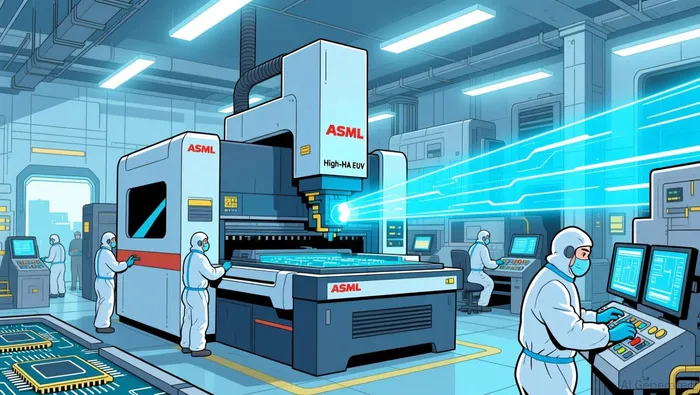
The financial implications are now crystallizing. ASML's raised full-year 2026 sales guidance of €36-40 billion implies a growth rate of 10-15% from its 2025 revenue of €32.7 billion. This forecast is not merely a function of industry growth; it is a bet on ASML capturing a disproportionate share of the surging total addressable market. The company's unique position, particularly with its High-NA EUV technology, gives it the scalability to meet this demand. The bottom line is that ASML's growth engine is being powered by AI, and its ability to sustain high growth rates will depend on its success in scaling to meet the unprecedented capacity expansion plans of its customers.
The Scalability Equation: How ASML Captures Market Share
ASML's ability to convert the massive AI-driven TAM into sustainable, high-margin growth hinges on a powerful combination of structural monopoly, a capital-light business model, and the industry's own capacity constraints. The company's dominance in EUV lithography is the critical bottleneck for advanced chip production, giving it unmatched pricing power and a durable competitive moat. No other player can match its technology, creating a scenario where customers must buy from ASML to access the most advanced nodes. This monopoly is not theoretical; it is the foundation of its financial performance. In the first quarter of 2026, ASML reported a gross margin of 53.0%, a figure that demonstrates its ability to capture demand at exceptionally high profitability. This margin power is further validated by its record backlog of €38.8 billion, which provides a high degree of visibility and locks in future revenue at premium prices.
The company's business model amplifies this advantage. ASML operates with a capital-light structure compared to its customers, who are investing tens of billions in new fabs. ASML's own capital expenditure is focused on R&D and manufacturing its complex systems, but its revenue is generated from selling these high-value tools. This creates a scalable growth engine where increased customer demand directly translates to higher sales and margins for ASML. The financial results are a clear signal: with Q1 2026 net income of €2.8 billion and a raised full-year sales outlook, the company is executing flawlessly on its growth plan.
Yet, this very success introduces a new constraint. The industry-wide surge in demand is creating bottlenecks not just for chips, but for the equipment and components needed to make them. According to senior Chinese semiconductor executives, AI-driven demand is creating bottlenecks across equipment, passive components, and workforce capacity. This means ASML itself could face challenges in scaling its own production and delivery timelines to meet the explosive order intake. While its monopoly ensures it captures the value, the physical and supply chain limitations within the broader ecosystem could temper the pace of its own growth. The scalability equation is thus a balance: ASML's structural advantages guarantee it captures the lion's share of the expanding pie, but the industry's capacity crunches may limit how quickly it can bake that pie.
Financial Execution and Margin Trajectory
The financial results for the first quarter confirm the strength of ASML's operational execution. The company reported total net sales of €8.8 billion and a gross margin of 53.0%, both beating expectations and landing at the high end of its own guidance. This performance is a direct reflection of the powerful demand dynamics it described, where AI-driven capacity expansion plans are accelerating. The bottom line was robust, with net income of €2.8 billion, demonstrating that the company is not only scaling its top line but also converting that growth into substantial, high-margin profits.
Looking ahead, the company expects a slight, normal seasonal shift in its profitability. For the second quarter, ASML projects a gross margin between 51% and 52%. This anticipated compression is framed as a typical product mix change and seasonal factor, not a sign of fundamental deterioration. The guidance for the full year remains strong, with a gross margin range of 51% to 53%. This trajectory suggests that while the peak margin from Q1 may not be sustained every quarter, the underlying profitability of the business remains exceptionally high and resilient.
The key to assessing the sustainability of this growth beyond the initial wave of new tool sales lies in two areas: backlog conversion and service revenue. The company's record backlog of €38.8 billion provides a high degree of visibility, but the pace at which that backlog converts into revenue will be a critical indicator of demand durability. More importantly, growth in its installed base management-encompassing service and field options-is becoming a vital pillar. As customers ramp up production, they will need ongoing support, performance upgrades, and maintenance for their existing ASML tools. This recurring revenue stream offers a more stable, less cyclical component to the business model, directly tying ASML's success to the long-term utilization of its installed equipment. For a growth investor, the focus will be on whether this service and upgrade business continues to expand in lockstep with new tool deliveries, signaling that the AI-driven capacity build-out is not a one-time surge but a sustained investment cycle.
Catalysts, Risks, and What to Watch
The path from ASML's record backlog to sustained growth is now in focus. The primary near-term catalyst is the conversion of its €38.8 billion backlog into revenue. The company's Q1 2026 results, reported earlier this week, provided a strong signal, with sales of €8.8 billion and a gross margin of 53.0% beating expectations. The outlook for the second quarter, which projects a slight seasonal margin compression, will offer a more granular view of demand durability and execution. For investors, the key will be whether this momentum continues to fuel the raised full-year sales guidance of €36-40 billion, confirming that the AI-driven capacity build-out is translating into predictable, high-margin sales.
A more significant long-term risk looms over the entire thesis: a demand correction if AI investment slows. The industry is navigating a high-stakes paradox, with the semiconductor market projected to reach a historic peak of $975 billion in annual sales in 2026, but with growth heavily concentrated in AI chips. This creates a vulnerability. As one analysis notes, the industry seems to have placed all its eggs in the AI basket. While the outlook remains strong, the scenario where AI demand moderates or shrinks represents a material downside. This would expose the heavy reliance on a single growth driver and could quickly dampen capital expenditure plans across the ecosystem, directly impacting ASML's future order intake.
Beyond the macro risk, investors must monitor several specific trends. Sales to China remain a critical variable. While ASML's 2025 revenue saw a decrease due to export controls, the company still shipped 33% of its tools by unit count to the People's Republic, indicating continued demand for trailing-edge nodes. Any shift in Chinese chipmaker investment plans or further tightening of export rules would be a direct hit to revenue and could signal broader demand weakness. Geopolitical developments, including evolving export-control regimes, will continue to shape the competitive landscape and market access. Finally, the capital expenditure plans of major chipmakers-Intel, TSMC, Samsung, and others-must be watched for any signs of acceleration or pullback. Their spending is the ultimate driver of ASML's growth, and any change in their multi-year fab build-out strategies will be the clearest signal of the AI boom's longevity.