

The market's attention is laser-focused on the AI chip story, and ASML is the undisputed main character. Search interest and investor flows are surging, with the company's shares up more than 40% so far this year. This isn't just a stock pop; it's a bet on the entire AI infrastructure build-out. The catalyst is clear: ASML is the sole maker of the extreme ultraviolet (EUV) lithography machines essential for producing the most advanced AI chips, making it a critical "pick and shovel" play.
The intensity of this narrative is reflected in concrete moves. Last month, ASML secured a landmark $8 billion order from SK Hynix, a major memory chipmaker, signaling massive, long-term investment in leading-edge tools. More recently, the company raised its full-year 2026 sales forecast to €36-40 billion, a clear signal that demand is not just strong but accelerating. This outlook is now explicitly tied to AI, as the company's own 2025 report named the artificial intelligence boom as the main driver for demand for the first time, a significant shift from earlier skepticism.
Sentiment is running high, with investors leaning back into AI and advanced-node capital expenditure expectations. The stock is moving higher alongside a broad semiconductor rally, supported by visibility into memory-led EUV spending. This creates a powerful feedback loop: strong results and raised guidance fuel positive sentiment, which in turn drives the stock higher, attracting more attention and capital. For now, the AI narrative remains the dominant force in the market, with ASML at its epicenter. The key question is whether this peak intensity can be sustained.
The Numbers: Q1 Beat & Raised Guidance
The AI narrative is translating directly into financial results. ASML's first-quarter report delivered a clear beat, with total net sales of €8.8 billion and net profit of €2.8 billion, both topping analyst expectations. This performance is explicitly tied to the chip demand surge, as the company stated the semiconductor industry's outlook is solidifying "driven by ongoing AI-related infrastructure investments."
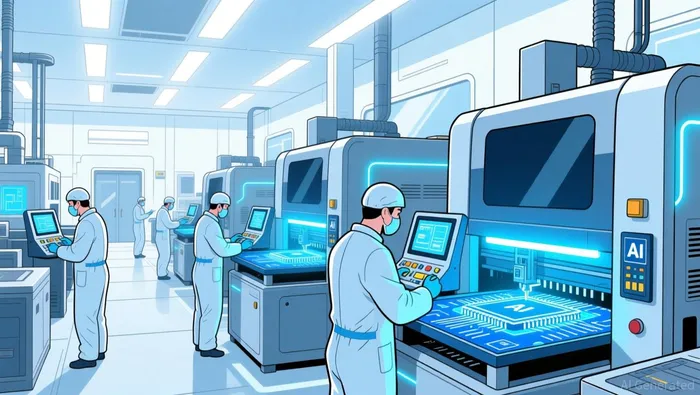
The quality of the growth, however, is shifting. While sales were strong, the mix of business is changing. The number of new lithography systems sold fell sharply to 67 units in the quarter, down from 94 the prior quarter. This indicates a move away from pure new tool sales toward service and installed base management. In fact, Installed Base Management sales jumped to €2.488 billion. This is a sign of a maturing, high-value installed base rather than just new capacity build-out.
The raised full-year forecast confirms the momentum but hints at future pressure. ASML now expects 2026 total net sales between €36 billion and €40 billion, up from a previous range of €34-39 billion. Yet the projected gross margin range of 51-53% suggests expected margin compression. The company itself noted in its outlook that it expects second-quarter gross margin between 51% and 52%, a step down from the Q1 level of 53.0%. This points to a trade-off: massive sales growth is coming, but it may be driven by a higher proportion of lower-margin services and upgrades, or by volume sales at competitive pricing.
The bottom line is that the AI demand surge is delivering robust, tangible results. The beat and raised guidance are a direct validation of the market's bullish thesis. But the shift in business mix and the guidance for margin pressure mean the path to sustained growth is becoming more complex. The company is scaling its revenue engine, but the profit margin story is starting to show some friction.
The Main Character: ASML's Position
ASML is the undisputed main character in the AI chip narrative, and its position is built on an unassailable monopoly. The company is the sole maker of extreme ultraviolet (EUV) lithography systems, the essential tools for printing the most advanced AI chips. This gives it a stranglehold over the entire semiconductor supply chain, with even giants like Taiwan Semiconductor (TSMC) dependent on its technology. The market's explosive rally, with shares up more than 40% so far this year, is a direct vote of confidence in this critical role.
The company's strength is now a two-part engine. First, there's the massive backlog of orders, including a landmark $8 billion deal from SK Hynix, which is being converted into revenue. Second, and increasingly important, is the growth of its installed base business. In the first quarter, sales from service and field options-essentially upgrades and support for existing machines-jumped to €2.488 billion. This shows customers aren't just buying new capacity; they're maximizing the performance of their current, expensive EUV fleets, creating a high-margin, recurring revenue stream.
The key watchpoint for the next leg of the story is the rollout of High-NA EUV machines. These next-generation tools are the next frontier for chipmakers, and ASML is the only supplier. The market is watching closely for updates on their shipment timing and customer adoption, as this will determine the next wave of demand and pricing power. The upcoming earnings call is a major catalyst, where investors will scrutinize commentary on EUV volumes, backlog conversion, and High-NA progress to see if the company can maintain its growth trajectory.
In short, ASML is the central beneficiary because it controls the bottleneck. The AI demand surge is a powerful, sustained force, and ASML is the single entity positioned to profit from it at every stage-from the initial purchase of new EUV machines to the long-term service and upgrade cycle. Its monopoly, combined with a growing installed base and a clear path to next-gen technology, cements its role as the main character in this multi-year story.
The Headline Risk: China Export Controls
While the AI demand story is the dominant narrative, a major headline risk looms: the ongoing decoupling of China from advanced semiconductor technology. This isn't a minor policy tweak; it's a structural shift that directly challenges ASML's global sales model. The impact is already visible in the numbers. In the first quarter, system sales to China fell to 19% of overall sales, a sharp drop from 36% in the prior quarter, due to existing export restrictions. This is a binary risk with clear sides.
On one path, continued decoupling forces a permanent structural shift. China's domestic chip industry is ramping up, but it cannot yet produce the most advanced nodes without ASML's EUV tools. This creates a gap between ASML's global growth trajectory and a key market that once contributed a third of its sales. The company's own guidance, which expects China's share to fall to about 20% this year, assumes this is a managed decline. But the risk is that it accelerates.
The more immediate threat comes from proposed U.S. legislation. Earlier this month, a bipartisan group of lawmakers introduced a bill that would even ban ASML's less-advanced machines for export to China. If passed in its strictest form, analysts estimate it would eliminate less than half of ASML's residual China sales. That leaves a significant portion of its current China business potentially intact, but it introduces massive regulatory uncertainty. The market hates uncertainty, and this legislative overhang is a persistent headline risk that could dampen sentiment or trigger defensive selling.
The bottom line for the AI demand thesis is that this risk is a test of ASML's monopoly power. The company's AI-driven growth is global, but its ability to capture that growth is now geographically constrained. The market is betting that demand from other regions-like South Korea and Taiwan, which accounted for 45% and 23% of Q1 sales respectively-can fully offset this loss. The raised 2026 sales forecast suggests management agrees. Yet, any acceleration in China restrictions would force a re-rating of that global outlook, potentially making the stock more vulnerable to geopolitical headlines. For now, the risk is contained but not eliminated, a constant reminder that even the main character's story can be interrupted by external forces.
The Takeaway: Is the AI Cycle Peaking?
The market's viral sentiment around ASML and AI is intense, but the cycle's maturity is now being tested by quarterly trends. The core question is whether the current search volume and capital flows can be sustained as the initial surge of new capacity build-out begins to show signs of saturation.
The evidence points to a cycle that is still accelerating, but with a subtle shift in form. Demand remains robust, with the company explicitly stating the semiconductor outlook is solidifying "driven by ongoing AI-related infrastructure investments." The raised 2026 sales forecast to €36-40 billion is a clear vote of confidence. Yet, the quarterly data reveals a maturing pattern: new lithography system orders fell to 67 units in Q1, down from 94. This drop signals a potential inflection, where the growth engine is shifting from pure new tool sales to a higher proportion of service and installed base management. In fact, that service segment jumped to €2.488 billion, showing customers are now focused on maximizing existing EUV fleets. This is a hallmark of a cycle entering a later, more profitable phase, but it also means the headline-grabbing volume of new system orders may plateau.
The other major risk to the cycle's longevity is geopolitical. While China's share of sales has already fallen sharply, the persistent threat of new export controls looms. Any announcement of stricter rules on less-advanced machines would materially alter the risk profile, potentially forcing a re-rating of ASML's global growth story. For now, the market is betting that demand from other regions can fully offset this loss, but the uncertainty is a constant headline risk that could dampen sentiment.
The bottom line is that the AI cycle is not peaking-it's evolving. The viral sentiment is supported by strong financials and a raised outlook, but the path forward is becoming more complex. Investors should monitor two key signals: first, whether the trend of declining new system orders continues, which would confirm demand saturation; and second, any new regulatory announcements from the U.S. or Dutch governments that could reshape the China dynamic. The cycle's peak intensity may have passed, but its power is being channeled into a more durable, service-driven model. For now, the main character's story has a clear next act.