

The headline says insiders are holding. The filings say otherwise.
AST SpaceMobile (ASTS) stock bounced back from a two-day slide recently, and a batch of retail-friendly commentary has been quick to crow about top executives "holding shares in a vote of confidence." The framing is deliberate: if insiders still own stock, the thesis must still be alive. That is a clever trick - and it collapses under scrutiny.
Let's separate what the filings actually show from the narrative being sold.
Insider ownership is a PR construct
AST SpaceMobile's CEO Abel Avellan holds 234.9 million shares, which sounds like massive conviction until you understand the mechanics. On June 2, 2026, ASTS filed a Form 4 showing that Avellan had 32,754 shares withheld at $113.41 per share to cover his tax liability from restricted stock unit vesting. That is not someone choosing to hold - that is the company forcibly withholding shares so the IRS gets paid. The net effect: his position shrank.
Meanwhile, director Julio Torres sold 15,000 shares in May 2026. Back in February, insiders were reported selling $9.7 million worth of stock in a single round. Total insider ownership across all officers and directors: 0.6% of outstanding shares. That is not conviction. That is rounding error dressed up as a signal.
The whole "insiders hold shares" argument only works if you never check how those shares got there, how they're being liquidated, or what fraction of the company insiders actually control.
The business is burning cash at a rate that should terrify investors
Q1 2026 results are the data the "vote of confidence" story is trying to distract from. Revenue came in at $14.7 million - roughly 40% of the $38–$39 million analysts expected. The non-GAAP net loss was $191 million, or $0.66 per share, more than three times wider than the consensus estimate of $0.23 per share.
$191 million in quarterly losses on $14.7 million in revenue. That is a 13-to-1 loss-to-revenue ratio. The company generated approximately one dollar of revenue for every thirteen dollars it burned.
ASTS ended the quarter with roughly $3.5 billion in cash. At a $191 million quarterly burn rate, that runs out in approximately 18 quarters - about 4.5 years - and that assumes revenue doesn't need to be reinvested, that capital expenditures for 45 satellites don't eat into the pile, and that no additional dilution is required. Each of those assumptions is aggressive.
The revenue miss is the louder signal than the loss. Management projected a transition from R&D to early commercialization. The market expected revenue to nearly triple quarter-over-quarter. It didn't come close. When a company tells you commercialization is starting and then delivers numbers that look like pre-revenue, that is not a timeline slip. That is an execution question.
The Blue Origin implosion was not a footnote
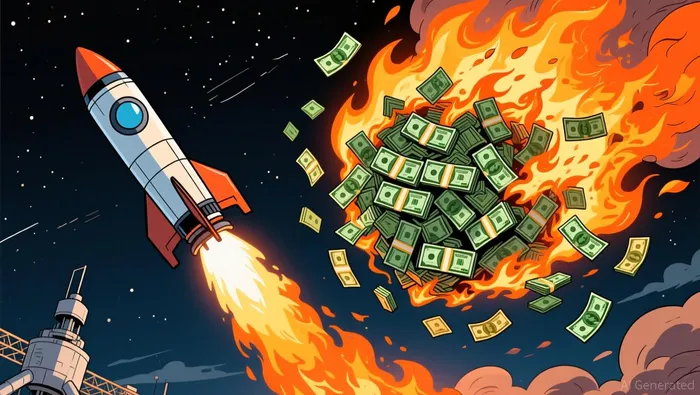
In April 2026, ASTS launched BlueBird 7 on Blue Origin's New Glenn rocket. The upper stage malfunctioned - one of the two BE-3U engines failed - and the satellite was stranded in a dangerously low orbit, effectively lost. The event wiped approximately £2 billion from ASTS's market cap in a matter of days and grounded the entire New Glenn fleet until Blue Origin completed its investigation in late May.
The cross-currents here are execution risk on the satellite side, launch provider risk on the rocket side, and cash runway risk on the balance sheet side. Directionally, all three point the same way.
ASTS pivoted to SpaceX for the next wave. BlueBirds 8 and 10 arrived at Cape Canaveral in late May, with BlueBird 9 shipped from the Texas manufacturing facility. A mid-June Falcon 9 launch is expected. But the dependency has shifted: one company that can't deliver its own hardware to orbit now needs another company's launch schedule to stay alive.
What the stock price is pricing in
ASTS is trading around $104 after surging from a $14 annual average in 2024 to roughly $44 in 2025 and now into triple digits. The move reflects the market pricing in a future where 45 satellites are in orbit, carrier deals convert to meaningful revenue, and the direct-to-device cellular broadband thesis plays out. That future is possible. The question is whether the stock has priced it in three years too early.
One analyst model places a fair value range between $25 and $55 - less than half of where the stock is trading today. The model accounts for the cash flow drain and the probability that commercialization takes longer than management's optimistic timeline. Whether you accept that model or not, the gap between current pricing and the most generous bear case is enormous.
It is not as good as it looks. The bounce from a two-day slide is noise. The insider ownership narrative is manufactured. The quarterly results show a company that is far from commercial and burning cash at a rate that demands flawless execution for the rest of the decade.
You decide which was marketing fluff and which one was analysis.