

Market Snapshot
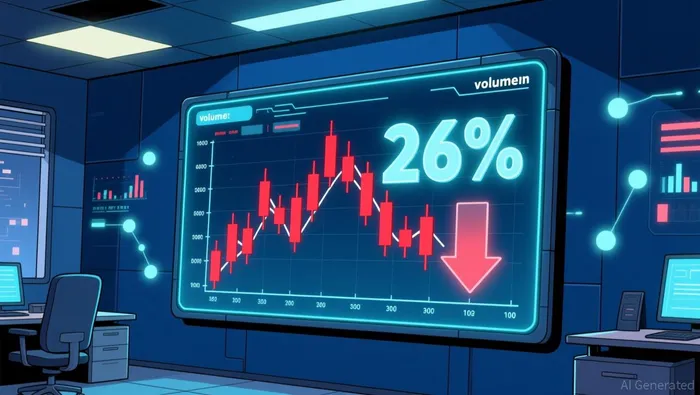
Atlassian Corporation (TEAM) experienced a notable contraction in trading activity and share price on May 12, 2026, reflecting a shift in investor sentiment or liquidity conditions within the broader market. The stock closed down 2.65%, marking a clear decline from its previous session's performance. This downward price movement was accompanied by a significant reduction in trading volume, with total turnover amounting to $0.51 billion. This figure represents a sharp 26.11% decrease compared to the previous day's volume, indicating a substantial withdrawal of capital or a pause in aggressive trading positions among market participants. Despite the drop in volume, the sheer scale of the transaction value placed Atlassian at the top of the daily trading rankings, highlighting its continued status as a highly liquid and heavily watched entity in the technology sector. The divergence between the high ranking in total turnover and the significant drop in volume suggests that while fewer shares changed hands, the average transaction size remained substantial, potentially indicating institutional rebalancing or large-block trades rather than retail-driven volatility. The combination of a negative price adjustment and reduced liquidity often precedes periods of consolidation, as the market digests recent developments and awaits clearer directional cues from upcoming earnings reports or macroeconomic data releases.
Key Drivers
An analysis of the available news landscape reveals a distinct absence of immediate, company-specific catalysts driving the stock's movement on this particular date. The provided dataset contains no raw news items, press releases, or editorial content directly attributable to Atlassian. This vacuum of specific corporate news is a critical data point in itself, suggesting that the price action and volume contraction were not the result of earnings surprises, product launches, mergers and acquisitions, or executive changes. In the absence of idiosyncratic news, market movements of this magnitude are frequently attributed to broader sectoral trends or macroeconomic factors. Investors may be rotating out of high-growth software stocks in anticipation of interest rate decisions or inflation data, a common pattern observed in the technology sector during periods of economic uncertainty.
The lack of positive or negative headlines implies that the market is currently in a state of equilibrium or cautious waiting. Without new information to disrupt existing valuations, traders may be adopting a "wait-and-see" approach, leading to the observed 26.11% drop in trading volume. This reduction in activity often signifies that major institutional investors are holding their positions steady rather than actively buying or selling, resulting in a thinner order book. Such thin liquidity can amplify price swings, meaning that even modest sell orders can lead to the 2.65% decline observed, as there are fewer buyers to absorb the selling pressure.
Furthermore, the high ranking in total turnover despite lower volume suggests that the remaining trading activity is dominated by large institutional players. These entities often trade in blocks to minimize market impact, and their decisions are typically driven by portfolio rebalancing strategies rather than short-term news cycles. The decision to reduce exposure to Atlassian by over a quarter in terms of volume could reflect a broader strategic shift within major funds, possibly reallocating capital to other sectors perceived as offering better risk-adjusted returns in the current economic environment.
The silence in the news feed also highlights the importance of technical analysis and market structure in short-term price discovery. When fundamental drivers are neutral, technical levels and momentum indicators become the primary guides for algorithmic and discretionary traders. The drop in volume combined with a price decline could be interpreted by technical analysts as a lack of bullish conviction, potentially signaling a near-term support test if the downward pressure continues.
Ultimately, the performance of Atlassian on May 12, 2026, serves as a case study in how stocks behave in the absence of specific corporate news. The 2.65% decline and significant volume contraction underscore the sensitivity of high-liquidity tech stocks to broader market sentiment and institutional positioning. Without new catalysts to drive enthusiasm or fear, the stock's trajectory is heavily influenced by the aggregate behavior of large-scale investors adjusting their portfolios in response to macroeconomic signals rather than company-specific developments. This period of quiet trading may precede a significant move once new information enters the market, making the current low-volume environment a potential precursor to increased volatility in subsequent sessions.