

Bank of America's warning is about risk-reward, not an imminent crash
This is a risk-reward warning, not a crash call. Bank of America turned red on seven of 10 bear-market signposts in May, up from four in March and five in April, and that seven-signal reading is seven was the average number reached ahead of previous bear markets since 1990. The message is not that every stock has to break lower. It is that the broad index is offering a less favorable setup for new buyers.
Why the signal matters even with the index near record levels
Bank of America still sees opportunity in S & P 500 stocks, but not in the cap-weighted basket, and its year-end target is 7,100. That implies 6% downside from here from current levels near 7,426. If the index is already above the bank's year-end target, the near-term odds are tilted toward holding gains rather than adding fresh broad exposure.
Where the pressure is building
Some of the concern sits at the market's core. Bank of America said cash flow conversion has flat-lined, while hyperscaler capital expenditure is approaching 100% of operating cash flow. Bulls can still argue the market only needs a modest earnings beat to hold up. Bears argue the index already assumes a cleaner cash-flow story than investors are getting. On the broad index, Bank of America is leaning toward the bearish side.
Narrow leadership and rich valuations are the bigger problem
The bear-signal count and the 7,100 target already suggest the broad index is less attractive. The bigger issue is structure. Bank of America still sees opportunity in S & P 500 stocks, but not the cap-weighted basket. That matters only if leadership stays narrow, which is the hidden risk: the index can hold while the market underneath gets weaker.
Why the S&P 500 can look fine while internals worsen
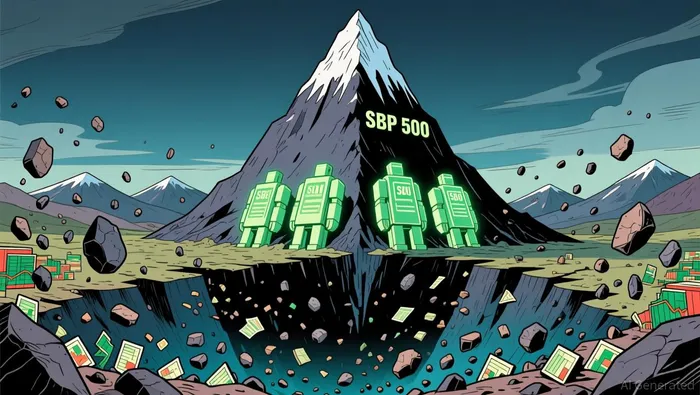
In a cap-weighted index, the biggest names control the scoreboard. Bank of America said the gap between the best and worst performers in the S&P's technology sector has hit 120 percentage points, the widest since February 2000. Just before the March 2000 peak, that spread reached 130 points.
That is the mechanism investors should respect. When dispersion gets that extreme, a few winners do most of the work. The headline index can still look stable while breadth cracks, which is why selective defense matters more than panic selling.
Speculation is concentrating in the most expensive stocks
The second problem is where that concentration is landing. The S&P 500 was statistically expensive on 17 of 20 metrics. Bank of America also said high price-to-earnings stocks were leading low-multiple stocks by a wide margin, a sign of excessive speculation.
That setup is fragile because narrow leadership needs constant upside surprises. If cheaper stocks start broadening the market, pressure can ease. If not, the expensive leaders are where investors are most exposed to a faster reprice.
Broadcom is the live test for the AI trade
Last week put that fight in plain view. Chip stocks sold off hard on Thursday and Friday after rallying in April and part of May. The move came after Broadcom held AI revenue estimates steady instead of raising them. Bears see that as the first real crack in the AI trade. Bulls argue the group is still intact.
What the positioning call means for investors
Breadth and valuation are the problem, so the move is selective defense, not panic. Bank of America still sees opportunity in S & P 500 stocks, but not in the cap-weighted index. That is a positioning call: take profits on broad exposure, then stay selective. If the index is already above the bank's year-end target of 7,100, buying the basket now means accepting worse odds for less room.
What to watch next
- Breadth: If more stocks participate instead of a handful of giants, the index can defend itself.
- Chips: If the group stabilizes after Broadcom, the AI trade may still be holding together.
- Fundamentals: If cash-flow conversion and other internals stay weak, narrow leadership can turn into a broader market problem quickly.