

The latest household spending figures paint a stark picture of economic fragility. In March, personal consumption fell 2.9% year-on-year, a sharp worsening from the 1.8% drop in February and a miss against market estimates. This marks the fourth consecutive monthly contraction in spending, signaling a deepening consumer retreat that is hard to ignore.
The data reveals a broad-based squeeze. While some categories like housing saw rebounds, spending plunged in transportation and communication, education, and other expenditures. The pattern points to households actively cutting back on non-essentials amid persistent inflationary pressure. This isn't a one-off dip but a sustained trend, with spending reversing a seasonal gain in March to fall 1.3% month-on-month.
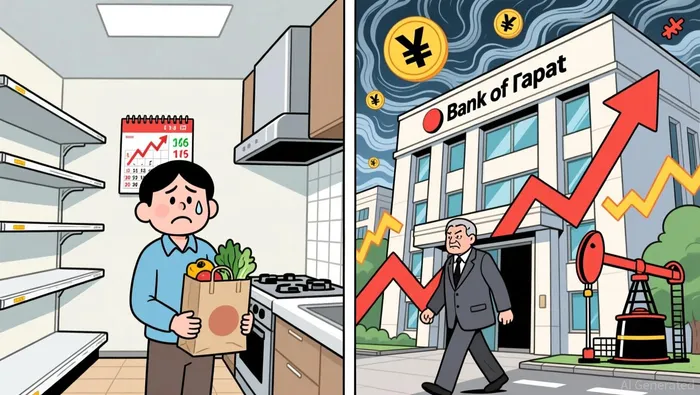
The Bank of Japan's recent policy move underscores the dual pressures at play. The central bank kept its policy rate steady at 0.75% but delivered a stark warning, cutting its fiscal 2026 growth forecast to 0.5% and sharply raising its core inflation outlook to 2.8%. The bank explicitly cited the Middle East crisis raising crude oil prices as a key risk, which it says will crimp corporate profits and real household incomes. This setup-a policy rate stuck at a historic low while inflation climbs and growth forecasts are slashed-creates a classic stagflation-like vulnerability. The central bank's decision, framed as a "hawkish hold," also signals growing concern over yen weakness, which further erodes purchasing power. The result is a household sector caught between rising prices and a weakening currency, with little room to maneuver.
Comparative Lens: Lessons from the Lost Decades and 2008
The current slump in Japanese spending echoes a familiar, painful pattern. The structural similarity to the 1990s 'Lost Decade' is clear: a collapse of asset bubbles led to a prolonged period of near-zero growth and deflationary pressures that lasted over a decade. During that era, the economy grew a mere 1.14% annually from 1991 to 2003, real wages fell, and the value of cash increased over time, discouraging investment and consumption. The financial sector was crippled by bad loans, and businesses were burdened by excess debt and capacity, creating a self-reinforcing cycle of stagnation.
Yet the key difference now is stark. That earlier period was defined by deflation. Today, the Bank of Japan has sharply raised its core inflation outlook to 2.8%, while growth forecasts are slashed. This creates a 'stagflation-like' risk-a scenario where inflation rises alongside stagnant or contracting output. As economist Shigeto Nagai noted, a "very light stagflation-like situation could happen this year". The central bank's dilemma is acute: it must fight inflation while growth is faltering, a far more complex task than simply battling deflation.
This contrasts with the policy response to the 2008 financial crisis. Then, the BOJ delivered aggressive stimulus and deep rate cuts to counter a severe recession. Now, the stance is markedly more cautious. The bank kept its policy rate steady at 0.75% in a split vote, a move described as a "hawkish hold." This reflects a different starting point. The current economy has a buffer absent during the previous stagnation: a relatively low unemployment rate and rising wages. While real disposable incomes have been negative, the labor market remains tight, providing a floor for consumption that was missing in the deflationary decades.
The bottom line is that history offers a warning, but not a perfect blueprint. The risk of a prolonged stagnation remains, but the presence of persistent inflation and a healthier labor market changes the dynamics. The BOJ's current cautious hold, while appropriate for its inflation target, may be insufficient to counter the growth headwinds now emerging.
Forward Implications: Scenarios for Q1 GDP and Policy
The market's split on Japan's first-quarter growth is a direct reflection of the economy's precarious balance. With the Cabinet Office set to release preliminary GDP figures on May 19, traders are pricing a 42.5% probability for a mild contraction of -0.3% to -0.1% year-over-year. This narrow majority against a downturn underscores the deep uncertainty. The remaining 57.5% of the market sees a wide range of outcomes, from a deeper recession to a surprise rebound. This contested view mirrors the conflicting forces at play: persistent consumer weakness versus a still-tight labor market and aggressive fiscal support.
The Bank of Japan's recent stance has only deepened this tension. In a split vote, the central bank kept its policy rate steady at 0.75% while sharply cutting its fiscal 2026 growth forecast to 0.5% and raising its core inflation outlook to 2.8%. This "hawkish hold" prioritizes inflation control, explicitly warning that Middle East-driven oil price hikes will crimp corporate profits and real household incomes. The decision signals a cautious, defensive posture. The BOJ is not cutting rates to stimulate growth, as it did in past crises, but is instead trying to manage the stagflation-like pressures it now faces.
In response, the government has moved to expand the fiscal stimulus. A new package of 17.7 trillion yen in new spending aims to relieve price pressures on households and businesses. This is a substantial effort, equivalent to more than 2.5% of GDP. Yet its effectiveness is questionable if the core drivers of household pain-persistent inflation and a weakening yen-remain unchecked. The stimulus runs counter to the BOJ's tightening, creating a policy conflict that could fuel long-term interest rates. More critically, if inflation and yen weakness persist, this fiscal support may prove insufficient to reverse the consumption contraction, leaving the economy vulnerable to a deeper deceleration.
The bottom line is a setup where policy is misaligned. The BOJ is trying to cool demand through higher rates, while the government is trying to boost it through spending. The market's thin, contested bet on GDP suggests few are confident in either approach. The coming data will test whether this delicate balance can hold or if Japan is indeed heading for a more pronounced stumble.
Catalysts and Risks: What to Watch
The coming weeks will test whether Japan's economic stumble is a temporary setback or the start of a deeper malaise. The primary catalyst is the May 19 release of first-quarter GDP estimates. The market's thin, contested bet-pricing a mild contraction at just 42.5%-means this data will be decisive. A print within the -0.3% to -0.1% band would confirm the market's narrow bearish call, validating the consumption slump. Anything outside that narrow band, whether a deeper contraction or a surprise rebound, would signal the economy is moving in a different direction entirely.
At the heart of the risk is the fragile wage-price balance. The Bank of Japan's sharp inflation outlook to 2.8% is already pressuring real incomes, with Governor Ueda noting they have been negative "for some time." The historical pattern is clear: when inflation consistently outpaces wage growth for three or more quarters, consumption typically falls 1-2% monthly. Japan is now showing the early signs of that dynamic. If wage growth fails to accelerate meaningfully to catch up, the household sector will have little choice but to cut spending further, deepening the slump.
A key external risk factor is the trajectory of the yen and oil prices. The BOJ's "hawkish hold" is partly a defense against yen weakness, which erodes purchasing power. A reversal in that trend-where the yen stabilizes or strengthens-could ease import costs and provide a much-needed reprieve from inflationary pressure. Conversely, sustained oil price spikes from Middle East tensions, as warned by the BOJ, would only worsen the terms-of-trade squeeze on households and businesses.
The bottom line is that the policy conflict between the BOJ's tightening and the government's 17.7 trillion yen fiscal stimulus creates a volatile mix. The coming GDP data will reveal whether this stimulus can offset the BOJ's cooling effect, or if the underlying consumption weakness is too entrenched. The market's thin bet suggests few are confident in a smooth landing.